
Tim Ferriss’s Confession of His Childhood Sexual Assault Made Me Cry
How to overcome trauma, use your success to touch others, and live a deeply fulfiling life.
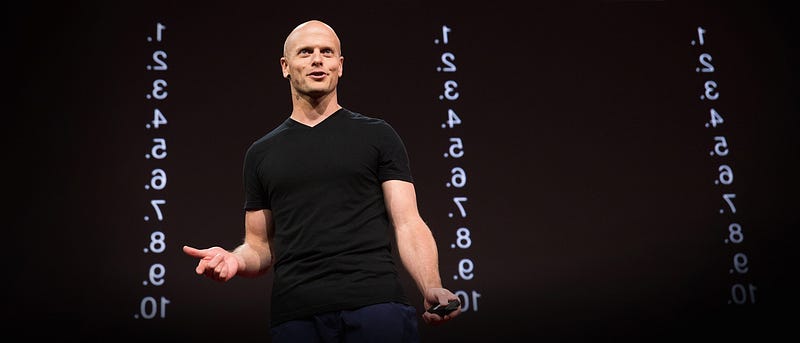
Tim Ferris is a veritable superman.
That’s literally his nickname – “The Superman of Silicon Valley.” He is known for his wild experiments — examples range from accepting a kickboxing match in 10 days (he won) to being a tango dancing champion to willingly altering his body and mind with a cocktail of crazy diets, workouts, and hallucinogenic substances.
Tim is perhaps best known for his bestselling book The Four Hour Work Week, a book that influenced my decision to quit school and become an entrepreneur. It’s no secret, I looked up to Tim. I still do.
Which made it doubly shocking when Tim recently revealed on his podcast that he was a victim of childhood sexual assault.
Tim’s Harrowing Experience
There is no easy way to put it, so I’m going to come right out and say it.
From the age of two to four, Tim was sexually abused by the son of his babysitter. He said with a quiver in his voice, “So if you imagine sort of the most disgusting, repulsive activities that you might envision with that statement, that is what happened.”
The abuse happened at such an early age that he has no recollection of the experience. But unfortunately, his body remembers the trauma.
Tim developed dissociative tendencies well into his adult life. Whenever he undergoes a period of stress, Tim would feel his consciousness leave his body. He describes it as his mind deciding to separate itself from his body so that it could withstand whatever it needed to withstand.
I’m not an emotional guy, but I teared up while listening to Tim’s revelation.
Tim’s honesty shines through in his delivery. His tone is raw and shaky. For Tim, sharing this deeply personal story comes at a great risk. His perception as a successful “manly” man may be tarnished in the eyes of some— but he decided to do it anyway, and in the process share with us some lessons from his traumatic experience.
Here are some lessons we can learn from Tim’s selfless act.
Stillness is the key to radical self-awareness.
As mentioned above, Tim had no memories of the abuse.
That is until he experienced what he described as high-resolution flashbacks during a psychedelic experience. Still, he disassociated himself from those traumatic memories. It wasn’t until he attended a 10-day Vipassana silent retreat that his healing began in earnest.
There, alone with his mind, the memories would come back like a tidal wave.
It was at the tail end of that retreat that I realized these, let’s just call it 17 seemingly inexplicable behaviours of mine, these vicious cycles or triggers that I had been treating like separate things, separate problems to be solved, were all downstream of this trauma, if that makes any sense. I don’t know if you’ve had this experience, but I was like, “Oh, now that you click that puzzle piece into place, these really strange behaviours, this self-loathing, this rage that was seemingly so exaggerated and disproportionate…
All of these things fell into places making sense.
In the age of distraction known as the 21st century, it has become increasingly easy for us to look outside, seeking constant entertainment for our wandering mind. Some examples are:
- The latest binge-worthy Netflix series.
- The endless buzzing of your iPhone.
- The newest celebrity gossip.
- The most shocking news update of the day.
This is a shame because as Tim found out, true healing can only begin when we look within.
“Your vision becomes clear when you look inside your heart. Who looks outside, dreams. Who looks inside, awakens.”
— Carl Jung
Ryan Holiday lamented in his bestselling book, Stillness is the Key,
“How different would the world look if people spent as much time listening to their conscience as they did to chattering broadcasts? If they could respond to the calls of their convictions as quickly as we answer the dings and rings of technology in our pockets?”
Don’t take it from us. Research backs up the positive benefits of purposeful acts of mindful stillness, which includes reduced negative rumination, increased focus and a boost to working memory.
Remember, to live without knowing oneself is like attempting to climb a mountain while blindfolded. It is impossible for you to know if you’re going up or down — or indeed if you’re at the right mountain at all.
It is only when the pond is still that we can see to its bottom. In the same vein, it is only when our minds are still that we are able to look within. That is how we perceive what cannot be seen. That is how we become radically self-aware.
So still your mind. It is the first step to healing.
You will meet many people in life who will inspire you. It is your job to pay it forward and inspire others in turn.
Tim sharing the story of his sexual abuse happened almost by accident.
Debbie Millman, Tim's friend and dance partner, candidly shared her story of being a sexual assault survivor on a previous episode of Tim’s podcast. The courage and conviction she displayed shook Tim to his core, and it would play a key role in Tim deciding to share his own story.
Like the Dalai Lama said,
“Just as ripples spread out when a single pebble is dropped into water, the actions of individuals can have far-reaching effects.”
Should Debbie have chosen to keep her trauma a secret, Tim wouldn’t have the motivation to share his own story. And I, in turn, would not have been brought to tears by Tim’s podcast. And as a result, dear reader, you wouldn’t be reading this article right now.
This is what’s known as the ripple effect.
According to the 6 Handshakes Rule, all of us are six social connections or fewer away from one another. Thus, our actions matter more than you think. We all have within us the ability to cast a tiny pebble, a pebble which, with the passing of time, have the power to reverberate through our chain of connections and shake the world.
So strive to do good. Strive to stand up straight and tell your story to the world. No matter how painful it is and how much your voice quivers, know that someone, somewhere out there, needs to hear what you have to say. Thus, keep conviction in your heart.
This is how you become the change you want to see in the world.
Are you running towards something — or away from something? There is a difference.
Here are some of Tim’s accolades:
- A successful entrepreneur with a multi-million dollar net worth.
- 4x New York Times Bestseller.
- A successful angel investor in companies such as Shopify and Uber.
- He is the host of The Tim Ferriss Show, a top podcast on Apple.
It’s safe to say that Tim has been a go-getter his whole life. This drive has brought him incredible success — but it might also have been an indicator that something was terribly wrong.
The most important lesson I learned during my 9 years of martial arts was the value of confronting your fears. There is a big difference between running towards something, and away from something. The former leads to worldly success, but the latter, according to psychological reports, is a sure-fire way to addiction and unhappiness.
This is what clinical psychiatrist and bestselling author Jordan Peterson is referring to when says,
“Confront the dragon in its lair before it comes to your home.”
All the external achievements in the world cannot help you outrun your inner demons. Sooner or later, you have to find your strength, stand your ground, and fight. And the sooner you do it, the better. For it is only when you rip the band-aid off that your wounds can begin to heal.
So stop fleeing from yourself. Strive to turn around for a change, and look your demons in the face. You might find that they are more terrible in imagination than in reality.
By confronting your fears, you take your first step towards the light.
There is a light at the end of the tunnel.
This last point is also the most important.
Tim said this during the podcast,
“I wouldn’t have believed this even five years ago, but I now consider myself living proof that deep, lasting change is possible. Don’t give up. You are never alone, and it is never hopeless. I’m right there alongside you, as are millions of others.”
We are living in a mental health Reinassaince.
These are unprecedented times, terrifying and exciting in equal measure. As someone who is diagnosed with ADHD and has a family history of mental illness, I understand more than most that there are times when where you feel down in the dumps, times you feel as alone as an alien, with what feels like a thousand thoughts racing through your mind and the weight of the world on your shoulders.
The thing is you’re never alone. There are countless other people with the same afflictions and struggles as you. If anything, we’re all down in the gutters together. This thought gives me a measure of companionable hope.
Tim Ferriss himself is a great example. He was in a dark place in 1999, and it came to the point where he seriously considered suicide. It was only by luck that it didn’t happen. Now, years later, Tim touches millions through his books and podcasts.
Yes, the world is full of suffering — but it is shared suffering. And if we can play our part in alleviating that suffering, we should. Remember that hope is always just around the corner, and you never know who’s life you’re going to change by your continued existence.
So keep trucking, champ. We’re with you.
There is a light on the other side…and it sure looks beautiful.
Final Thoughts
When I heard Tim recount the trauma of his sexual assault, I was in disbelief.
You see, there is a part of me that thinks my idols live perfect lives. This is a timely reminder that they don’t — celebrities and millionaires are people made of flesh and blood, just like us. They hurt, too.
That disbelief slowly gave way to sadness, then eventually, hope.
Because Tim’s honest confession does more than show us that ultra-successful people can be hurt. It shows us that it is possible to overcome deep trauma and go on to lead productive lives, lives just like theirs, lives that will go on to become a source of inspiration for thousands. Like Hellen Keller said, “Although the world is full of suffering, it is also full of the overcoming of it.”
Tim knows that better than most, and I think that maybe, just maybe, the decision to tape and release his confession has more to do with his listeners than with himself. I’ll end of this post with a quote from Gautama Buddha. 2,500 years ago, the Enlightened One said:
“Thousands of candles can be lighted from a single candle, And the life of the candle will not be shortened. Happiness never decreases by being shared.”
We are all candles, guttering in the wind. All of us will eventually go out.
But by illuminating the lives of others, we temporarily banish the darkness. Through our examples, we help bring a little more light, a little more clarity to the world. Multiply that by a millionfold, and the universe will become an infinitely brighter place.
It is our light, not our darkness, that defines us. So shine on my friend. Shine on, and bring joy, hope, and meaning to your life and that of others.
That’s how you overcome pain to live a fulfiling life.


