
Throw Away Your Self-Help Books, Here’s a Realistic Guide to Success

Mount Everest is beautiful. Not only for the view but also for its symbolic meaning. We often associate Mount Everest with motivation and success. We think of people who successfully climbed it as superhumans. Damn, one day I want to climb it myself.
But there is something about Mount Everest that isn’t that beautiful. It’s horrifying. It’s macabre. It’s 200 human bodies spread across it. It’s so dangerous to attempt recovering them that they are often left there for good. And if you will climb it one day, you may even find some of them yourself.
You have probably seen the meme. “For every corpse on Mount Everest, there was once a highly motivated person”. Can’t argue with that.
Mike Hughes was a highly motivated person himself. He didn’t aspire to get on the top of Mount Everest, he aspired to get much higher. He wanted to launch himself on a rocket to prove his theory that the Earth is flat.
He actually built a rocket and launched himself on January 30, 201⁴¹. He crashed and suffered from injuries, but this failed attempt didn’t stop him. He made other unsuccessful attempts, until February 22, 2020, when he failed for the last time, crashing on private property and dying².
I don’t believe he was actually a flat-earther, I think it was just a strategy to get publicity. Anyway, whatever his real goal was, it’s likely that he failed, unless he actually wanted to die.
Brace yourself. This is going to be a long-ass story.
The Only Value of Self-Help Books Is Short-Term Motivation

With these two examples, I hope you see where I’m going. If you are reading this, probably you somewhat like self-help and probably you have read some books or blogs on the topic.
I like the concept of self-help, as studying strategies and techniques to improve one’s life. But the actual self-help market is full of horse shit.
I admit it, I have read my share of self-help books and blogs. And I may have even liked some of them. But none of them was really useful.
There is one thing that is actually great about self-help books: they make you feel awesome for a while. With all the positive talk, it’s difficult to feel otherwise. That feeling will make you motivated to improve your life, and you may even start doing something about it. You can feel that your life is getting better and mistakenly credit the content of the book for this. But you would be wrong. Maybe one day or one week later, the motivation fades, as any good resolution you made. Until you read another book. And claim that it was better than the previous one.
Now, short-term motivation sounds great, but it’s useless as fuck. If you want actual value, if you want to know what self-help is all about, you need to look at the whole picture. The good, the bad, and the ugly.
No self-help book ever will tell you that a major factor in your success is luck. No self-help book will tell you that, no matter how motivated and hard-working you are, you may end up dead without accomplishing your goal, while Mike Hughes and Mount Everest climbers tell you otherwise.
I know it may sound pessimistic or even depressing, but it’s the truth. I don’t want to fuck with you, I just want to share the truth. And I know you are smart enough to accept it.
Luckily, there is still something you can do to succeed without relying on luck alone. It’s not a 100% guarantee of success, but you can increase the probability. This is the first important concept you have to learn and keep in mind until the end of this article (or better, until the end of your life):
It’s all about increasing the probability of success, there will always be some doubt.
This can be rephrased in the following way:
You can do everything right and still not succeed.
One of the most recent self-help books I’ve come across (without finishing it) is Think and Grow Rich by Napoleon Hill³, which is supposedly the most influencing book on self-help. I gave it a try, before discovering that the whole book revolves around a New-Agey secret, that I will spoil for you:
Whatever the mind of man can conceive and believe it can achieve.
What a huge pile of bullcrap! Tell this to the 200 corpses on Mount Everest. I doubt that there was a single person among them who didn’t believe they couldn’t get on the top of that mount. I doubt that this conversation ever happened anywhere on Earth anytime in history:
“Honey, I’m going out”
“Where?”
“You know, the top of Mount Everest… I don’t think I will actually reach it, but you know, maybe I will try it just to prove that it’s impossible so I will never think about going ever again”
Anyway, the book goes as far as saying things like these:
In planning to acquire your share of the riches, let no one influence you to scorn the dreamer. […] Columbus dreamed of an Unknown world, staked his life on the existence of such a world, and discovered it! Copernicus, the great astronomer, dreamed of a multiplicity of worlds, and revealed them!
Oh, come on. Columbus didn’t discover a new world because he dreamed about it. Every third-grader knows that he was just lucky to find it, and if it wasn’t there, he would have never reached the East Indies (he wasn’t wrong about the Earth being round, he was wrong about the distance of the East Indies, they were just too far to be safely reached by his caravels).
And Copernicus? He just proved his hypothesis following something similar to the scientific method (even though it wasn’t an “official” method at his time). The hypothesis could have been proven wrong, and he would have moved on. Do you know how we call someone who wants to prove something at all costs even if all the evidence shows the opposite? A bigot. Like a highly motivated flat-earther.
Anyway, these were the sentences that made me quit reading the book:
Every day I renewed the pledge I bad made to myself, not to accept a deaf mute for a son. […] WE WOULD NOT PERMIT HIM TO LEARN THE SIGN LANGUAGE.
This is not high motivation, this is borderline delusional and abusive. Hill then claimed that his son’s hearing improved, and I’m happy for him, but this isn’t always the case. He would never admit it, but he got lucky.
Those Who Could Have Been

I would love to live for thousands of years. There is just too much to experience in the world and a lifetime is not enough.
Maybe in the future science will find some ways to extend our life expectancy. Unfortunately, as of today, we can consider ourselves lucky if we get to live for one century.
Those who surpass the 100-year mark are often regarded with curiosity and amazement. While some scientific studies try to find patterns between those centenarians to unlock their secrets, we are often just too curious and directly ask them how they did it.
Their answers⁴ are just too funny, ranging from staying single to following weird diets, from smoking to minding their own businesses. It’s easy to fuck with other people at that age. It would take too long to disprove them.
Now, if a 109 grandma told you that she stayed alive by sticking an entire avocado up her ass every single day, you may or may not believe her. But I’m sure about one thing. If she actually did stick an entire avocado up her ass every single day BEFORE knowing she was going to live so fucking long, there were hundreds of other people in the world who did the same, and nobody reached past 100. Many of them probably died way earlier from a perforated colon.
They are “those who could have been” 100, but didn’t, either because sticking an avocado up your ass doesn’t prolong your life, or because it actively harms it. But nobody interviews these people. They never did anything worthwhile. Why should we ask them what do they do with avocados?
The most likely thing is that the 109 years old grandma doesn’t know how she got there. This is true for longevity, this is true for successful entrepreneurship, this is true for just about anything.
I’ve always got good grades at school and at university, and most people asked me how I did it. I gave them advice because I didn’t want to sound like a total dickhead, but the truth is that I didn’t know. I didn’t study harder than my classmates. I was just clueless about my own success, and I still am.
When I liked reading self-help books, I built a mental image of a successful person, in particular of a successful entrepreneur. A charismatic, altruistic, and workaholic person.
Last year I gave my first try to the startup business and for the first time of my life I actually met some successful entrepreneurs. Some of them were the dullest, most selfish, and laziest people I’ve ever met. When I asked them how they managed to be successful, everyone gave me a different and superficial answer. Something on the lines of “I’m hard-working”, “I’m motivated”, “I found a niche” etc.
Self-help books portrait successful people with given characteristics. But like playing dangerous games with avocados, these characteristics are also portraited by many unsuccessful people too. The problem is that we never hear of them.
This is another example of the common confusion between causation and correlation. Just because someone has some characteristics, it doesn’t mean that these characteristics are the cause of their success. Maybe only when you become very old you start feeling a strong urge to stick avocados up your ass.
Anyway, here’s another important concept:
If you ask anybody how they achieved something, chances are that they will make their answer up.
Luckily, we can still find patterns that are shared mostly by successful people, if we use the scientific method. But even finding patterns that are only shared by successful people doesn’t get rid of the correlation-causation problem.
I will give you a simple example. You probably know that most successful CEOs read a lot, something like one book per week, while “normal” people read just 1 or 2 books per year. We may be tempted to assume that reading improves our probability of being successful. But what if CEOs just have big libraries to look smart? What if CEOs actually develop a passion for reading only when they are already successful, because they feel smarter? Honestly, I can’t answer that, and I haven’t found studies on the topic. But the point I’m trying to make isn’t whether reading will make you successful, but that you should be careful to jump to conclusions in assessing what makes a successful person (or just about anything else).
I’m not a researcher on what causes a person to succeed, so I can’t give you all the answers. I admit it, most of the subsequent explanations may appear anecdotal. But having worked with both unsuccessful and successful people, while being myself unsuccessful in some aspects and successful in others, I hope I can shed some light in the darkness of the mountain of shit that covers whatever self-help should be about.
In the remainder of this article we will analyze the most common aspects described by self-help books and determine:
- What doesn’t work
- What kinda works
- What does work
Some of these common aspects are taken from the book The Success Principles by Jack Canfield⁵, another pile of crap just as stinky as Hill’s one.
One more thing before we go on. You may argue that authors like Hill and Canfield are indeed successful, at least more than me. So they should know better. But realize that most successful self-help writers, even if they do apply all their principles in their lives, are as clueless about success as the 109-year-old avocado grandma is clueless about longevity.
What Doesn’t Work

Some things just don’t work, others are harmful. I think that knowing what doesn’t work is even more important than knowing what does work. If you know where NOT to focus your energy, it’s more likely that you will actively find the right places where to direct it.
Motivation and Faith
Don’t get me wrong, there is nothing bad about having faith in yourself and being motivated. But if your plan is to rely on them to be successful, I have some bad news for you.
Here are some reasons why:
- They don’t guarantee success. Do you remember the 200 corpses on Mount Everest? Or the last attempt of Mike Hughes? These are clear examples that motivation and faith alone are not enough.
- They can be dangerous. If you have too much motivation and faith you can become blind to reality and stop assessing things rationally. Flat-earthers are one example. Columbus is another. He got lucky to reach the Americas, but if the Americas weren’t there, it would have taken too long to reach the East Indies, and he would have died along with his crew. And we probably wouldn’t have heard his story.
- Stories about the role of motivation and faith are the exception, not the rule. Hill said he removed the word “impossible” from his dictionary. I have to admit, some limits really are in our heads and we could achieve much more without them. George Dantzig got to a class late and copied two problems written on the blackboard thinking they were homework. He solved them. They were two famous unsolved problems in statistics⁶. Would he have solved them if he knew they were unsolved? Probably not. But while there are some stories of people doing the impossible without knowing it was impossible, there are many more stories of people NOT achieving the impossible. I’m sure there have been a couple of other late Dantzigs who didn’t solve the problems.
- Some things are really impossible or unfeasible. Want to get to Mars in one second? Impossible. Want to go back in time? Impossible. Want to ask your highschool crush out? Also impossible. Maybe in some distant future scientists will discover that FTL travel is possible. Maybe they will also discover that time travel is possible (nothing about your highschool crush, sorry). But the probabilities are so slim, especially in the scope of your lifetime, that you better focus on something else. Of course, if you asked Columbus to build something resembling a modern computer, he would say that it’s impossible, while you would say that it isn’t, as you witnessed computers in your epoch. But he would be right. He couldn’t do it in the scope of his lifetime, without the technological, socio-economic, and geopolitical infrastructure we had in the 20th century. Dream big, but keep your feet on the ground.
- Motivation and faith are not constant. You get motivated after doing something like reading a self-help book, but it only lasts for a while. You may want more of what is called “internal motivation”, a more constant source of motivation, but it isn’t immune to the points previously discussed.
Affirmations, Visualizations and the Law of Attraction
If you are one of those people who like saying mantras as soon as they wake up, or doing auto-suggestion exercises, or listening to motivational audios, you may want to stop.
A Canadian study⁷ showed that not only these things don’t work, but they may actually backfire. Thinking too much about your goals may actually convince your brain that you have already achieved them, leaving yourself with a false sense of satisfaction that leads to inaction.
But what about the Law of Attraction? If you managed to read until this point and the answer to this question isn’t clear yet, please understand that the only good place for the Law of Attraction, cosmic ordering and cosmic vibrations is up your ass together with the avocado.
That said, I’m not belittling the power of the subconscious mind. But remember, the subconscious is useful in achieving your goals only when it’s perfectly aligned with the conscious mind. By that I mean that rational thought always comes first. Thinking, Fast and Slow by Daniel Kahneman⁸ makes a good job in explaining the difference between the two main systems of thinking and the role of each of them.
Perfectionism
We are all humans, and we all make mistakes. Period.
No successful person is a perfectionist, so why should you be one just because a self-help book told you so?
Perfectionism is becoming some sort of a bad word, so it’s only used in disguise recently. Self-help gurus stress on the importance of sticking to your routine or performing a meticulous goal-setting.
There’s nothing inherently bad with that. But chances are that, if you are a perfectionist, you are being a perfectionist on the wrong things, and you are wasting a shitload of time.
Remember, before you start any project, that it’s more likely to fail than succeed. So it’s important that you are not a perfectionist about it, because you may waste other chances at actual success (more on that later). Now let me say that again but in quotes:
Remember, before you start any project, that it’s more likely to fail than succeed.
If you are like me, it’s a bit hard not to be a perfectionist. So you should be particularly conscious of the potential dangers of it.
Let me make another example. Let’s say you want to watch less TV, so you decide to quit watching it altogether. This is not good, not only because it’s hard, but because you let the habit of restraining yourself from watching TV control you just like the previous habit of watching too much TV controlled you. What you want is to be the one in control of your choices. You CAN watch TV, but no more than an acceptable amount of time.
Never Giving Up on a Project
If you quit, you are a loser. This is something like the golden rule of self-help. You may fail, and that’s awesome, but you should never quit. If you quit, there are no chances for you. The legend says that if you quit three times, an angry Tony Robbins will appear in your house, follow you everywhere and whisper positive affirmations in your ears.
This is closely related to the argument made about motivation and faith. If you give up on a project, it means that you don’t believe in it enough. If you really believe in it, you should not give up. And if you don’t believe in a project, why would you even consider starting it?
This is a highly retarded argument. A project, like getting to the East Indies by going West, is not about belief. It’s about facts and logic. As cold and dry it can sound to the angry Tony whispering in your ears, it’s true. If something is unfeasible, the smart thing is to do is to quit as soon as you realize it.
Now, I’m not saying not to be ambitious. And I’m not saying that difficult projects should be abandoned. Dantzig’s story is still an inspiration. What I’m saying is that you should assess the risk of a project, if it’s really worth pursuing at this moment. If a project is unfeasible now it doesn’t mean that it will be unfeasible in the future or with different resources.
I encourage you to take on difficult, but feasible projects. The difficulty should also be proportionate to your resources. It was dumb of Columbus to think he could get to the East Indies with his caravels. But better ships could have done the job.
The ability to know when it’s time to quit is too important in today’s rapidly evolving world. We will later encounter this concept again.
What Kinda Works

Some other things do work sometimes, under some conditions. They are not useless or harmful like the previous ones, but they are neither necessary nor sufficient.
Passion
“Follow your passion” — Just about every self-help guru ever
Following your passion is necessary for your success. Well, this can be true, if by “passion” you mean “anything that you don’t completely hate to the point of becoming capable of hurting yourself or others”.
Many self-help gurus talk about the importance of turning your favorite hobby into a job. While it sounds like the most beautiful idea ever, before you do it, it’s important to assess which assets and potential leverages you are losing by working full-time on your hobby.
I have already talked about leverages before. I gave the following definition:
Leverage — Anything that accelerates the pursuit of your goals.
Let me give you a personal example. At some point between the failure of my first startup and now, I pondered on whether to quit my job as an AI researcher to work full-time on a new startup. It’s not that I don’t like research, but I thought I couldn’t do so many things at once, and that I had to choose. I realized that, if I did it, I would likely fail again for the same reason I failed the first time: I didn’t have any leverages. I kept working at my university, and I managed to talk with a professor about running a startup together. He knows a lot of people, so I can leverage his network. We are only starting, so I can’t say whether I made the right choice yet, but I’m confident that this leverage will turn out to be useful.
While this story is purely anecdotal, in the book So Good They Can’t Ignore You by Cal Newport⁹, there is plenty of evidence and arguments on why “following your passion” is usually a bad idea. Newport argues that if you quit everything to follow your passion, you have to start from square one. He also argues that following your passion won’t actually satisfy you, it’s better to excel at your current job and then turn it into a passion.
Goal-Setting
You know the formula. You set a SMART goal (Specific, Measurable, Achievable, Relevant, Timely). You divide it into many sub-goals and tasks, maybe with a backward analysis. You begin from the first task.
Sounds good, doesn’t work.
Actually, it works sometimes, but I just wanted to use a Trump quote.
Anyway, if you carefully plan your goal, expect to be disappointed on most occasions. There are two main reasons why this approach can fail:
- It psychologically tricks you into thinking that you have already achieved it. We have already discussed it before, talking about affirmations, visualizations and avocados. The more you think about your goal, the less likely you are to achieve it, because you think you already did.
- It’s highly unlikely that you have all the information before you start working. You can’t predict much, you will screw up your plan. Tell me about one time in your life when you made a plan and actually stuck to it until the end. If you can find such time, why the fuck are you even reading this? Damn, it’s been almost 4,000 words. Find a hobby or something.
If you have a background in computer science, you may find some similarities with software engineering approaches. This kind of approach is the plan-based one, as opposed to the agile one which popularity has immensely surpassed the other recently.
You may want to adopt an agile methodology to your personal goals as well. Since this post is already getting long as hell, I can’t dig more deeply into this topic here, but given its practicality and usefulness, it’s one of the few aspects of self-help (actually, self-management) that I encourage you to investigate further.
I encourage you to study the SCRUM and Kanban methods. While these have been thought for software engineering, they can be easily extended to self-management, and you don’t need a CS background to understand them.
Learning
This is tough. There are just so many things to say about learning.
It’s hard to argue with the value of learning. I am a big fan of learning. I read more than one book per week. Sometimes two.
Many self-help gurus stress the importance of a growth mindset. But again, does a growth mindset cause success, or is the success that causes a growth mindset? We don’t like to feel responsible for our failures, but we do like to feel responsible for our successes. So it’s natural to think that unsuccessful people have an external locus of control (fixed mindset), while successful people have an internal locus of control (growth mindset).
There are some examples of people that didn’t need to “learn” to succeed. One example is Chris, the 18-year-old kid from my previous post. He leveraged just about anything and became successful. But he is hardly the most learned person I know.
Another example is Paypal. Paypal has been co-founded by a bunch of people, including Peter Thiel and Elon Musk. Elon Musk just gave a weird-ass name to his latest son. Even worse, I just discovered that the A in X Æ A-12, which stands for the initial letter of his favorite song Archangel, actually refers to Archangel by Burial and not to Archangel by Two Steps from Hell, which made me pretty disappointed.
The thing is, that last piece of information has literally nothing to do with the point I was trying to make or with the story in general, but I really wanted to say it.
Now, back to my point, Paypal’s co-founders claimed that the reason Paypal succeded was that they didn’t know shit about the credit card industry, so they had to rethink it from scratch and had a chance to disrupt it. In this case, ignorance was an asset, not a liability.
I still believe in the power of learning, and I believe that Chris and Paypal are the exceptions, not the rule. But we must be careful not to glorify learning per se. There are different kinds of learning, some more useful than others.
Again, there are really so many things I want to say about this, but this is getting too long. Maybe in the future I will talk more deeply about it, but for now, I will just consider two very broad types of knowledge:
- Volatile knowledge
- Evergreen knowledge
Volatile knowledge is the knowledge specific to a time period. In a few years it won’t be relevant anymore. Some examples of volatile knowledge are:
- Any programming language.
- Current socio-economical and geopolitical forces in the stock market.
- The protocols you follow in your company.
Evergreen knowledge lasts forever, or at least for a very long amount of time. This type of knowledge will always be relevant. Some examples of evergreen knowledge are:
- Theoretical computer science.
- Theoretical economics.
- Best practices in lean organizations.
As you have probably guessed, you may want to maximize the time you spend learning evergreen concepts and minimize the time you spend learning volatile concepts. I’m not saying that volatile knowledge is useless, but that you should probably leverage other people’s knowledge about volatile topics. Unless you are one of those people and your job actually requires working with volatile knowledge.
But even in this case, the methods of acquiring volatile knowledge are different from the methods of acquiring evergreen knowledge:
- Volatile knowledge should be learned by “doing”.
- Evergreen knowledge should be learned by “reading”.
There are two main reasons for this distinction:
- Volatile knowledge tends to be more practical, evergreen knowledge tends to be more theoretical.
- It’s impractical to dig too deep into volatile knowledge. You may master volatile concepts perfectly by reading every single book on the topic, but it would be a waste of time when the knowledge won’t be relevant anymore.
For this reason, I quit following Coursera courses about Machine Learning. They focused too much on teaching libraries like Tensorflow and Keras.
I want to tell you a secret: I made many projects with Keras. But if I have to do a new project from scratch using Keras, I wouldn’t know where to start. All my projects are the result of editing other projects I found on Github or Stack Overflow answers. And they turned out okay. Why should I waste my time learning Keras seriously? It would have been useful if I knew that Keras will be around forever and that I will always work with it. But I know that neither of these things is true.
If managed correctly, learning is a powerful force. But there is something that is even more powerful than learning: unlearning.
The more you learn, the more nuanced your view of the world will be. The problem is that you will be more prone to biases, stereotypes, and bigotry. Nobody is born a racist, a homophobe, a xenophobe.
In less extreme cases, we may end up thinking that, for example, building an online bank is impossible. But ignorant Paypal co-founders taught us otherwise.
So, if unlearning is more important than learning, is it even worth trying to learn something? I think it is. But you have to develop a very particular skill, that is:
Being able to ignore information at will while retaining it in your mind.
That’s a very hard thing to do.
Compromising
Maybe it’s just me, but I think that all self-help gurus share a big contradiction. They say that you should never compromise, while at the same time they stress the importance of saying no.
Maybe what they mean is that you should never compromise on your final and perfect goal, while compromising on just about anything else? I don’t know, I’m just confused.
Anyway, I have often changed my mind about the value of compromising. With my first startup, I compromised a lot. I knew I was a nobody, and that I didn’t have any leverage.
I have already mentioned Chris. In my previous post, I said that I hate Chris because of his shitty personality. While this is true, what I didn’t tell you is that I was his little bitch for a while.
Chris was a client of mine. But he liked my business model so much that he copied it and made it more successful than me. He stole all my clients, and he proposed to share some of his clients with me for a fee.
I didn’t know how any human being could have the nerve to do such a thing. Stealing my clients and then offering to share them with me. But I reluctantly accepted. I didn’t have any clients, and this was the only way to keep my business from dying. So I started being his bitch.
It was humiliating, and my self-esteem was shattered. Also remember that Chris was only 18 years old. He soon started to raise his fees and I kept accepting his bargains, I wasn’t even trying to negotiate anymore.
At some point, I decided I couldn’t do that anymore. I decided that I would rather fail than being his bitch for one more day. So I literally told him to go fuck himself and I quit my business.
Working with him was just one of the many compromises I made, and let me tell you: none of them worked.
Being skeptical of all the self-help mojo, I thought that compromising was good and necessary, and there was no such thing as having it all. Everything comes with a price.
But did Chris ever compromise? Did Chris ever pay the price? If you have read my previous post, you probably remember that the only things he did were asking a loan to his parents, finding some freelance gigs online without directly working on them, and going to parties. Sometimes there IS a free lunch.
The only price he ever paid was probably the risk. There is always a risk, and he got lucky. But he never compromised. And it worked.
For the rest of us, we can’t expect this to work every time. This is why I think that you should compromise sometimes, although when in doubt, don’t.
You compromise every day. You compromise by going to work to earn money. You compromise by not eating junk food to be healthy. You compromise by finding uncommon uses for avocados to live longer.
But in order to decide whether it’s worth compromising, you have to calculate the expected value of each outcome. The expected value is calculated as the product between the gain of an event and the probability of that event. This is not easy for two reasons:
- It’s difficult to estimate the probability of an event.
- It’s difficult to quantify the gain. Is it a monetary gain? Is it a QALY (Quality-Adjusted Life Years) gain? How do I compare two different types of gain?
Given that it’s difficult to make these estimates, you should only compromise when the difference between the two outcomes is very high (in favor of the compromise). If that difference is low, you should not.
This simple to understand but difficult to apply methodology can be used just about anywhere, anytime you want to know if a thing is worth doing. Like, for example, workaholism and the power of saying no.
Is it worth to be a workaholic? Is it worth to work on Friday night when everybody is out there partying (well, except now, because you know, the pandemic)? Some say yes, some say no, but the truth is that I can’t answer that question, and probably nobody can. It all depends on your particular situation and on your assessment of expected values.
Deliberate Practice and Productivity
What you probably already know is that Malcolm Gladwell in Outliers¹⁰ popularized the 10,000 hours theory, in which he states that if you put 10,000 hours of deliberate practice into something, you become a world expert on it.
What you probably don’t know is that it’s wrong. Some studies¹¹ debunked this myth. The reality is that becoming an expert has both to do with deliberate practice and genetics. You need both to succeed.
But even if the theory was correct, is it worth it to become an expert at something?
I warn you, this is just a personal opinion made as a result of a bunch of observations. I think that becoming an expert is not worth it for most of us for two main reasons:
- Your expertise will gradually fade. Think about top athletes. They start training hard at a very young age. They make a lot of sacrifices and compromises in their childhood and adolescence. They usually peak just after 20. And then? What do they do until they are 80, 90 or 109? Of course, they can still use their past successes to inspire and teach others, but only up to a point, and it won’t be the most impactful use of one’s expertise. When you eventually lose your hard-gained expertise, you lose yourself. This is why most athletes get depressed after they peak. You lose everything that defined you. And this leads me directly to the second point.
- You become too specialized in a fast-changing world. We erroneously think that in order to excel in the 21st century, we need to find a niche and become heavily specialized. This is just wrong. Your profession has a deadline. This is so important that after this bullet point I will repeat it in quotes. What will you do when an AI will learn in 1 hour what you learned in 10,000 hours before devoting your life to it? But even without looking too far in the future, it’s not difficult to see how expertise is at the mercy of short-term events. The current pandemic is a perfect example. It totally reshaped the world. Athletes, actors, singers are currently unemployed. I have a friend who is a talented and famous singer, but she had to put her talent on hold until at least 2021. The only people who thrived in this period are the so-called essential workers and those who can work remotely and/or have online businesses.
And now, as promised:
Your profession has a deadline.
I’m not saying not to become an expert. It’s wonderful if you do. But you may want to get a broad knowledge on many topics and get a bit deeper on a couple of them while being conscious that you may need to explore new areas in the future. Notice the connection with the concepts of volatile and evergreen knowledge.
The same can be said about productivity. Self-help gurus glorify sheer productivity. But focusing on being productive can be as dangerous as trying to become an expert in a very specific sector.
We feel good to be productive, as we feel good to deliberately practice, but we may focus on the wrong things. It’s better to be smart about your success, as I’m going to show you now.
What Does Work

You didn’t skip the previous two sections, didn’t you? You impatient fucker. Listen, if you want to succeed, you need to know what works as well as what doesn’t, because the following points alone won’t give you the complete picture.
That said, these are the points that have been repeatedly proved to work as methods to succeed.
Luck
Okay, this isn’t really a method. But if there is one thing that is shared by every successful person ever, it’s luck.
Self-help gurus hate using the word luck and would never admit that luck is a huge contributor to success. It’s understandable. If they did, they would be without a job.
Honestly, I hate using this word too, but for different reasons. The word luck resembles something mystical, it would be incoherent to talk about supernatural in a story grounded on analytical thinking. In this story, luck has more to do with randomness, or something on the lines of the following definition:
Luck — The fraction of the success probability that is only influenced by things outside our control.
This definition is important in order to understand if, and how, we can change the impact of luck.
So let’s say that you are working on a project and you have a 10% probability to succeed. 3% of this probability is given by factors you can control like those we already discussed (productivity, skills etc.). The other 7% is given by factors you can’t control, hence luck.
Is it scientifically possible to get lucky? Well, there are two things you can do:
- Next time you are born, choose wealthy parents. Wealthy people like Bill Gates, Warren Buffett and Elon Musk have all been born in wealthy families. Don’t get me wrong. They did earn their wealth by creating actual value. But this was partly possible because of the opportunities they got in their childhood and the mindset they inherited from their parents.
- Okay, maybe you can’t choose your parents, but here’s something you can do: say yes. Yes, do the opposite of what Tim Ferriss tells you every day in his podcast, i.e. saying no. Be less like Tim Ferriss and more like Jim Carrey. By becoming a Yes Man, you attract people, opportunities and ideas. Your life becomes richer, and you are more prone to attract luck. Remember the definition: by “attracting luck” I’m not talking about New Age crap, I actually mean increasing the potential factors contributing to your success. There are even scientific studies backing this up, like in the book Luck Factor by Richard Wiseman¹².
No wonder successful people have so rich lives. They travel, make new experiences, meet new people. Of course, they have money, but you don’t need to be super-rich to try something new every day. Ignore the NO fetish that’s so common in the self-help industry. Say YES.
Of course, there ARE some things you should say no to. Things like trying heroin or being the little bitch of an 18-year-old who stole your clients. Remember when we talked about compromising. Before taking a decision, you should calculate the expected value of each outcome. The same applies in deciding whether to say yes or no.
Never Giving Up on Trying Different Projects
There is a more indirect yet simpler way to attract more luck. Allow me to get a bit nerdy with a mathematical formula:
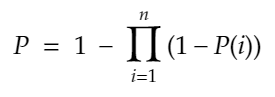
Feel free to interpret the formula if you like math, where P is the total probability of success, P(i) is the probability of success for a project i and n is the total number of projects.
The meaning of this formula is more intuitive than it seems. The more projects you take on, the luckier you get. Remember that you only need ONE good project to be successful.
Let’s make an example using the formula above. Let’s say that, for the sake of simplicity, every project has a 10% probability of success. If you work only on one project, the total probability is obviously 10%. If you work on two projects, the total probability is 19%. Three projects: 27.1%. Four projects: 34.39%. And so on.
The reality is just a bit different, but the concept is sound. Let’s focus on the part where I said that you only need ONE good project to succeed.
Success, like many natural phenomena, tends to follow an S-shaped curve. The first projects, no matter how good they are, will be failures. At some point, you will create a project, not necessarily good nor bad, without thinking it will succeed. But it will. It will explode. It will change your world. And the following projects, even if they are mediocre, will gain more popularity than the first ones.
You can see this everywhere. Take for example your favorite blog. Look at the first posts. They weren’t so popular. Then at some point, there is a post that suddenly got immense popularity. This post is probably good, but it isn’t objectively much better than the previous ones. It just succeded for some unknown reasons, unknown even to the author. The subsequent posts, even if objectively bad, are more popular than the first ones, just because they follow the successful one. This successful post is known as the Tipping Point¹³.
This leads to another concept that challenges common wisdom:
Focus on quantity over quality.
Film photography professor Jerry Uelsmann of the University of Florida made an experiment. He divided his students into two groups: group A would be graded on the quantity of photographs produced while group B would be graded on the quality of the best photo. Surprisingly, the quality of group A photos was on average superior to the quality of group B photos.
If you focus on quality, you may be a victim of perfectionism, which we have already discussed. While if you focus on quantity, you will make a lot of shitty work, but eventually, even if only by chance, you will make something great.
It’s also important to diversify your work to achieve this effect. Try different things. Diversification is more important than focus. This is yet another concept that gurus hate.
Rapid Prototyping
If you want to focus on quantity over quality, you need to be fast. You can’t spend years or even months on unsuccessful projects. You need to understand as soon as possible if your project is going to succeed or fail.
This is another point in favor of agile methodologies against plan-based ones, as we discussed earlier. Ideally, you should build an MVP in no more than 2 weeks, then start gathering clues about the potential success of your project. One way to gather these clues is by building the hype. If you want to launch a startup, you can build a website and start getting subscriptions before actually building the product. I did something similar last year.
Anything that accelerates this process is welcome. I have mentioned leverages several times before. Knowing the right people is more important than having fantastic ideas.
In fact, especially in the case of entrepreneurship, the best thing you can do is building a robust team. The team is one of the most important factors in startup success (if we ignore luck, obviously). But this is another story.
A Smooth Machine
I would have called this point “attention to details” but I didn’t want you to confuse it with “perfectionism”.
But whether you are building a startup or improving your life, you have to take care of every aspect of it. If you neglect some aspects, they become bottlenecks. Bottlenecks are the enemy of rapid prototyping and success.
The good thing is that, even if you have to improve everything, you don’t have to improve everything too much.
British Cycling sucked ass before 200²¹⁴. At the 2008 Beijing Olympics, it won seven out of 10 gold medals available in track cycling.
The secret of its success? The theory of marginal gains, or improving everything by just 1%:
- 1% improvement in aerodynamics.
- 1% improvement in personal hygiene to avoid illness.
- 1% improvement in diet.
- 1% improvement in sleep quality.
- 1% improvement in just about anything.
When you apply small improvements in everything, the resulting total improvement is higher than the sum of the single improvements (this concept is also known as synergy). It’s amazing how easily you can apply this concept in your personal life:
- Make your daily workout 1% longer.
- Make your diet 1% healthier.
- Sleep 1% longer.
- Be nice to 1% more people.
If you are careful about every aspect of your personal life and improve it by as little as 1%, the final result will surprise you.
Conclusion
Mount Everest’s height pales in comparison to this story’s length. But I know I didn’t cover every aspect of self-help.
I focused particularly on success, but most concepts can be applied, directly or indirectly, to other aspects too, like self-esteem, happiness and personal growth.
I also want to draw a line between self-help and self-management. I think that topics like time management, productivity, soft skills, etc. are worthy of further exploration in the future.
In this story, I just wanted to make order in the huge pile of shit around the world of self-help and success. I hope you have learned that success is not assured and is mainly caused by sheer luck, but it’s still worth finding some ways to get luckier.
You may finally argue that I’m personally not successful enough to teach about success. You are right. I don’t consider myself “successful”, yet. I told you from the beginning, I don’t want to fuck with you. I tried to be objective and analytical, but I know, and you should know, that everything I said can be bullshit. Maybe Napoleon Hill is right. Maybe the Law of Attraction is real. Maybe Copernicus created planets because he really believed in them. Maybe avocados in your ass really make you live longer. Or, in a less extreme example, maybe saying no is better than saying yes.
But I’m sure of one thing. I may not know the answers now, but if one day I will be successful, I still won’t know them.
[1]: http://www.cbc.ca/news/world/rocket-scientist-mad-mike-hughes-blasts-off-california-1.4592170
[2]: https://edition.cnn.com/2020/02/22/us/science-channel-mike-hughes-dead/index.html
[3]: https://www.amazon.com/Think-Grow-Rich-ebook/dp/B001NGN2D2
[4]: https://www.businessinsider.my/secrets-to-long-life-that-people-reached-100-swore-by-2020-4
[5]: https://www.amazon.com/Success-Principles-TM-Where-Want/dp/0060594896
[6]: https://www.snopes.com/fact-check/the-unsolvable-math-problem/
[7]: https://journals.sagepub.com/doi/full/10.1111/j.1467-9280.2009.02370.x
[8]: https://www.amazon.com/Thinking-Fast-Slow-Daniel-Kahneman/dp/0374533555
[9]: https://www.amazon.it/Good-They-Cant-Ignore-You/dp/1455509124
[10]: https://www.amazon.com/Outliers-Story-Success-Malcolm-Gladwell/dp/0316017930
[11]: https://royalsocietypublishing.org/doi/pdf/10.1098/rsos.190327
[12]: https://www.amazon.co.uk/Luck-Factor-Scientific-Study-Lucky/dp/0099443244
[13]: https://www.amazon.com/Tipping-Point-Little-Things-Difference/dp/0316346624
[14]: https://hbr.org/2015/10/how-1-performance-improvements-led-to-olympic-gold


