Three Ways To Free Yourself From What You Should Be Doing
What works best for you might not work for me or anyone else, yet we’re conditioned by society to follow certain expectations. However, this gets murky, especially after the Covid pandemic. Many people started to think about what they wanted to do instead of doing what they should be doing.
The Wrong Fuel

What do you think happens when you use the words should, could and would? You’re putting unnecessary pressure on your powerhouse. How? It’s sending the wrong signal to the brain by confusing it.
The choice of words you’ve used doesn’t fire up the cylinders. Instead, your choice of words puts your powerhouse in a stationary mode. Plus, you’ll feel guilty because you’re not true to yourself.
There’s a big difference between what you should be doing and what you want to do. I know; I see it every day when I work with clients. You’d be surprised how many talk about doing something because of other people’s expectations.
Imagine The Following
Ted had the right pedigree, background and career track, but he didn’t choose his career path. His parents encouraged him to pursue medicine, but his heart was never in it. They believed he should follow a ‘respectable’ profession.
Ted wasn’t a medical person interested in it like his girlfriend Sam, who went on to specialise in Paediatric Medicine. On the surface, his life looks idyllic, but internally, he’s all over the place. He’s decided to take a sabbatical and think about his future seriously.
His parents have invited him to lunch over the weekend because they’re concerned he’s making the wrong decision. Ted knows what’s going to happen. His parents are going to try to talk him out of taking a sabbatical with the view of keeping him on track with his career.
Quiz
Should Ted…
- Listen to his parents and carry on
- Take the sabbatical and rethink his future
- Do Nothing
If you answered 1 and 3, it’s time to talk.
Three Ways To Free Yourself From What You Should Be Doing
- Inside Out vs Outside In
2. Managing Expectations
3. Water Your Patch
- Inside-out vs Outside In.
When you begin to understand this, you’ll be able to appreciate the self-awareness that goes with the territory of taking back control. For example, many get put off executing their dreams for fear of other people’s ‘Why?’ because they start questioning their judgment. Don’t.
Instead, know your objectives and end goals and stick to them. The rest starts falling into place when you know you’re ‘what’ and ‘why’. You never need to explain or justify your actions, but if you ever find yourself being questioned, your self-awareness and clarity will help you handle the questions from people in your world.
2. Managing Expectations
Other People’s Opinion Don’t Matter. Consciously and subconsciously, it shouldn’t, but it does for many. Our connections from school, college, university, workplace, and personal relationships have imprinted on us. How? From the outset, we learnt patterns in human relationships very quickly. We may have listened too much to others or followed their advice, sometimes sacrificing our own What and Why.
For many, what others say matters because others supposedly know best. They didn’t. We give them that permission because, in reality, they don’t know what’s good for you. Only you know what’s best for you. Even if you haven’t engaged much in personal or professional development, you’ve got that ‘gut’ feeling. Tune into it continuously.
3. Water Your Patch
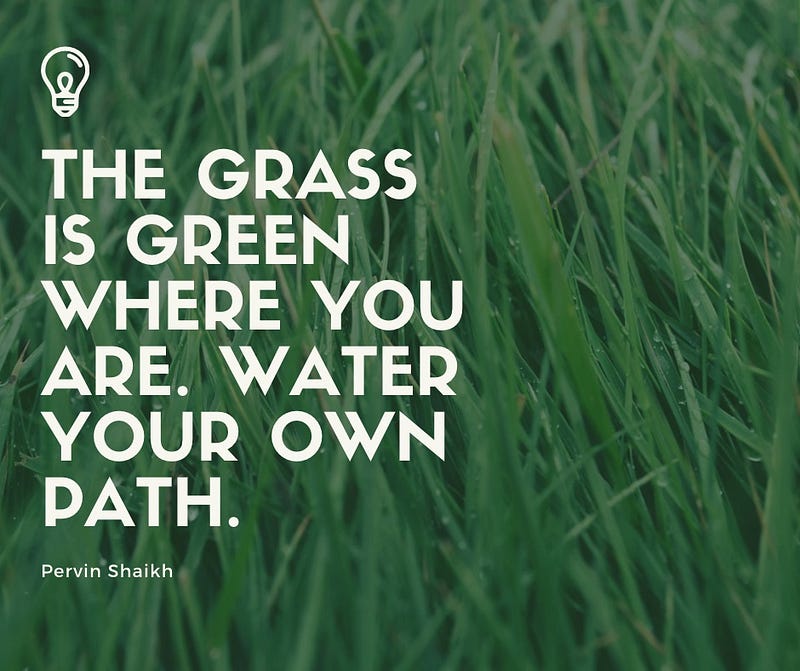
Rather than yearning for greener pastures elsewhere, why not invest time and effort into nurturing your garden? By watering your patch, you will find contentment.
Instead of seeking external validation or envying others, you find peace in your accomplishments, big or small. Additionally, by focusing on yourself, you’re in a better position to identify areas of improvement, learn new skills, and grow as an individual.
You’ll also sow great seeds. The seeds you plant today determine the fruits you reap tomorrow. Instead of wasting time comparing your progress to others, invest it in your Self-awareness.
Doing so lets you understand your strengths, weaknesses, and aspirations. Dedicate time to learn, evolve, and enhance your skills. You’ll, therefore, be in a better position to build meaningful relationships and develop connections that uplift and support you.
My Story — Swimming Against the Tide
I had an excellent track record when I started as a young grad. I had great grades, and I worked with big names. Generally speaking, I had a great time. However, I knew something was missing. I wanted to do something different but didn’t know what. After a bit of research and reading, I came across Coaching.
When I first became a coach, many people questioned my career change. I heard a lot of ‘Why’ questions, and at the time, it felt like I were swimming upstream. However, I’m glad I stuck to my guns and tuned out the external noise because most of it was negative. You probably wouldn’t have read this post if I had listened to them.
Parting Comments
While it’s natural to glance at others and wonder about their lives occasionally, if you do it often, you might be swayed by what you think you should be doing to what you want to be doing.
Remember, the grass isn’t always greener on the other side; sometimes, it’s just the filter. Embrace your journey, water your patch, and cultivate a life filled with purpose and contentment.
Finally, Changes Don’t Happen Overnight. Keep working on yourself daily. This way, you’ll start building momentum and, over time, seeing the changes. You’ll learn when to tune out the external noise; to do this, try different things to help you. Keep it positive, and keep remembering why you started in the first place.
Thank you for your attention.
Follow me for more valuable tips.
Pervin
linktr.ee/AimHighLtd


