perform the equivalent work of a <a href="http://theoildrum.com/node/4315">person working for 25,000 hours</a> (12.5 years at 40 hours per week). Fossil fuels allowed us to traverse continents, extend daylight at will, and control temperature with a switch. They’ve shaped the world as we know it. And they are also leading to its destruction.</p><figure id="7521"><img src="https://cdn-images-1.readmedium.com/v2/resize:fit:800/1*TZVf2ywnTnWRr-jkf6X_fA.png"><figcaption>Source: <a href="https://ourworldindata.org/grapher/annual-co2-oil">OurWorldInData</a></figcaption></figure><h1 id="e016">#02: Inertia — Stuck in the Fossil Fuel Rut</h1><p id="6695">Our world is structured around fossil fuels. With approximately <a href="https://www.notion.so/b32ab04ae16b405d96694a89ad140a1f?pvs=21"><b>1.474 billion vehicles</b></a> and <a href="https://www.notion.so/Three-Reasons-Why-The-Transition-Away-From-Fossil-Fuels-Is-Still-Impossible-aad476f057fe4b758aaf426cf0b14fc9?pvs=21"><b>28,674 aircrafts</b></a><b> </b>worldwide, gasoline and diesel rule the transportation sector. A network of refineries, pipelines, and filling stations keeps them running. Despite the advantages of electric vehicles, gas-powered cars will linger for decades, a luxury we can’t afford if we hope to address climate change. Just take a look at the cars going the opposite way on the road. How many of them are single passengers, like you and me, most of the time? E-cars, public transportation development, and a shift in our habits and consumption patterns seem to be the core solutions.</p><p id="ea18">But the challenge becomes steeper when we consider our own houses: a hot shower, cooking, staying warm or cooling down, and even turning on the lights; they all consume energy — and probably not the greenest kind.</p><p id="33fc">We need decisive action to accelerate this transition.</p><h1 id="a69a">#03: Vested Interests — The Puppet Masters Behind Fossil Fuels</h1><p id="f85b">Renewable energy makes sense on many fronts — it’s cost-effective, clean, and available globally. But for those who profit from oil wells or coal mines, it’s a catastrophe. <b>The fossil fuel industry wields immense political power.</b></p><p id="2c8d">Here’s the utmost example:</p><p id="6106"><a href="https://www.science.org/doi/10.1126/science.abk0063">ExxonMobil</a> has known about climate change since the 1970s. It even started building higher drilling rigs to compensate for the rising sea level they knew was coming. But opted to spread doubt in a lengthy campaign to downplay or discredit what its own scientists had confirmed rather than act.</p><p id="ff70">By 1989, the company had actively contributed to forming the now-disbanded <a href="https://www.ucsusa.org/sites/default/files/attach/2015/07/The-Climate-Deception-Dossiers.pdf"><b>Global Climate Coalition</b></a> to raise doubts about the scientific consensus on climate change. In 1998, it played a pivotal role in preventing the United States from signing the international climate treaty known as the Kyoto Protocol, which aimed to control greenhouse gas emissions. Exxon’s tactics also discouraged other nations, including emerging giants like China and India, from endorsing the treaty.</p><p id="af22">Even as recently as 2013,<a href="https://insideclimatenews.org/news/22122016/rex-tillerson-exxon-climate-change-secretary-state-donald-trump/#:~:text=At%20the%20company's%202013%20annual,our%20ability%20to%20project%20with"> Rex Tillerson</a>, then chief executive of the oil company (later <a href="https://uy.usembassy.gov/learn-secretary-state-rex-tillerson/">Trump’s Secretary of State</a>, and Trump’s fired Secretary of State <a href="https://www.theguardian.com/us-news/2022/oct/03/rex-tillerson-former-secretary-of-state-testifies-corruption-trial-trump-ally">witness</a> at the trial of a Trump ally accused of leaking intelligence to the United Arab Emirates, lol), publicly expressed skepticism about climate models. He said that they were<a href="https://www.nytimes.com/2019/10/30/climate/rex-tillerson-exxon-climate-change-case.html#:~:text=Tillerson%2C%20including%20his%20comments%20at,gets%20put%20into%20all%20our"> <i>“not competent”</i></a> and emphasized the presence of uncertainties regarding the impact of burning fossil fuels.</p><p id="cff0">For nearly three decades, the global discourse stagnated in a fruitless argument over the authenticity of global warming despite both sides fully acknowledging its undeniable reality. One that exacted a heavy toll on our most precious and dwindling resource: time.</p><p id="85b4">It wasn’t until the <a href="https://www.pulitzer.org/finalists/insideclimate-news">Pulitzer-nominated </a>works from <a href="https://insideclimatenews.org/book/exxon-the-road-not-taken/">InsideClimate News</a> and The Climate Deception Dossiers finally ended Exxon’s long tenure of climate denialism for profit harvesting.</p><figure id="8c0a"><img src="https://cdn-images-1.readmedium.com/v2/resize:fit:800/1*uLcBWnZcqF3Xpif_62oD7g.jpeg"><figcaption><b>Historically observed temperature change (red) and atmospheric carbon dioxide concentration (blue) over time, compared against the extremely accurate global warming projections reported by ExxonMobil scientists. </b>(Source:<b> <a href="https://www.science.org/doi/10.1126/science.abk0063"></a></b><a href="https://www.science.org/doi/10.1126/science.abk0063">Assessing ExxonMobil’s global warming projectio
Options
ns — Science</a>)</figcaption></figure><p id="f5b3">But there are many other players in the fossil fuels chess board besides private companies.</p><ul><li>Some of the world’s most prominent political donors, such as the <a href="https://www.forbes.com/profile/koch/?sh=ef116595a5b3">Koch brothers</a>, are oil and gas barons.</li><li>At least <a href="https://www.notion.so/The-Tonga-volcanic-eruption-reshaped-the-seafloor-in-mind-boggling-ways-65ee24980c17453ba644a3218e956adc?pvs=21">29 countries</a>, such as Saudi Arabia, Netherlands, and Kuwait, source more than 90% of their energy from fossil fuels, including coal, oil, gasoline, and natural gas.</li><li>Entire nations in the Gulf, Russia or Venezuela, are petrostates depending on fossil fuel revenue, making the shift to renewables a hard-fought battle.</li></ul><p id="e7fe">And they all collaborate in shaping a speech away from what we truly need and closer to their profitable interest.</p>
<figure id="8649">
<div>
<div>
<img class="ratio" src="http://placehold.it/16x9">
<iframe class="" src="https://cdn.embedly.com/widgets/media.html?src=https%3A%2F%2Fwww.youtube.com%2Fembed%2Fm95K7LClIC4%3Ffeature%3Doembed&display_name=YouTube&url=https%3A%2F%2Fwww.youtube.com%2Fwatch%3Fv%3Dm95K7LClIC4&image=https%3A%2F%2Fi.ytimg.com%2Fvi%2Fm95K7LClIC4%2Fhqdefault.jpg&key=a19fcc184b9711e1b4764040d3dc5c07&type=text%2Fhtml&schema=youtube" allowfullscreen="" frameborder="0" height="480" width="854">
</div>
</div>
</figure></iframe></div></div></figure><h1 id="3a99">The Renewable Challenge</h1><p id="d92f"><b><i>Everything’s tied to CO2 Emissions.</i></b> Even when we consider alternative energy sources, they come with their environmental costs. Electricity, hydrogen, or biofuels can thrust vehicles, but all have emissions tied to their production. Solar and wind power produce no emissions during use, but they require energy to manufacture. <b>Solving the climate crisis means looking at the bigger picture and changing how we live.</b> It touches every aspect of our lives, starting with our consumption obsession.</p><p id="ed23"><b><i>Because there’s a simple reality: no energy source is perfect.</i> </b>No energy source comes without human and environmental costs:</p><ul><li>Mining for minerals used in solar panels and batteries</li><li>The<a href="https://readmedium.com/wind-whales-and-misinformation-at-the-jersey-shore-1919f853a2a9"> invasion of windmills</a> in wildlife’s landscapes</li><li>Changing the flow of rivers</li></ul><p id="ac56"><b>There will be pain and gain in this transition.</b> Some will face difficulties while others prosper. This is inevitable in transformative shifts. From horses to cars, typewriters to computers, change happens. A <a href="https://www.etymonline.com/word/crisis">crisis</a> is a point at which change must come, for better or worse. Those who adapt early and shape the transition will reap the rewards.</p><p id="63f1">But still, there’s an even more significant upside besides a cleaner environment. <b>Renewable energy offers a chance to reduce the unfair distribution of power.</b> For example, recent developments in <a href="https://www.eiu.com/n/investor-interest-in-kenyas-renewable-energy-sector-rises/">Kenya’s renewable energy</a> potential underline high levels of investor interest, focused on geothermal and wind power. Kenya relies on renewables for roughly 90% of its power needs and to 100% by 2030.</p>
<figure id="a7bf">
<div>
<div>
<img class="ratio" src="http://placehold.it/16x9">
<iframe class="" src="https://cdn.embedly.com/widgets/media.html?type=text%2Fhtml&key=a19fcc184b9711e1b4764040d3dc5c07&schema=twitter&url=https%3A//twitter.com/MikeHudema/status/1698841401016865262&image=https%3A//i.embed.ly/1/image%3Furl%3Dhttps%253A%252F%252Fabs.twimg.com%252Ferrors%252Flogo46x38.png%26key%3Da19fcc184b9711e1b4764040d3dc5c07" allowfullscreen="" frameborder="0" height="281" width="500">
</div>
</div>
</figure></iframe></div></div></figure><p id="5852">The time to make this transition is running out.<b> We need a combination of technology, behavioral change, and policy to drive the transformation necessary to avoid the worst of the climate crisis.</b> Technology alone won’t save us; changing behavior in isolation is insufficient.</p><p id="bc68">This moment is both a challenge and an opportunity. But let’s be clear: it’s time to stop burning things on Earth’s surface. We shouldn’t dig up coal, gas, and oil or chop trees to set them on fire — it’s dirty and dangerous. Instead, it’s energy from the elements: sun, wind, and water.</p><p id="2198"><b>The energy from above, not below, holds the key to fueling a sustainable future.</b></p><p id="0995"><i>Thank you for your thorough reading and support!</i></p><p id="aa51"><i>If you crave more insights into climate change, scientific progress, and geopolitics with a Patagonian twist, subscribe to the newsletter <a href="https://rickylanusse.substack.com/?utm_source=navbar&utm_medium=web&r=271e6q"></a></i><a href="https://rickylanusse.substack.com/?utm_source=navbar&utm_medium=web&r=271e6q"><b>Antarctic Sapiens</b></a> <i>and dive into thought-provoking content weekly.</i></p></article></body>
Three Reasons Why The Transition Away From Fossil Fuels Is Still Impossible
The schemes and roadblocks promoting fossil fuel dependency, even as the climate crisis escalates
Last week, I went for an earlybird ski session before heading to the office. I was in line to get one of the first chairs up the mountain when the energy cut down, making some crackling noises, signaling a bad prognosis. I stood in line, watching maintenance people running back and forth with heavy tools and hospitality guys, assuring this was just a temporary shortcut coming from town. It took them 20 minutes or so, but then, the entire ski resort was running as usual. It was only after some groomers that I arrived at the office and learned the accurate diagnosis; it was not the power supplier’s problem, but the ski resort’s: their vice of tying everything with wire had blown up the transformer.
But they had a quick fix at hand: a massive diesel genset.
The 20 minutes it took them to get everything up and running again was the 20 minutes it took to charge the generator.
Show must go on.

Heart cloud and joyful fossil-fueled ride (photo by author)
My hometown receives 60–70% of its energy in a clean way from Alicura and El Chocon hydroelectric power plants, 125 and 360 kilometers away. The largest consumer is, by far, the ski resort and its 29 chairlifts, with a capacity to transport 33,000 people per hour.
The problem is that the ski resort continues to expand (this year, they incorporated two major new lifts), as so does the population of our town. And the means to sustain energy consumption are not being upgraded and/or expanded. On the contrary, they are taken to the limits of collapse, and then culprits look aside to blame responsibility.
Because they know there’s always fossil fuels to save the day…
Energy lies at the epicenter of the climate crisis
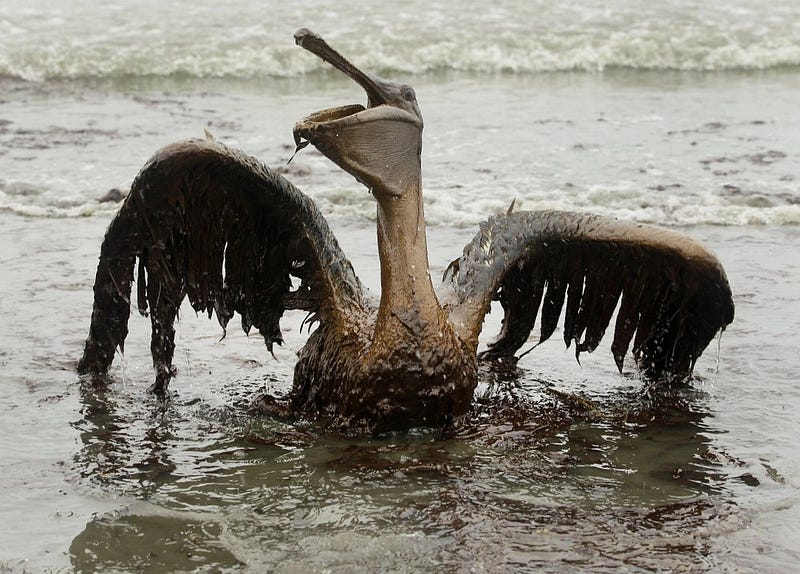
Our addiction to fossil fuels has pushed our planet to the brink, but transitioning away from its piling emissions is one of humanity’s most troubling challenges. In a world driven by numbers (especially profitable ones), the arithmetic problem we face centers on our energy sources:
more fossil burning = more greenhouse gases = accelerated climate crisis
Getting this equation right is our only hope:
more renewables = less greenhouse gases = mitigated climate crisis
Since the Industrial Revolution, when coal entered the scene as a visible sign of pollution from its combustion (now claiming 8.7 million lives annually, more than AIDS, malaria, and tuberculosis combined), we gradually gave way to an even deeper issue — the invisible and odorless carbon dioxide (CO2). Burning a liter of gasoline may seem harmless. But the world consumes 35,442,913,090 oil barrels of 159 liters annually, and 2.6 kilograms of CO₂ released per liter — the perfect recipe for a global warming crisis.
CO₂ concentration in our atmosphere has surged from 275 parts per million (ppm) to 422 ppm today, entailing a daily accumulation of heat equivalent to 500,000 Hiroshima-sized bombs. The consequences are tangible — melting ice sheets, rising oceans, and more powerful hurricanes.
So why is transitioning away from fossil fuels, the very source of our dilemma, still a seemingly impossible task?
#01: Fossil Fuel — Sunshine in a Bottle
Imagine if you could harness the sun’s power, bottled and condensed into a single substance. That’s what fossil fuels represent. Over millions of years, nature grew forests, oceans overflowing with plankton, and plants feeding countless creatures. These life forms became coal, gas, and oil when they died. We’ve unearthed this millenary energy in just two centuries, creating a world throbbing with Sunpower. A barrel of oil, about 159 liters, can perform the equivalent work of a person working for 25,000 hours (12.5 years at 40 hours per week). Fossil fuels allowed us to traverse continents, extend daylight at will, and control temperature with a switch. They’ve shaped the world as we know it. And they are also leading to its destruction.
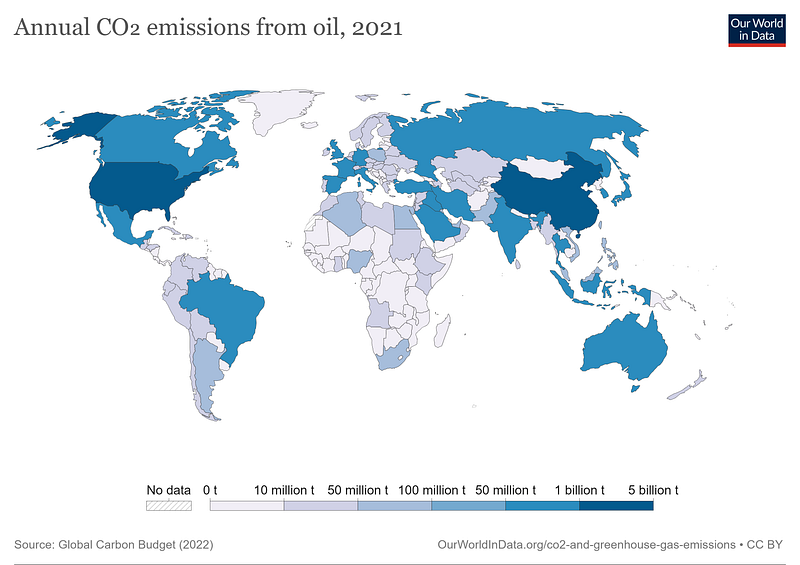
Our world is structured around fossil fuels. With approximately 1.474 billion vehicles and 28,674 aircraftsworldwide, gasoline and diesel rule the transportation sector. A network of refineries, pipelines, and filling stations keeps them running. Despite the advantages of electric vehicles, gas-powered cars will linger for decades, a luxury we can’t afford if we hope to address climate change. Just take a look at the cars going the opposite way on the road. How many of them are single passengers, like you and me, most of the time? E-cars, public transportation development, and a shift in our habits and consumption patterns seem to be the core solutions.
But the challenge becomes steeper when we consider our own houses: a hot shower, cooking, staying warm or cooling down, and even turning on the lights; they all consume energy — and probably not the greenest kind.
We need decisive action to accelerate this transition.
#03: Vested Interests — The Puppet Masters Behind Fossil Fuels
Renewable energy makes sense on many fronts — it’s cost-effective, clean, and available globally. But for those who profit from oil wells or coal mines, it’s a catastrophe. The fossil fuel industry wields immense political power.
Here’s the utmost example:
ExxonMobil has known about climate change since the 1970s. It even started building higher drilling rigs to compensate for the rising sea level they knew was coming. But opted to spread doubt in a lengthy campaign to downplay or discredit what its own scientists had confirmed rather than act.
By 1989, the company had actively contributed to forming the now-disbanded Global Climate Coalition to raise doubts about the scientific consensus on climate change. In 1998, it played a pivotal role in preventing the United States from signing the international climate treaty known as the Kyoto Protocol, which aimed to control greenhouse gas emissions. Exxon’s tactics also discouraged other nations, including emerging giants like China and India, from endorsing the treaty.
Even as recently as 2013, Rex Tillerson, then chief executive of the oil company (later Trump’s Secretary of State, and Trump’s fired Secretary of State witness at the trial of a Trump ally accused of leaking intelligence to the United Arab Emirates, lol), publicly expressed skepticism about climate models. He said that they were“not competent” and emphasized the presence of uncertainties regarding the impact of burning fossil fuels.
For nearly three decades, the global discourse stagnated in a fruitless argument over the authenticity of global warming despite both sides fully acknowledging its undeniable reality. One that exacted a heavy toll on our most precious and dwindling resource: time.
It wasn’t until the Pulitzer-nominated works from InsideClimate News and The Climate Deception Dossiers finally ended Exxon’s long tenure of climate denialism for profit harvesting.
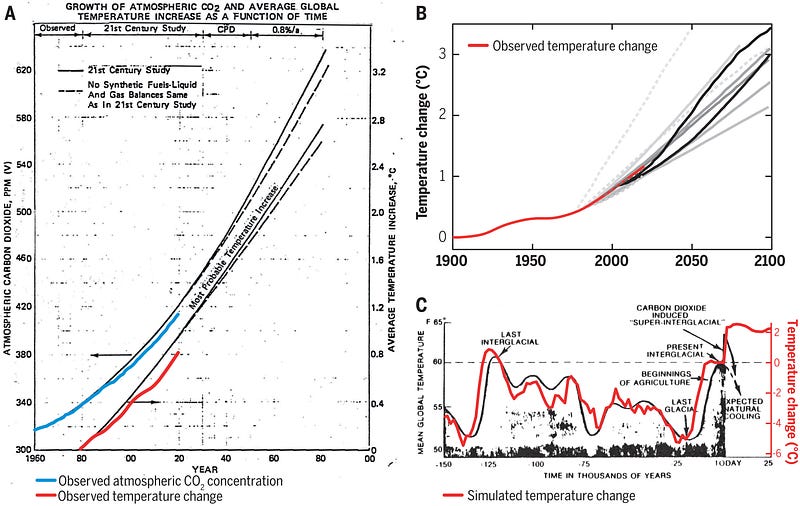
Historically observed temperature change (red) and atmospheric carbon dioxide concentration (blue) over time, compared against the extremely accurate global warming projections reported by ExxonMobil scientists. (Source:Assessing ExxonMobil’s global warming projections — Science)
But there are many other players in the fossil fuels chess board besides private companies.
Some of the world’s most prominent political donors, such as the Koch brothers, are oil and gas barons.
At least 29 countries, such as Saudi Arabia, Netherlands, and Kuwait, source more than 90% of their energy from fossil fuels, including coal, oil, gasoline, and natural gas.
Entire nations in the Gulf, Russia or Venezuela, are petrostates depending on fossil fuel revenue, making the shift to renewables a hard-fought battle.
And they all collaborate in shaping a speech away from what we truly need and closer to their profitable interest.
The Renewable Challenge
Everything’s tied to CO2 Emissions. Even when we consider alternative energy sources, they come with their environmental costs. Electricity, hydrogen, or biofuels can thrust vehicles, but all have emissions tied to their production. Solar and wind power produce no emissions during use, but they require energy to manufacture. Solving the climate crisis means looking at the bigger picture and changing how we live. It touches every aspect of our lives, starting with our consumption obsession.
Because there’s a simple reality: no energy source is perfect.No energy source comes without human and environmental costs:
Mining for minerals used in solar panels and batteries
There will be pain and gain in this transition. Some will face difficulties while others prosper. This is inevitable in transformative shifts. From horses to cars, typewriters to computers, change happens. A crisis is a point at which change must come, for better or worse. Those who adapt early and shape the transition will reap the rewards.
But still, there’s an even more significant upside besides a cleaner environment. Renewable energy offers a chance to reduce the unfair distribution of power. For example, recent developments in Kenya’s renewable energy potential underline high levels of investor interest, focused on geothermal and wind power. Kenya relies on renewables for roughly 90% of its power needs and to 100% by 2030.
The time to make this transition is running out. We need a combination of technology, behavioral change, and policy to drive the transformation necessary to avoid the worst of the climate crisis. Technology alone won’t save us; changing behavior in isolation is insufficient.
This moment is both a challenge and an opportunity. But let’s be clear: it’s time to stop burning things on Earth’s surface. We shouldn’t dig up coal, gas, and oil or chop trees to set them on fire — it’s dirty and dangerous. Instead, it’s energy from the elements: sun, wind, and water.
The energy from above, not below, holds the key to fueling a sustainable future.
Thank you for your thorough reading and support!
If you crave more insights into climate change, scientific progress, and geopolitics with a Patagonian twist, subscribe to the newsletter Antarctic Sapiensand dive into thought-provoking content weekly.