
Wind, Whales, and Misinformation at the Jersey Shore
Does offshore wind power really harm whales?
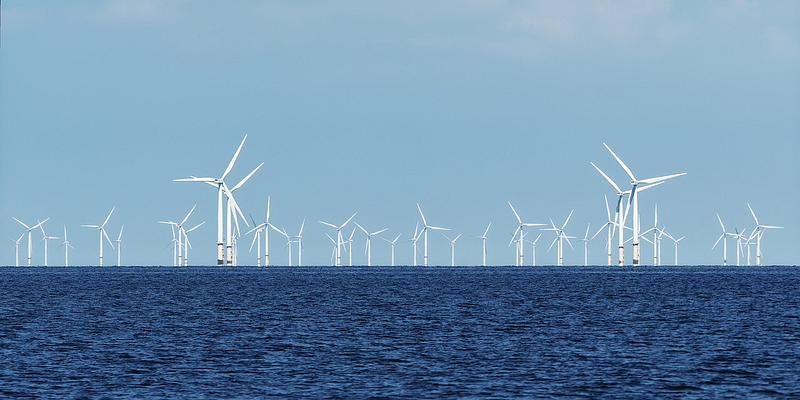
A few months ago, an old friend of mine posted an Instagram story that appeared to show him at some sort of “save the whales” rally. Pleasantly surprised to see this person engaged in environmental activism, I sent him an encouraging message. His reply informed me that the event he attended was actually a protest against offshore wind power development in our home state of New Jersey.
My heart sank.
Since then, I’ve lost sleep over this issue. As if the tragedy of dying whales washing ashore wasn’t bad enough, the issue is generating misinformation that threatens to destroy vital renewable energy projects.
Spoiler: There’s no evidence that offshore wind projects on the East Coast, or anywhere else, have caused any whale deaths.
Yet, there’s a powerful movement to cancel offshore wind development and whales are at the center of the conversation. Let’s sort out the distressing facts from the distressing fictions.
Stranded Whales on the Atlantic Coast: An Unusual Mortality Event
Along the US Atlantic Coast, there’s an ongoing “unusual mortality event” concerning whale strandings. Stranding, or beaching, refers to a live whale or dolphin that comes ashore. Strandings are usually fatal.
The Marine Mammal Protection act defines an unusual mortality event (UME) as “a stranding that is unexpected; involves a significant die-off of any marine mammal population; and demands immediate response.”
The following three species are affected:
It’s important to note that these three UMEs have been ongoing since 2016 and 2017. While this year has been particularly bad, especially in New Jersey, whale strandings are not a new problem for 2023.
Here’s a look at the past seven years of strandings for the species most affected, humpbacks and minkes.
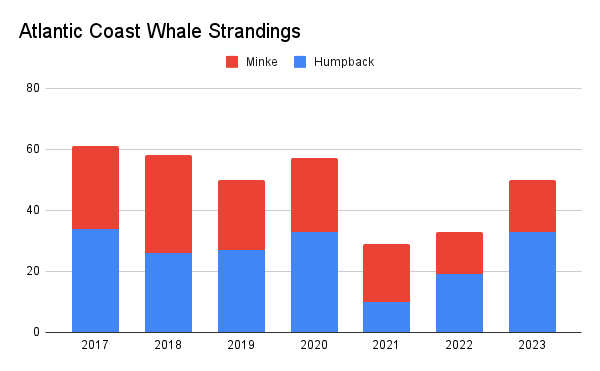
In New Jersey, there have been zero minke strandings since 2021. There have been eight humpback strandings in 2023, compared to zero in 2021 and four in 2022.
Thanks to a surge in media attention and grassroots activism, 2023 is the first time that many folks took notice of whale strandings. However, while many activists seem to have appeared overnight, the hazards that cause strandings are nothing new.
What’s Killing the Whales?
Globally, the top threats to whales include:
- Whaling
- Climate change
- Ship strikes (collisions between whales and ships)
- Fishing gear entanglement
- Oil and gas operations
- Habitat degradation and food supply loss
- Water pollution
- Noise pollution
Regarding strandings on the beaches of New Jersey and other East Coast states, it’s difficult to quantify the severity of some of these threats. Climate change, food chain disruption, and pollution issues are incredibly complex and interconnected.
Amid the uncertainty, these two points are crucial for understanding the increase in whale strandings:
- Whales are spending more time close to the Atlantic shore
- Many of the recently stranded whales were victims of ship strikes
Let’s unpack those two points separately.
Whale Presence Near East Coast Shores Has Increased Significantly
New Jersey’s whale-watching industry is booming. That’s because, in recent years, there have been more and more humpbacks spending time near the shore.
According to NJ.com:
“Humpbacks have become a year-round regular in New York and New Jersey waters in the last decade as they feed in the area for longer periods of time and return for consecutive years.”
Humpbacks are highly mobile, with migration routes that span thousands of miles. However, they seem increasingly likely to linger once they come close to the NJ/NY shores. A seven-year study from Rutgers University indicates that whales visiting the region are spending an average of 37 days per year. Around one-third of the whales that visit return the next year.
It’s not entirely clear why humpbacks are spending more time in the area, but it seems that climate change is affecting prey species in northern waters, including the Gulf of Maine. This is driving whales toward new feeding grounds, such as the more stable fish populations near the Mid-Atlantic coast.
Ships Kill Whales
Friend of the Sea, an international conservation group, describes ship strikes as “a silent massacre”. It’s estimated that each year around 20,000 whales die from ship strike injuries and around 300,000 whales and dolphins die from fishing gear entanglement.
Around New Jersey and New York, an increased whale presence has coincided with an increase in ship traffic. The Port of New York and New Jersey had its highest cargo activity in history in 2022, with 27% growth compared to pre-pandemic 2019.
Here’s a snapshot of the area’s ship traffic, which includes fishing boats, tankers, cargo vessels, and other ships:
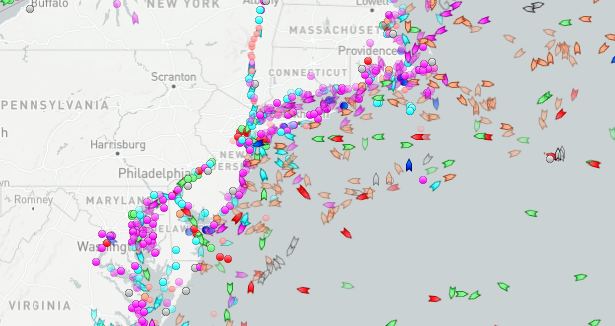
Ships kill whales. When the carcasses of stranded whales are examined, there’s often clear evidence of a fatal collision with a ship. According to the National Oceanic and Atmospheric Administration (NOAA), around 40% of necropsies performed on Atlantic Coast whale strandings reveal either a ship strike or fishing gear entanglement.
Lately, each high-profile stranding on the Jersey Shore spurs new calls to shut down wind energy development. However, many of these strandings, such as this one in Atlantic City or this one in Manasquan, were shown to be caused by ship strikes.
Wind Energy Projects and Whales
New Jersey doesn’t yet actually have any offshore wind turbines constructed. Rather, those opposing wind development argue that noise from the temporary pre-construction site surveys could be the cause of recent whale strandings.
The sense of sound is important for whales. They use sound for communication, navigation, and prey-finding. Excessive human-caused noise can disrupt communication and interfere with feeding, mating, and nursing. Noise pollution can be a fatal hazard if it causes permanent hearing loss or causes a whale to be separated from its group.
Here’s the thing: noise from wind project site surveys is far less intense than other permitted sources of ocean noise pollution, such as military sonar or the seismic airguns used for oil and gas surveys. Compared to those much more abundant sources of noise, wind power survey noise is less intense, less frequent, more temporary, and affects much smaller areas.
It’s conceivable that wind project site survey noise could be distracting whales, leading to ship strikes. Or, that the survey ships themselves could be striking whales. But those scenarios are highly unlikely.
First of all, these ships aren’t numerous. They’re a drop in the bucket compared to other sources of ocean traffic. Second, they’re held to a very high standard for marine wildlife protection. Each wind project ship has a third-party Protected Species Observer on board who monitors the water for whale activity. The ship shuts down operations immediately when a whale is detected nearby.
According to NOAA:
“At this point, there is no scientific evidence that noise resulting from offshore wind site characterization surveys could potentially cause mortality of whales. There are no known links between recent large whale mortalities and ongoing offshore wind surveys.”
The Misinformation Campaign Against Wind Energy
Among federal government agencies and conservation groups, there’s a broad consensus that offshore wind site surveys are not killing whales. The real threats to whales are well-established and have been causing East Coast strandings for many years.
Nevertheless, “save the whales” is the current rallying cry for New Jersey’s enthusiastic anti-wind movement. That includes a group of 30 mayors calling for a moratorium on all offshore wind activities.
What forces are backing this movement? The usual suspects:
- The fossil fuel industry: “According to the Union for Concerned Scientists, the Heartland Institute and CFACT have both received about $500,000 in funding from ExxonMobil… CFACT President Craig Rucker said, “[we are] very concerned about the future of the right whale, which extensively uses the ocean waters affected by the wind-power project.”
- Fox News: “Fox News is rapidly escalating its anti-offshore wind campaign. There’s no evidence that offshore wind farms are killing whales.”
That’s right: suddenly, Fox News cares about whales. But only regarding this one particular issue — they aren’t airing any segments about ship strikes or fishing gear entanglement.
The manipulation is heartbreaking.
Offshore wind presents valuable opportunities for reducing fossil fuel dependency, a shift that humanity so desperately needs. Offshore wind will also directly benefit whales by reducing the number of deadly oil and gas ships in the water.
I’m glad that more folks in my home state are taking an interest in wildlife conservation. However, to newcomers to the “save the whales” movement, I say this: if the first environmental protest you ever attended was one against green energy, then there’s a good chance you’ve been duped.
If you’re located in New Jersey or another US state that’s exploring offshore wind development, please write to your local elected officials to let them know that you support offshore wind. Find your elected officials here: https://www.usa.gov/elected-officials
If you want to learn more about helping whales, here’s a helpful resource from the Ocean Alliance: How You Can Save Whales
I also recommend this great article by Ricky Lanusse on whales and climate change:


