
3 Qualities to Set Your Writing Apart
Syntax and word choice (verbs, specifically) factor into the weave of any text

Oceans of ink have been spilled here on Medium and elsewhere, dispensing hard-earned or technical wisdom about writing. Personally, I have found the broad body of writing advice cumbersome (i.e., requiring too many steps) or simply not relevant to my interest in writing.
In my attempt to improve upon such advice, I acknowledge that I risk making the same missteps with readers here.
From my experience in academia, writing for periodicals, and (yes) studying Hebrew scriptures, I’ve distilled my own writing guidance into two, at most three maxims. Great writing sets itself apart with a focus on syntax, word choice, and verbs (which arguably is another word choice). This marks one of the few occasions when I subscribe to the ‘less-is-more’ view of quantity as quality.
It’s not what she said but how she said it
Let’s talk about the order of words that appear in a sentence: syntax. A more illustrative explanation of syntax is the sentence diagram. Below I’ve posted an image featuring a sentence from Franz Kafka’s short fiction masterpiece “Metamorphosis,” followed by a dissection of the sentence into its grammatical order. Each word or phrase is color-coded for the parts of the sentence they represent (noun, verb, adjective, adverb, preposition, etc.).
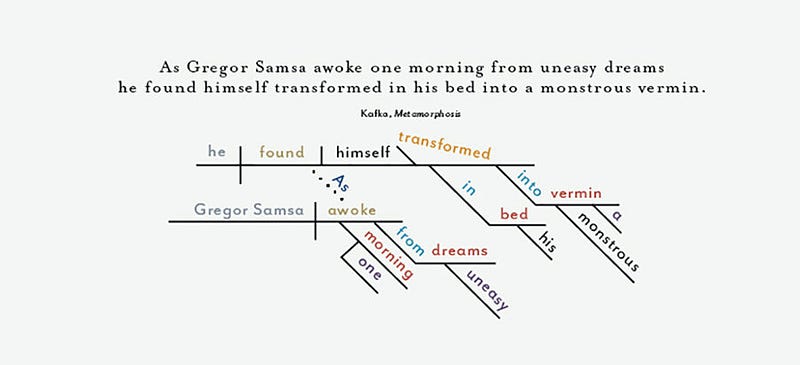
I did a cursory search of Medium to get an idea of what other writers might be saying about syntax (the order of words in a sentence that typically begins with a subject [noun] followed by a verb, then a direct object [typically a noun phrase or pronoun that receives the action]). What my search produced were mounds of articles on code writing and software engineering. It so happens that my wife is a software engineer, so I know developers bandy about that syntax subject quite often.
There was one non-coding result: Anna Rozwadowska’s prose poem “Syntax”, which admittedly was locked in a metaphor and did not provide any particular instruction about writing.
Given how little has been written about the structure or order of words in writing, I feel obligated to risk overstating its importance. Minding the quality of syntax helps a writer avoid monotony when moving from sentence to sentence; even possibly from phrase to phrase. See the “Dick and Jane” learn-to-read series as an exaggerated example of the rut a writer can easily fall into when composing.
Speaking of ruts, I am knee-deep in a re-write of a fiction piece I’ve titled “Sick and Bludgeoned.” As I have not ventured much further than a second or third draft, the text remains mired in the stilted language I resorted to just to get it on paper. The story opens on a passenger airliner in Mexico City, set in the early 1980s. Instead of spelling out the time the story is in, the narration refers to a magazine cover the protagonist Hector glances at in passing.
In the magazine pouch in front of Hector, a sports periodical cover headlined the recent death of a South Korean boxer who had fought Ray “Boom Boom” Mancini.
By rearranging the order of the sentence, I am giving the story a chance to lift itself above early draft status. Hopefully, the effort in reworking syntax breathes life into a story, phrase by phrase, sentence by sentence. So, the sentence in question now reads as follows:
A magazine stuck out of the pouch in front of Hector. The cover featured a South Korean boxer who died after facing Ray “Boom Boom” Mancini at a Las Vegas prizefight.
Rather than placing the magazine in a passive embrace of its pouch, it reads dynamically as an object that “stuck out of the pouch” — a detail that will resonate later on in the story. Also needing mention is how I broke up the tedium of one long sentence into two shorter sentences, a pair where the latter sentence elaborates upon the former.
Producing a text that imitates life or effects a realism that a reader can identify (with) strikes me as a worthy goal of writing. I think specifically of words strung together in such a way as to pave so smooth and unbroken surface that a reader overlooks the artifice of writing itself. I offer this aim, not as a target that I always hit, but a destination that distinguishes writing from mere words.
The language buffet
Word choice sounds like a no-brainer. Of course, a writer faces word choices every waking moment when composing a text. Why even discuss it?
Doubtless, you’ve heard the well-worn cliche that Eskimos have 50 words for the signified ‘snow’. I’ve always understood it as a gentle reprimand of American English speakers. Our crime? A crime of omission: a failure to use the full scope of the English language when communicating. It’s well within the realm of possibility that many writers in English are liable for the same offense. Hence, we talk about word choice.
There is any number of metaphors that can open the mind to word choice’s possibilities. Think of word choice as a painter’s palette from which a spectrum of colors can be mixed to produce the precise tone or shade of a painting. An individual word choice can wield that kind of impact on a text, topic, or character.
A music metaphor is applicable as well; word choice a key signature, whose change can alter the range of notes within which music performs. Changing key marks a shift in the mood or theme of a song.
With either the music or painting metaphor, the selection method forces a writer’s observance of how the word choice relates to the sentence, in particular, and the text as a whole.
The iceberg metaphor illustrates a given word at the tip of the triangle while all its synonyms, antonyms, and associated signifiers remain concealed beneath the surface of the water. A Google search quickly produces the lower icy mass of words from which a fitting piece can be selected.
Let your verbs sing
Typical advice about verbs only goes a short distance. “Avoid the passive voice,” is the dictum of choice. Verbs merit greater consideration than simply avoiding the to be formed. To do so, let’s take a step back and look at the (usage) clash of civilizations.
Modern languages tend to favor the subject over verbs. When diagramming a sentence, the subject typically gets first mention, followed by the verb. Perhaps René Descartes’s maxim “I think therefore I am” coined in 1644, reflected the transformation that would privilege the subject over the verb.
In biblical Hebrew, the verb comes first. A literal translation of the first line of the book of Genesis would read, “In the beginning, created God the heavens and the earth.” Prioritizing verbs means emphasizing action over being or identity. While there may not be many opportunities to place verbs before subjects without causing readers to cringe, the writer can opt to make verbs do the heavy lifting. This means selecting a verb with a very specific meaning; or, if the context allows, a verb that encourages a variety of connotations.
Now, back to the workshop effort on “Sick and Bludgeoned”….
Gonzalez’s comments revived Hector’s memory of the hellish, knock-down fights between his father and mother.
The verb revive suggests a memory that had been dormant or dead for years. Gonzalez had just offered Hector a crucial clue to the mystery behind his father’s battered and ill condition. If a child witnessed violent confrontations between parents, who could imagine that memory needs reviving? Think of it rather as a disturbing vision seared into the mind. So, I must swap out revived for a verb that better serves Hector’s experience and the overall force of the sentence.
Gonzalez’s comments stoked Hector’s memory of the hellish, knock-down fights between his father and mother.
Along with modern language’s reliance on the subject, it so follows that speakers and writers lean too heavily on adjectives for color or mood. When the occasions allow, a clever verb choice can accommodate the removal of an adjective from a sentence. Instead of writing
Harold turned pale at the thought of owing back taxes.
It could also read along the lines of
Harold blanched at the thought of owing back taxes.
Again, such opportunities do not abound, but a writer who wants to stand out should take advantage when possible.
So, syntax, word choice, and verb are by no means exhaustive measures that can distinguish one’s writing, however, I believe them to be impactful whenever I’ve found myself pushing a pen around a blank page.
As far as I am aware, very few writing tutorials offer these techniques in combination. Utilized together, they fashion a textual weave that is both striking and engaging. As a very short list of writers to-do’s, they remain ever-relevant guidelines in times that are fast-paced and populated with stunted attention-spans.


