
Thoughts on NFT Marketing (and Why It’s Easier for Generative and/or Larger Sets / Collections)
[2022 UPDATE: As noted in placed below, marketing NFT sets has changed a lot since 2021 when I wrote this article. I should probably do an entire 2022 guide to NFT marketing. That said, I’m leaving this article posted as it probably has a few decent ideas.]
If you’ve been following my writings on Non-Fungible Tokens (NFTs), and especially generative NFT programming, you’ll be familiar already with my fascination regarding the production side of NFTs. I feel like, at least as far as programmatically generating huge sets of NFTs goes, I have a fine handle on that.
But there’s so much more to the NFT game. I get asked all the time about aspects of it that I just do not know (well, at least yet). For example, as of this writing, I’m not experienced with coding smart contracts or, say, the OpenSea SDK end of things. DAOs is another giant area I really really need to dive into as soon as I can!
But today I want to talk about marketing because, just like anything, NFTs aren’t just a “build it and they will come” scene. Even for anyone who’s gone viral lately, there was surely at least some level of marketing that happened. Though, of course, some NFT makers get luckier than others. If the right influential person sees your NFTs and likes them for some reason, then you’ve got a much better chance of success.
As great as those stories are, though (and I love seeing them!), I feel like the necessity to do marketing is a reality for most NFT producers and teams.
After seeing what I’ve seen so far over the past few whirlwind months of NFT activity (which sounds like nothing but actually is a long time in the NFT world!), I personally believe that marketing sets of NFTs (whether they’re a hundred hand-drawn avatars or 10,000 programmatically generated unique Tuxedo Cat portraits) is a bit easier to do than marketing one-off art pieces.
Why?
For one, the one-offs are usually more $$$ (and deservedly so, as an artist might’ve spent countless hours creating it). But not a lot of casual buyers are willing to drop, say, 1 ETH on a piece no matter how cool it is (and that goes doubly if you’re not already known as a digital or traditional artist).
But if you’ve got, say, 10,000 random/unique avatars sitting there at a floor price of like 0.005 ETH, well it’s a much easier sale. And, while the cryptoverse surely has its whales, a lot of NFT enthusiasts right now are low-$$$ individuals just looking to get involved and maybe own some cool artwork — both for personal as well as speculative reasons.
Everyone hopes that whatever they buy will become more valuable later, but the average nifty-collector isn’t shopping for Beeples.
But we can talk about that stuff all day. I wanted to instead talk about this:
What I Do Daily to Market NFTs
I’ll be 100% transparent about this here. And to begin, please do NOT consider me an expert in this area. Instead, I’m just aiming to document my process here.
My NFTuxedoCats have generated about $435 in commerce since launch, and that includes a secondary-market sale that accounts for about half of that. So, clearly, I’m not saying that to impress anyone. As of today, I’ve got 0.05 ETH in my MetaMask wallet, so you could almost take what I’m about to say as anti-advice because I’m sitting here with just 17 owners for my NFTuxedoCats, and that inlcudes a handful of cats that I airdropped to collectors (which also cost me some ETH to do!).
That all said, here’s what I do:
First, I made a list of all social media sites that I felt were relevant for my marketing rounds, and bookmarked them. It looks like this:
[2022 UPDATE: Sorry, I have had to remove the list I previously had here because the landscape has changed so dramatically since first posting this article. In 2021, most NFT-related Facebook groups and subreddits allowed people to post marketing materials freely (announcing current and upcoming drops, etc.). However, as the popularity of NFTs rose dramatically since then, most groups have disallowed this ability for members, opting to charge people instead. I guess we can’t blame them, of course. But it’s now significantly tougher to cheaply, or freely, get the word out about NFT drops. Everyone wants their slice of the pie, lol. Even when posting an NFT drop on your own Instagram or Twitter, you’ll notice that you’ll get tons of replies with nothing more than an offer for you to promote it somewhere.]
The top ones are FB groups, which is a no-brainer, and is super easy. What I do first is to write up some sort of catch-all post in a notepad, like so:
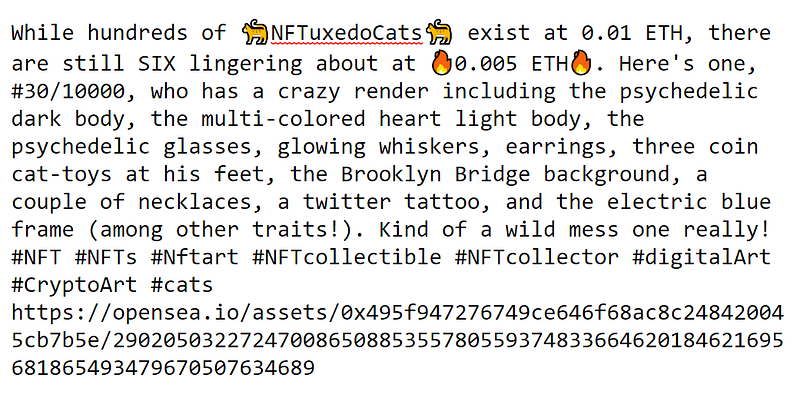
… and then I go down that list and post that updated basically in each one. Some require small edits, of course, and sometimes I change up the sample NFT. (This is another potential benefit to doing sets vs. one-offs — you have more to market and thus aren’t seen as plastering the exact same thing in 200 places.)
The Facebook ones are quick. I probably needn’t put the hashtags in those, as they’re all in groups, but the hashtags come in handy elsewhere, so it’s good to have them there, I think. (I don’t usually post on my personal FB profile, as I think I’d drive my personal FB friends nuts with daily cats. But, I do sometimes announce sales there, as most of my FB friends have barely heard of NFTs at all and see this as a complete novelty.) (What other FB groups am I missing?? I’d love to know!)
Next up are a couple of NFT promo sites — Dijaux and NFT Hunt — that I like to pop by and post on. Both of these places are currently free and allow you to post links to specific NFTs. It only takes a minute, and is easy. And, for some sites like these, you also get permanent profiles, another nice SEO detail for your marketing. (What other sites like these am I missing?? I’d love to know!)
After that, I go to Instagram, where the hashtags are definitely helpful. Insta seems fairly open to NFTs and, at least in my view, should be super-welcome there always. It’s too bad they don’t allow direct links (except in bios, which is stupid, but…). For my cats, I just grabbed a domain — NFTuxedoCats.com — and include it in my Insta descriptions. At least that’s easy and gets the domain in there (though not in a handy way in the post, but it’s in my bio link, too).
You don’t see Twitter on my list, as I use Firefox for that one, but I definitely go to Twitter just after Insta each day and post there. Again, another daily pain in the rear, as you have to edit it down to Twitter-size. But still worth doing definitely. I can 100% attribute NFT sales to tweets. (Always, always, always hashtag there!). (What other hashtags am I missing?? I’d love to know!)
I wanted to add here that, for my own NFTuxedoCats, I started a whole new Twitter account separate from my personal one, as I wanted that nice vanity URL: https://twitter.com/NFTuxedoCats. That, and I wanted to use an NFTuxedocat as my avatar, and also pop some into my banner, like so:
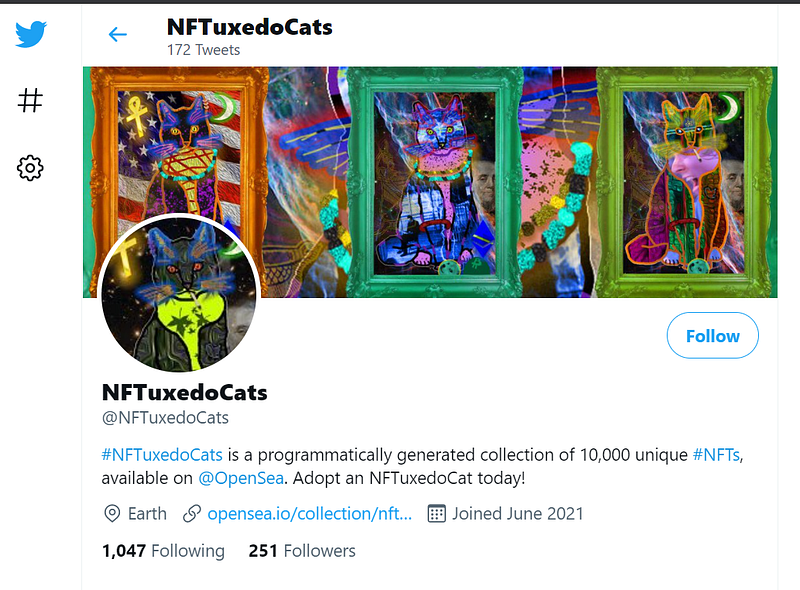
Note that I’m following 1,047 others, by the way. I think that following other NFT accounts is probably a great idea, so since launching this, I’ve routinely gone in and followed as many other NFT-specific Twitter accounts as possible. (Just search for NFTs in the Twitter search and follow everyone that comes up in the results.) If you have an account name that indicates that you’re into NFTs, and if you’re posting NFTs as well, there’s a decent chance they’ll follow you back. (Well, judging from my stats, above, there’s about a 25% chance, I suppose.) Not bad!
Many of these accounts are really into NFT promotion. You’ll routinely see tweets saying something like “Drop your NFTs here!” which means you can grab a URL from your collection and pepper it all over the place on those messages (and no one will mind at all!).
Again, so much of this is more relevant for generative set versus one-off artwork. With a 10k generative NFT set, you potentially have 10,000 different URLs to shill. If you chose one per day to post all over the place, that would take 27 years to get through posting all of your different URLs.
Discord is also good for fly-by posting. It’s probably better to engage a bit more, if you can. I feel like I don’t really know anyone there, but do try to comment as I can. One thing I love about Discord is that it saves whatever channel you’re on when you last post. So, I can pop by servers like VeeFriends and r/NFT (from Reddit) and OpenSea’s server, and just drop links into their self-promo groups. I’m not sure if anyone really looks there, but it’s a quick link-drop and worth a visit. Plus, you can pick up on other hot NFT news/happenings in those groups. (What other servers am I missing?? I’d love to know!) (I’ll talk more about Discord, below.)
LinkedIn. Yeah, I don’t think LinkedIn is of much use in the NFT space, but as I’m also into generative NFT coding, it’s not an awful place for me to network a bit. I kind of have a love-hate relationship with LinkedIn. But, as a web development pro, it’s just standard that I’ll have a profile there. And I guess my talking about NFT cats, even on a site like that, fits in somehow. So, I stop by sometimes and drop whatever observations I can about NFTs and crypto.
Last up is Reddit, which for almost anything else in the world, is an awful place to just shill products. But, being that NFTs are crypto-tech developments, plenty of groups welcome that sort of thing. But, Reddit’s system itself doesn’t tend to like if you just go sub to sub dropping links. You’ll almost always get a “hey slow down” kind of warning, which can cramp your style if you’re just trying to make a thorough marketing round in one sitting. (What other subs am I missing?? I’d love to know!)
For all of the above, time-permitting, it’s also a great idea to engage people. Not just for the sake of making sales or whatever, but to actually be involved in the space. I mean, sure I’d love to make more sales, but it’s also cool to just get comments from strangers like, “Hey dude, cool NFT!” So, you should give those comments out, too. If you like something, tell the artist!
I’ve experimented with a few other places, with unsure results. Telegram, for example, strikes me as a giant mess. I really don’t understand that whole platform, but I guess others love it. I’ve dropped a few links there, but maybe I just don’t fully understand what makes Telegram so popular. (Care to explain Telegram marketing? I’d love to know!)
Anyway, the above is what I’ve been doing thus far on a daily basis. I try to just mint another 100–200 cats per day from my collection (using my automation method), and then do a round of marketing before getting to my actual job.
But what about other marketing?
Back to Discord (and/or other Group Sites)
I mentioned Discord, above, of course, as a place to drop links. But, based on my observations of other NFT projects, it seems that starting a Discord server is also fairly routine in terms of marketing NFT projects. It’s not something I’ve yet put a ton of effort into for my NFTuxedocats, but I at least started one as a home for all things NFTuxedoCats in the future. (If you want to join it, though there’s nothing much going on there yet, it’s here.)
Discord provides the community aspect, as it allows a well-organized (via channels) area to discuss various components of your NFT project. After all, it’s nice to have a place where collectors can gather and perhaps chat with the NFT team about things — asking about rarities, requesting things, showing off their own, discussing things, etc.
Again, I think this pertains more to generative projects than it does to one-off solo NFT artworks by an artist (though, I imagine an artist could also certainly have his/her own Discord server — but it would be all about the artist instead of an NFT type, which is a distinction). I think if you were a famous artist, then this would make more sense and work better.
Similar to this concept, an NFT team could of course utilize some other group-type site, such as a Facebook group. I think most teams I’ve seen gravitate to Discord, though, because it’s more organized (via channels) than Facebook, and also because it’s more modern and tech-friendly than Facebook. NFTs are techy things, after all. Facebook is perhaps a bit too old-school.
Custom Web Sites
Finally, some NFT teams also have custom web sites. Sometimes it’s just a flashy front-end for whatever platform they’re on. Other times they’re more fully integrated, offering things like mint-on-demand, requiring a wallet sign-in right there on the site. I may publish some further ideas about mint-on-demand soon. For now, I just wanted to mention that custom web sites that go along with NFT collections are certainly a thing, and that they range in complexity from super-simple to almost entire platforms. (Indeed, many of the larger projects include “roadmaps” describing what’s to come.)
For NFTuxedoCats, I might put up a site in the future, once I’m done minting. It’d be a nice place for my stats and so forth. For now, the domain name NFTuxedoCats.com just auto-forwards to my OpenSea collection page.
Advertising and Other Pay Sites
I mentioned a few NFT showcase sites, above. But there are tons more — some free, others pay-to-play. I’d love to gather a listing to put here of some of the major ones, along with some sample pricing, just so people have a starting point if they’re considering paid exposure.
One site I came across for this is https://rarity.tools/, which seems to be a great site for posting your generative sets, along with an interface for filtering traits and whatnot. It costs “only 2 ETH” to list your set there. (Might be cheap for some, but that’s just about “only 2 ETH” more than I have to market my NFTuxedoCats, so it’s a no-go for yours truly at the moment.)
Other Marketing Topics for NFTs
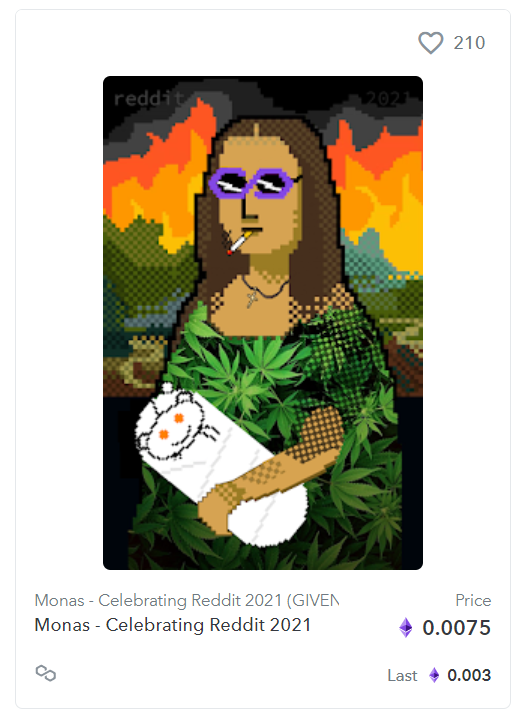
Giveaways. Giveaways are an excellent way to build awareness quickly because most people interested in NFTs would love a free NFT. The giveaway model I’ve seen most is usually a free promotional NFT (not necessarily a 1-of-1 from your 10k set, but a 1-of-many promo one). Typically, the giver would pay gas as well (if you want the best results). To qualify for the freebie, the giver would require some sort of action — usually a combination of (1) joining the collection’s Discord, (2) sharing or retweeing the promo and/or the collection URL, and/or (3) tagging or inviting friends. Usually there are other requirements as well (such as one per person, only for users on a certain platform, takers must also already hold an NFT, etc.) On the plus side, this seems to work fairly well. On the money side, note that this is far from free. If gas fees are, say $3 per NFT, and you get 200 takers, well you’re going to spend $600 on this. So, it’s not a cheap thing (well, unless gas fees are particularly low at the time of your giveaway). (I’ve heard of others doing giveaways by pricing existing NFTs at $0, and thus the buyer would pay the gas. But, I don’t know how successful that tactic has been.) (NOTE: Of course, fees could vary here depending on what blockchain you’re on.)
Airdrops. Speaking of giveaways, another form of this is the airdrop — where you basically just drop NFTs into others’ wallets. I’m frankly not sure if this works as a marketing initiative, but it’s kind of interesting. The weird thing about airdrops is that if you drop an NFT into someone’s account, others can see it. And this seems strange — though, I suppose, it’s not like a ton of people will go looking at others’ accounts. But, I can see the allure of doing this — dropping one of your NFTs into an influencer’s account in hopes of (1) that influencer noticing it and perhaps mentioning it, or (2) others looking into that influencer’s account, seeing your NFT, and buying one of yours — either because they like it or because they think the influencer bought one. (Confusing, right?) Of course, the tricky part is figuring out who the influencers are, and where to send your airdrop. Frankly, I’m up in the air about this as a tactic. Seems kind of long-shot-ish to me. But, I’d love to hear others’ experience here. Maybe I’m missing something.
I did try it, btw. I sent about 10 NFTuxedoCats out to prople with fairly high-profile collections. I’d made a few NFTuxedoCat sales early on and had some ETH to blow on gas, so I tried it. Didn’t really hear anything back. One person immediately listed it for sale at like 4x the price, which I thought was pretty neat. (Flippers are out there and actually I think can help your cause marketing-wise.).
Update: What Social Media Numbers / Stats Do I Like to See that May Indicate a Sell-Out Drop?
Sorry for all of the updates on my NFT articles. This world changes so fast, and I learn so much so fast, that time slows down considerably for me. A day is now a week, a week is now a month, and a month is a year! I keep absorbing so very much about this field; it’s incredible. So, I wanted to add a note about successful metrics, at leat in my opinion.
Basically, I see THREE main potential components that can lead to a successful NFT generative drop. This is all IMHO, of course. But, they are:
- Discord membership and engagement. Membership alone is good, but engagement I think is truly key. You have to keep in mind that with today’s lightning-fast marketing possibilities, a group can build up many thousands of members in almost an instant. So, we can’t just fly-by an NFT Discord server, see that it has 4,000 members, and assume that it’s going to sell out. But then again, a number around there or even higher (typically I see up to around 10k) is a super great sign. (It’s not a gaurantee, though.) That said, what I like to see in Discord is a lot of community interactivity, and ideally also a lot of participation by moderators as well. You can get a true sense of the hype level by reading these conversations, and of course through patricipating in them yourself.
- Twitter. Same points as above. The main difference is that it’s usually less many-to-many interaction within the community here and more of a one-to-many announcement-type situation. Again, I like to see a minimum of 3,000–5,000 Twitter followers (more is always better). Twitter is a great place to drive Discord numbers, which drives community excitement and involvement.
- Instagram. This is basically equivalent to Twitter, only I personally find it frustrating that you can’t post links there. So, the whole “link in bio” thing is about all anyone can do. I suspect Insta is somewhat less effective for hyping NFTs, but will readily admit that everyone seems to be using it, and I’ve also seen some well-performing drops from groups that had high Instas, but low Twitter/Discords. So ... what do I know? lol.
In the end, getting those numbers can happen organically (if people love your art, your roadmap, etc.), or they can be bought, I suspect. Or some whale could swim by and give you a nod of approval, and that may also be all it takes. I suspect there’s a mix of talent, strategy, and luck, to all drops.


