
Thorium Energy Will Change the World
And it’s already begun
There is literally nothing in our world, whether natural or man-made, that came into existence without energy. It keeps the earth warm. It grows and cooks our food. It keeps us warm. It moves us around. Everything we buy and consume comes to us with energy.
At first, we used human energy to get things done. When our own energy wasn’t enough, we domesticated animals to do more. And when that wasn’t enough, we enslaved people to do more. As terrible and barbaric as slavery was (and is), it was used all over the world because we needed more energy to improve our condition. This was bioenergy.
Then we started to make carbon our slave.
This, in part, was responsible for banishing slavery in developing countries. We burned wood, then coal, then oil to improve the world around us and it truly worked wonders because we got so much more energy from carbon than we did from bioenergy. For those who harnessed carbon energy and machines together, life expectancy increased and the human condition improved immensely.
But as our populations grew, carbon fuels started to make our world dirty. And just when we were starting to do something about it, a new type of energy came along. Nuclear energy didn’t burn carbon, which was good, but it had other problems, big problems.
Today, our populations are growing so much that we simply have a hard time producing enough energy to keep up with demand. At the same time, some of us are trying not to destroy the planet. If we’re going to be concerned about improving our lives while protecting the big blue marble we call home, there is no issue more important than energy.
In this first paper on the subject, I am going to introduce a new energy source that most of you have never heard of. It will probably seem unbelievable, too good to be true, but it IS TRUE and truly amazing.
The proof of concept has already been established and there are now a dozen or more countries and companies who are now investing in this new energy source. Soon, we will be making great strides toward a new age where energy will be plentiful, safe, clean, consistent and affordable for everyone.
This new energy is going to come from Thorium and it has the potential to change our world on the same level that the internal combustion engine or the Internet changed our world.
It’s time to learn something about it.

So, what is Thorium?
Thorium is a natural element, number 90 on the Periodic Table of Elements, two doors down from uranium.
Back in the 1960s, the National Laboratories in Oak Ridge, Tennessee were developing not one, but two, systems of electric power generated from nuclear energy. The first system used uranium which became the catalyst for developing the Uranium Light Water Reactor (LWR). All of the nuclear power facilities in the world today (currently 450) are variations of the LWR, which is now 60-year-old technology.
Later in that decade we also developed a second nuclear power system based on Thorium. This was not the same system using a different nuclear fuel, it was a completely different system and the best performing design was called the Thorium Molten Salt Reactor (MSR). This experimental Thorium reactor was operational for 4 years and it ran at full power for over 8 months. So, this is not some high minded theory or science fiction promise.
The proof of concept has already been done and it’s time we put serious money, time, and R & D into scaling up this technology into a commercially viable system. Frankly, our world depends on it.
There are many fascinating details and differences between the Uranium LWR and the Thorium MSR, and most of them favor the thorium system, but first, it’s important to speak to people’s fears about nuclear energy. So let’s talk about the Thorium benefits regarding meltdowns, radioactive waste, and safety. I think you’ll be amazed.
At it’s core, these two Reactor Designs are completely different.
Uranium LWRs utilize solid uranium fuel rods and liquid water as a coolant.
Thorium MSRs suspend the thorium fuel in a hot liquid (or molten) salt and use solid graphite as a moderator to control the fission reactions.
Thorium MSRs can’t meltdown.
The possibility of a nuclear meltdown is still the main concern and objection for most people when it comes to nuclear energy. In the LWR, the cooling water prevents the uranium fuel from meltdown, but as we’ve seen at Chernobyl and Fukushima, terrible things can still happen. In both cases, different circumstances caused the reactor to lose water, causing the solid fuel to overheat and basically melt the surroundings, causing explosions and releasing radioactive elements into the air. These events were catastrophic failures that crippled the nuclear industry for years.
But what if nuclear meltdowns were not even possible?
Due to the physics of Thorium fission and decay, and because the thorium is dispersed in a large volume of liquid salt, it is chemically impossible for Thorium MSRs to meltdown or contaminate the environment.
Even in catastrophic situations, like say, complete loss of power to the reactor controls, the radioactive material remains suspended in the liquid salt. In the case of a power outage, the liquid salt immediately starts cooling down (instead of heating up like it does in uranium reactors) and eventually turns into a solid as it continues to cool. All of the radioactive elements are still held in the solid salt. It’s a beautiful system built on the properties of a very different kind of nuclear material, that is, Thorium. (More technical papers will be coming to explain this, but for now, just accept that thorium behaves very differently than uranium.)
Thorium reactors produce very little radioactive waste.
This is going to be a surprise to most of you, but Uranium LWRs only consume about 5% of the solid uranium fuel before it becomes nearly useless due to daughter byproducts and neutron-eating xenon and other complicated reasons. Therefore, 95% of the fuel rods become radioactive waste. Yes, I know, it’s terribly inefficient and wasteful, but it’s true.
Thorium, on the other hand, burns very efficiently with complete opposite results. According to the studies done at the National Labs, MSRs burned 95% of the thorium fuel, leaving only 5% waste.
Furthermore, once the thorium reactor gets going, it can actually burn the radioactive waste we already have in storage. Wouldn’t that be nice, to actually reduce our radioactive waste while getting energy from it? Is this starting to make sense?
There is No Pressure Problem.
The main reason a uranium reactor is dangerous is because it uses water as a coolant. This is a terrible design because water evaporates at 100 degrees Celsius. In order to keep the water in liquid form, the entire reactor has to be pressurized up to 160 atmospheres. That kind of pressure is so extreme that even the pipes that move the water around need walls that are 4 inches thick to contain the pressure. The slightest microscopic seam leak can lead to meltdown disaster.
But Thorium MSRs operate at one atmosphere pressure, basically, under no pressure. This is possible because there’s no water in the reactor and the molten salt is already about 300 degrees Celsius and stays liquid up to about 1,200 degrees Celsius. This temperature range is perfect for transferring the heat energy to a Heat Exchanger for electricity production. Here’s a cartoon diagram that I made to visualize the principles of how it works:
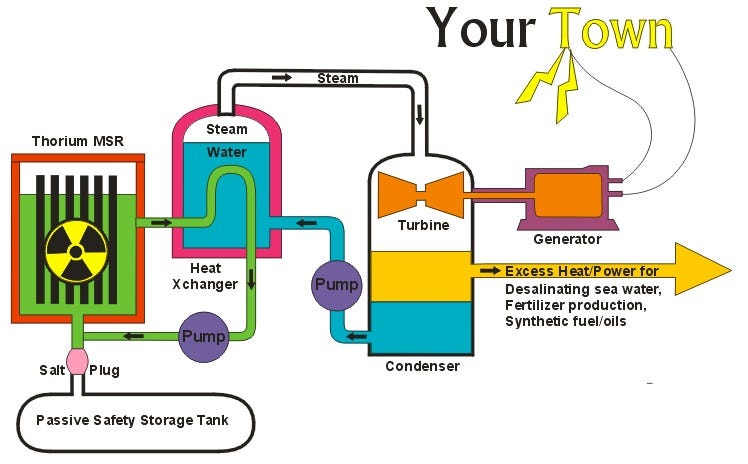
Notice, there IS water in the Heat Exchanger that turns to steam and later spins a turbine generator to produce electricity, but the water never mixes with the green liquid salt. Only the heat is exchanged. The water stays in the Heat Exchanger while the nuclear material stays in the MSR.
Active vs Passive Safety
We’ve all seen the movies that depict a sterile nuclear control room. Hundreds of dials and digital displays are on the wall. A small team of controllers sit or stand at their post moving dials and pushing buttons. This is not far from the truth. In a uranium reactor, there must always be several people monitoring the reactor to make sure that pressures and temperatures and radiation levels stay within safe limits. This is what we call Active Safety, because if things turn wrong, they must actively make adjustments to fix the problem.
This also adds another level of complication to the system because in this system, safety is dependent on humans making right choices. What if someone pushes the wrong button when they sneeze, or they get a little sleepy, or get distracted by a funny story, or a hundred other things. Humans have been known to make errors, and some errors lead to disaster.
On the other hand, we have the thorium system based on a liquid fuel. We’ve already talked about the impossibility of meltdown and the fact there is no pressure problem. Plus, there is another fool-proof Passive Safety mechanism.
Underneath the reactor vessel, where the thorium liquid fuel is, there is a drain with a salt plug. (See the diagram above.) Remember that the liquid salt is 300+ degrees Celsius, so it could melt the salt plug. But the salt plug is kept cool by fans or refrigerant coils.
Suddenly, something happens; the power goes out. The fans and cooling coils loose power. At this point fission has already stopped in the reactor, but the latent heat begins to melt the salt plug. As the plug melts, the radioactive liquid flows down into a huge drain tank in the ground. All of the radioactive material is still contained in the liquid salt as it continues to cool. This Passive Safety system always works because gravity is always on. Ingenious, right?
When testing the first thorium reactor back at Oak Ridge, it was noted in the log books that the scientists and lab techs would often go to lunch, leaving the nuclear reactor completely unattended. It was considered that safe.
There is so much more.
There are many more benefits about Thorium MSRs, including smaller footprints, lower costs, energy density, cancer-fighting byproducts, environment issues, and more. But this is enough for now. The purpose of this first article is to address the fears that some people have about nuclear energy.
I hope your fears have been calmed and perhaps you have gained a new curiosity for the possibility of a bright future in energy production. Our energy demands continue to increase and we need another solution to keep up.
Thorium Molten Salt Reactors are the solution.
We had a working thorium reactor over 50 years ago, which proved its viability, and it’s very different than the dangerous nuclear systems we have now. It can’t meltdown. There is very little radioactive waste. And it is much safer than current nuclear reactors.
How’s that for the tip of the iceberg? Imagine the world when energy will be abundant, safe, clean, consistent and affordable. That’s why it’s going to change the world. Help me spread the good news.
If this still seems unbelievable to you, search “Thorium TedTalks” on YouTube for confirmation.
The book, Super Fuel, by Richard Martin, is also an excellent source that details how Thorium MSRs were rediscovered after 40 years of dormancy.
Questions and knowledgeable input are welcome.