
9 More Benefits of Thorium Energy
The energy revolution is coming and it’s all blue sky
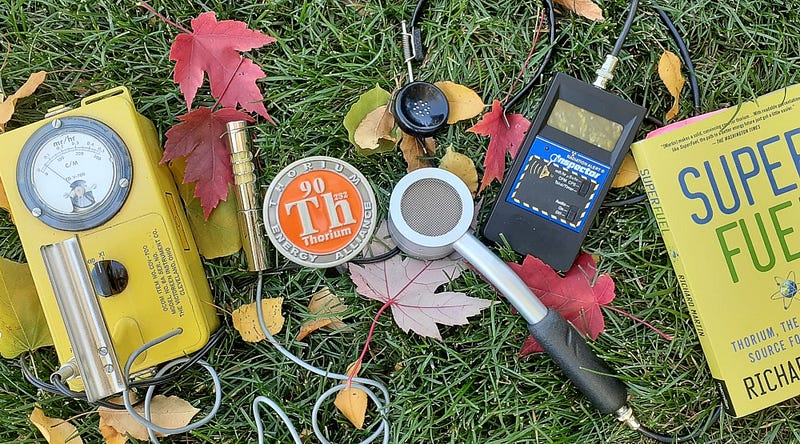
We are teetering on the edge of an energy revolution. It’s been helped along by advances in wind and solar, but we’ve also been shutting down coal and nuclear plants, so there has been little net gain in energy production. But the energy revolution I’m talking about is going to come from something very different — the abundant, clean, safe, consistent and affordable energy that comes from Thorium Molten Salt Reactors (MSR).
In my first article on this topic I introduced readers to what Thorium is and how it’s very different from the Uranium reactors we now have. Then I addressed the fears that people have concerning meltdowns, radioactive waste, and safety. With Thorium, meltdowns are physically impossible, radioactive waste is minimal, plus, it can burn the radioactive waste we already have. And there are other safety features that make it impossible to ever have another accident like Fukushima again — ever.
Now I’m going to talk about the other benefits of Thorium Molten Salt Reactors.
As I go through these, be thinking about how our world is going to be different when this technology ramps up, because it’s coming. Though this technology was designed and tested at the National Labs in Oak Ridge, Tennessee in the 1960's, those experiments, data, and reports were made public in the 2000's. So now, half a dozen countries are vying for the lead spot in this important race.
Whoever scales up to commercial production first will put a fire under everyone else to spread the benefits worldwide, just like Sputnik put a fire under America in the space race . The more that we learn about these benefits now, then the more we can pressure our governments and private sectors to invest in this coming energy revolution.
So buckle up as we delve a little deeper into the future of energy.

Benefit #1 — Thorium is Plentiful
I don’t mean plentiful like silica or carbon, but it is 3 to 4 times more plentiful than uranium. And only a small percentage of uranium is the type that is fissionable, so there is actually much more energy in thorium. Some scientists estimate we can get energy from thorium for several thousand years, others say forever. Either way, by that time, we will probably have nuclear fusion figured out. So we’re all good.
Thorium is also dispersed fairly evenly around the globe. Some countries do have higher concentrations, like Norway and India, but generally most every country has its own stores of thorium in the ground.
The big advantage to this is that no one country (or few countries like OPEC) can hold a monopoly on the world’s energy. World politics will be so much more amicable when many countries don’t have to beg or buy energy from the few who have it, which is pretty much the way it is now.
The last point on this benefit is we already get plenty of thorium from other mining industries. There is no need to scar the land with new mines.
The problem right now is that federal regulations, created by the current nuclear industry, classify thorium as a radioactive element, which it is, so the rules say we have to put it back in the ground. It’s foolish that we’re not storing it for future use, but it’s just one example of many that demonstrate the legal and legislative battles we have in America. In other countries, this isn’t a big problem and that’s one reason why they’re moving ahead.
Benefit #2 — Radioactive Waste from Thorium is short-lived.
Thorium MSRs don’t produce very much radioactive waste to begin with (see the first paper), but even the waste it does produce doesn’t last very long. Traditional uranium reactors produce radioactive waste that lasts over 10,000 years, which is a hell of long time to store anything, but even more so when it’s dangerous to the environment.
Thorium reactors, while not perfect, produce waste that only lasts around 300 years. This is because thorium decays into radioactive isotopes that have much shorter half-lives. Eventually, all these isotopes decay into something inert, like lead (Pb-206), which is not radioactive at all.
Benefit #3 — Thorium reactors have a much smaller footprint.
Currently in Burke County, Georgia there are two nuclear reactors under construction at the Vogtle (silent ‘t’) Power Plant. Construction started in the Fall of 2009 and as of September 2020 they are 87% finished. These are the only new nuclear reactors being built in America and it has been 30 years since the last nuclear plant was built. Each of the 2 reactors are expected to produce 1,200 megawatts of power, enough to power 300,000 homes each. All that is interesting, but I want to focus on the size of this behemoth. Take a look at this picture from June 2018….
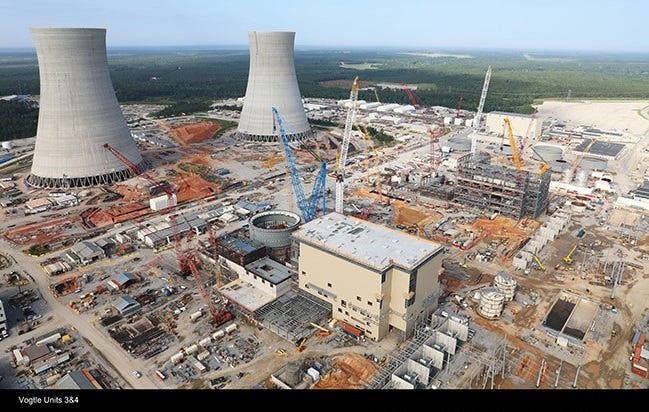
The two large buildings under construction are the containment structures where the reactors are located. The reactors themselves only take up a small area in that building, so why is the building so big? Because if there is an accident the large building is designed to contain any possible explosion (due to the high pressures in the reactor) and/or release of radioactive steam. When water at 600 degree Celsius (1,100 degree F) is suddenly released, it immediately flashes to steam, increasing the volume by 1,000 times. So the building must be very big.
Look at the size of those cooling towers at the back end of the 1,600 acre property. Those are designed to cool down the steam that was used to generate the electricity.
The reason many nuclear power plants have two reactors or more is because some of the uranium fuel rods have to be replaced every 18 months or so. To do this regular maintenance, the reactor has to be shut down, which leaves the other reactor to still generate consistent power.
Much of the big footprint is due to the large output of the power plant, at 2,400 MWs for both reactors. This requires more resources, material, space and employees than most power facilities by a long shot.
Thorium MSRs, in contrast, don’t need any of this. Current designs for Thorium MSRs have a footprint about the size of a football field or a barge. This is possible because there is no need for large containment buildings, cooling towers, and multiple generators.
Most MSR designs would generate less than 100 MW of power, so the long range plan is to rethink our power grid altogether. Instead of building behemoths like the Vogtle Plant and connecting it to a large power grid, the idea is to connect each town to its own power source with a Thorium MSR. This would greatly reduce power loss due to long transmission lines and protect against power grid failures.
Benefit #4 — Thorium reactors can be modular.
Some companies are working on designs for even smaller modular systems about the size of a school bus. If these small designs are successful, it will be easy to produce the MSRs in a factory and then deliver power plants across the globe on a flatbed truck. Talk about being efficient.
Benefit #5 — Everything about Thorium reactors costs less.
As you can imagine, if Thorium is more plentiful and can be harvested from current mining projects, then in terms of economics we’re starting out on the right foot.
When we see that a modern uranium reactor costs about 12 billion dollars, while most Thorium designs will cost less than one billion, we should start to think this is probably a good idea.
Since MSRs have a much smaller footprint and are more efficient, they will need less maintenance and fewer employees.
The cost of the fuel itself is about 80% less for thorium than uranium. Thorium is winning on every economic point.
When we’re done with all the comparisons, Thorium reactors cost about 1–2 cents per kW hour verses 7 cents per kWh for Uranium reactors. Energy from Thorium will even cost less than coal, which, according to the US Energy Information Administration averages about 2.5 cents per kWh.
All of these saving will translate to lower energy costs for consumers. And not only that, but in many industries, next to labor, energy costs are the most expensive line item. That can also translate to lower costs for many goods and services.
Benefit #6 — Thorium reactors do not have to be built next to water.
Another down side to using water as a coolant in uranium reactors is that they need to be built next to large bodies of water. Not only is the reactor continually supplied with new water, but if there’s an accident, then the reactor will probably need LOTS of water to prevent meltdown. That’s why all nuclear reactors are built next to oceans or large lakes and rivers. (If you look at the Vogtle Power Plant picture above you’ll see the Atlantic Ocean on the horizon.) In America, there are 20 States with no nuclear power simply because they don’t have the water resources.
With Thorium reactors, since water is not used as a coolant and the reactor can’t meltdown, we can supply energy to every town across the Midwest and Mountain States without that limitation.
Benefit #7 — Thorium MSRs are environmentally friendly.
This is understood if we just connect the dots, but I’ll say it anyway. Thorium is an energy source that would not require new mining activity. It has a much smaller footprint so it uses far fewer resources to build. There’s no danger of meltdown or exploding radiation into the air. And it’s carbon zero. What energy source is more environmentally friendly than that? There simply isn’t one. Even wind and solar is scarring land in China to mine the rare earth elements needed for the wind turbines and solar cells. So thorium wins again.
Benefit #8 — Thorium reactors produce medical isotopes for cancer therapies.
Fission bi-products of thorium can be used for medical diagnosis and treatments. If you’ve ever known someone who was in a cancer battle and they needed a $6,000 shot for the fight, that shot was likely a radioactive isotope like molybdenum-99 or bismuth-213. These two isotopes (and others) are produced in the normal operation of an MSR when the thorium splits into daughter isotopes. Many of these isotopes can even be separated from the MSR during operation.
These specialized cancer treatments are so expensive because the radioactive isotopes are rare and only produced with great difficulty. Thorium reactors can easily supply some of these much needed isotopes that will help thousands of people every year at a much lower cost.
Benefit #9 — Reduces the threat of nuclear war.
Last but not least, unlike the Cold War era when possible nuclear annihilation was in the news, Thorium can make no contribution to the nuclear arsenal. This in fact, in the 1960’s, was the main reason why we went down the uranium road instead of the thorium road. It was shown in the experiments at Oak Ridge that only uranium could provide the plutonium needed for nuclear weapons. So the results from the thorium experiments were put on the shelf.
Now that the Cold War has passed, there is less need to build up huge arsenals of nuclear weapons. This opens the door for thorium to provide the energy we need.
Given all these benefits, you can see why there is a growing interest in Thorium Molten Salt Reactors, but the general public is still unaware. That is why I’m writing these papers and I thank Illumination-Curated for publishing them to a larger audience.
In the future I will be crunching some numbers, getting a little more technical, sharing how this technology got lost, introducing the companies that are paving the way, and I hope to provide updates from our annual meetings from the Thorium Energy Alliance.
In the meantime, if this is interesting to you, because after all, why wouldn’t saving the world be interesting, I have created a one-page summary comparison sheet between traditional uranium reactors and new thorium reactors. Feel free to print and share it with others….