avatarDark Energy Articles

Free AI web copilot to create summaries, insights and extended knowledge, download it at here

2110

Abstract

of which matter is composed.</p><p id="3695">Since then, the Large Hadron Collider has been shut down twice. The first time the device was improved between 2013 and 2015. The second time, from 2018 to April 2022. In both cases, in addition to maintenance work, <b>the collider was upgraded so that the proton beams let loose inside could be given even higher energies.</b></p><p id="63bc">The higher the energies, the greater the chance to record rare particles and make scientific breakthroughs. Researchers hope to unravel some of the biggest mysteries of modern physics — <b>the secret of dark matter and dark energy</b> — with the help of the LHC.</p><figure id="6287"><img src="https://cdn-images-1.readmedium.com/v2/resize:fit:800/1*s3Bixz_bTmRaDeAe3G_KRg.jpeg"><figcaption>[Photo: SimonWaldherr, <a href="https://creativecommons.org/licenses/by-sa/4.0">CC BY-SA 4.0</a>, via <a href="https://commons.wikimedia.org/wiki/File:CERN_LHC_CMS_08.jpg">Wikimedia Commons</a>]</figcaption></figure><h1 id="6312">Record energy at the LHC</h1><p id="8e6f">Beams of protons have been circulating at the LHC for two months. However, it is only tomorrow that they will be accelerated so that they will reach a record energy. This time it will be 13.6 TeV (trillions of electron volts). When the Large Hadron Collider took off, it could give the proton beams an energy of 1.18 TeV.</p><p id="bbe8">The qualitative leap made possible by the latest upgrade includes a reduction in the beam’s diameter. Now scientists have managed to narrow it down to just 10 microns (or millionths of a meter). A human hair has a diameter of about 70 microns.</p><p id="8fe4">The narrower the beam, the greater the chance that the protons forming it will collide. The researchers hope that the ATLAS and CMS detectors will record 1.6 billion collisions per second. That’s twenty times more than in the days when collisions inside the LHC led from the discovery of the Higgs boson.</p><figure id="efec"><img src="https://cdn-images-1.readmedium.com/v2/resize:fit:800/1*oDqgDnU9G1LWL2AcY_bwBQ.jpeg"><figcaption>[Photo: Maximilien Brice (C

Options

ERN), <a href="https://creativecommons.org/licenses/by-sa/3.0">CC BY-SA 3.0</a>, via <a href="https://commons.wikimedia.org/wiki/File:Views_of_the_LHC_tunnel_sector_3-4,_tirage_2.jpg">Wikimedia Commons</a>]</figcaption></figure><h1 id="c857">What will the Large Hadron Collider study?</h1><p id="99db">With new capabilities at their disposal, scientists want to take another look at the Higgs boson. This is because it still raises many questions.</p><blockquote id="6260"><p>“For example, is it really an elementary particle, or does it have some components after all?” — said Joachim Mnich of CERN at a conference announcing a new series of experiments starting tomorrow.</p></blockquote><p id="2f4f">This time, <b>the LHC will operate continuously until 2026</b>. In the further future, meanwhile, scientists pan to build an even larger particle accelerator.<b> The Future Circular Collider is to be 100 km long and reach energies of 100 TeV.</b></p><p id="7ea9"><i>Source: <a href="https://home.cern/news/news/physics/lhc-run-3-physics-record-energy-starts-tomorrow">CERN</a></i></p><div id="dfd2" class="link-block"> <a href="https://readmedium.com/the-capstone-mission-has-launched-and-will-explore-the-orbit-of-the-future-gateway-lunar-station-37e9342254b2"> <div> <div> <h2>The Capstone mission has launched and will explore the orbit of the future Gateway lunar station!</h2> <div><h3>A small satellite with a size of only 34 x 61 cm. A small Electron rocket, only 17 meters high. Low cost, at only $30…</h3></div> <div><p>medium.com</p></div> </div> <div> <div style="background-image: url(https://miro.readmedium.com/v2/resize:fit:320/1*E8QKy73GzXirPZmt4tDr2w.jpeg)"></div> </div> </div> </a> </div><p id="0061"><b>Cool that you made it to the end of this article. I will be very pleased if you appreciate the effort of creating it and leave some claps here, or maybe even start following me. Thank you!</b></p></article></body>

This week the Large Hadron Collider (LHC) will break its own record for collision energy — what new things might it discover?

Two months after its launch, the Large Hadron Collider (LHC) will set a new record. As early as tomorrow, the world’s largest particle accelerator will unleash protons so that they will collide at previously unattainable energies.
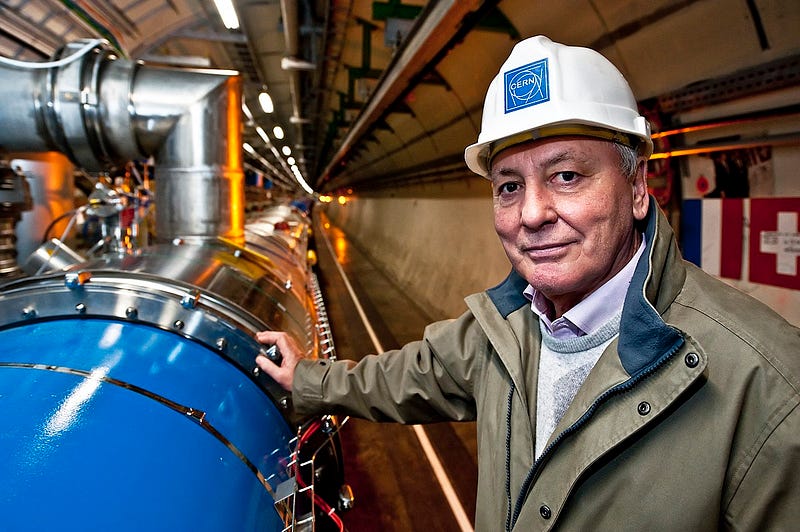
[Photo: CERN, CC BY-SA 4.0, via Wikimedia Commons]

“A new season has begun for physics”, CERN authorities declared last week.

CERN, or the European Center for Nuclear Research near Geneva, is home to the world’s largest particle accelerator, the Large Hadron Collider.

The Large Hadron Collider (LHC) is a giant device housed in a 27-kilometer-long ring dug into the ground. The machine produces beams of protons that are let loose in opposite directions. When the protons reach speeds close to the speed of light and gigantic energies, they are collided with each other.

The collisions produce many other elementary particles. Their appearance is recorded by seven detectors placed at different locations in the tunnel. Scientists analyze the records of the collisions. In this way, they can study the smallest particles that make up the macroscopic world as we know it.

Large Hadron Collider takes off for the third time

The Large Hadron Collider was launched in 2008. Four years later, on July 4, 2012, scientists announced the biggest discovery yet made with its help. It was the confirmation of the existence of the Higgs boson — until then a purely hypothetical particle. The Higgs boson is an important component of the Standard Model, an atlas of the elementary particles of which matter is composed.

Since then, the Large Hadron Collider has been shut down twice. The first time the device was improved between 2013 and 2015. The second time, from 2018 to April 2022. In both cases, in addition to maintenance work, the collider was upgraded so that the proton beams let loose inside could be given even higher energies.

The higher the energies, the greater the chance to record rare particles and make scientific breakthroughs. Researchers hope to unravel some of the biggest mysteries of modern physics — the secret of dark matter and dark energy — with the help of the LHC.
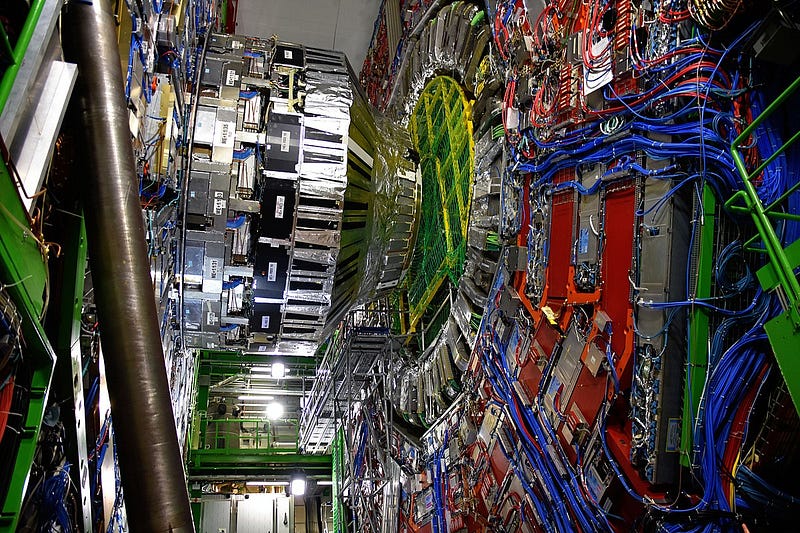
[Photo: SimonWaldherr, CC BY-SA 4.0, via Wikimedia Commons]

Record energy at the LHC

Beams of protons have been circulating at the LHC for two months. However, it is only tomorrow that they will be accelerated so that they will reach a record energy. This time it will be 13.6 TeV (trillions of electron volts). When the Large Hadron Collider took off, it could give the proton beams an energy of 1.18 TeV.

The qualitative leap made possible by the latest upgrade includes a reduction in the beam’s diameter. Now scientists have managed to narrow it down to just 10 microns (or millionths of a meter). A human hair has a diameter of about 70 microns.

The narrower the beam, the greater the chance that the protons forming it will collide. The researchers hope that the ATLAS and CMS detectors will record 1.6 billion collisions per second. That’s twenty times more than in the days when collisions inside the LHC led from the discovery of the Higgs boson.
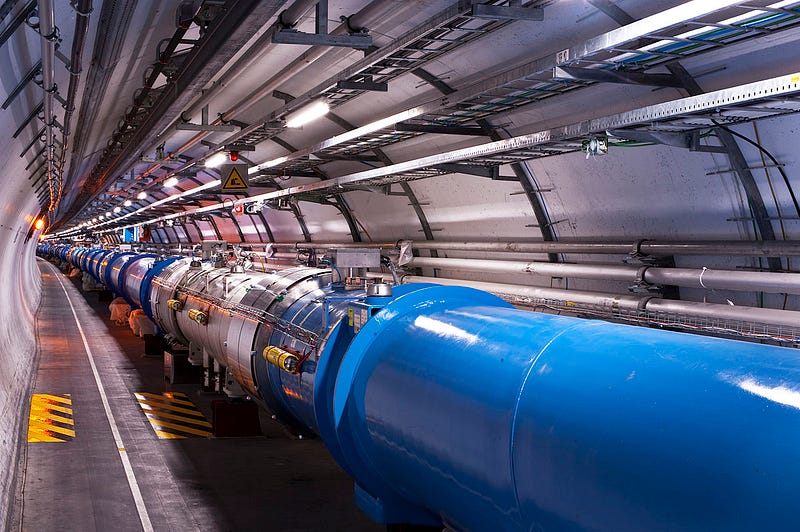
[Photo: Maximilien Brice (CERN), CC BY-SA 3.0, via Wikimedia Commons]

What will the Large Hadron Collider study?

With new capabilities at their disposal, scientists want to take another look at the Higgs boson. This is because it still raises many questions.

“For example, is it really an elementary particle, or does it have some components after all?” — said Joachim Mnich of CERN at a conference announcing a new series of experiments starting tomorrow.

This time, the LHC will operate continuously until 2026. In the further future, meanwhile, scientists pan to build an even larger particle accelerator. The Future Circular Collider is to be 100 km long and reach energies of 100 TeV.

Source: CERN

Cool that you made it to the end of this article. I will be very pleased if you appreciate the effort of creating it and leave some claps here, or maybe even start following me. Thank you!

Science
News
Physics
Technology
Tech
Recommended from ReadMedium