ART PROMPT
If We Weren’t Knowledge-Wreckers, We Could Have Had Space Travel 8 Centuries Ago
And have we learned from it? Hell, no!
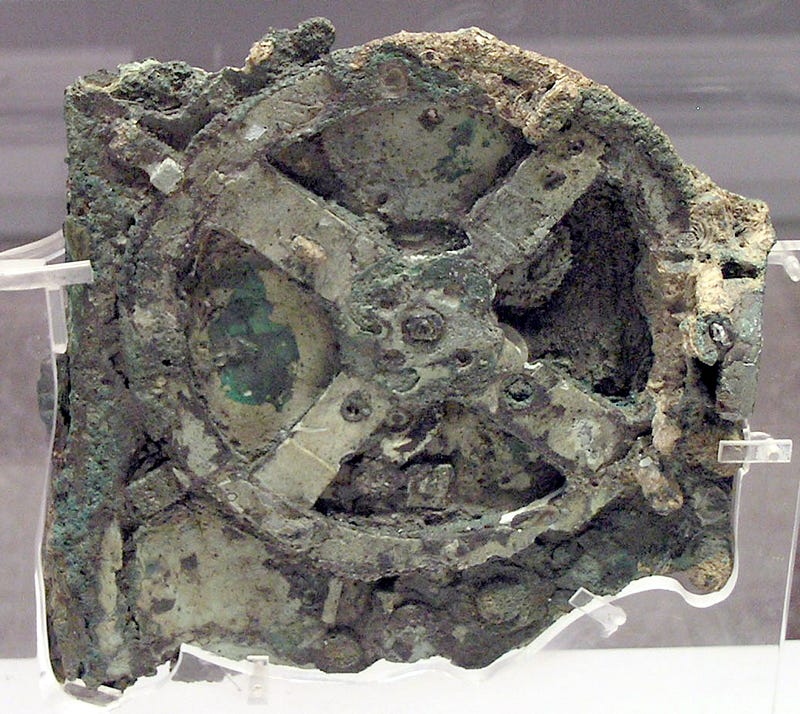
Suppose humankind had made it to the moon in the 1200s — round about the time that Genghis Khan captured Peking, King John signed the Magna Carta, and the Chinese launched rockets in battle for the first time — where would we be in the 21st century, as we looked back on a first moon landing eight centuries ago rather than five decades?
It’s an interesting question, although we can’t know a definitive answer. And I don’t ask it idly. It could have happened.
A Discovery That Changed Our View Of Ancient Technology
In 1901, sponge divers discovered an ancient Greek shipwreck in the waters off the Greek island of Antikythera. Although numerous artifacts were salvaged at the time — including bronze statues, marble sculptures, glasswork, ship’s equipment and marble horses — the original expedition was called off when one diver died and two were paralysed following decompression sickness. It would take a century to uncover the extent of the underwater site and the size of the vessel, although celebrated explorer Jacques Cousteau returned with a team in 1976 and recovered another 300 artifacts. The hostile marine environment and depth makes it a difficult area to explore even now.
The Antikythera Mechanism itself was recovered by the original divers and languished unnoticed amongst the numerous treasures stored at the National Archaeological Museum in Athens. As a smallish and fragile lump of fused and corroded gears, with some evidence of an outer wooden box, it looked more at home in a scrapyard than beside the imposing bronzes and statues that had been recovered.
In 1902, museum director and archaeologist, Valerios Stais, studying the Antikythera finds, was the first to recognise something special in the mechanism.
Over a century later, the work of many different people has revealed the mechanism’s technical secrets. The fragments are fragile and hard to analyse, but advancing technology, particularly in X-ray and scanning techniques, has allowed the fragments to be decoded.
It’s a complex structure with gearing mechanisms that work together to show astronomical movement, dates of eclipses, dates of key sporting events, phases of the moon and the alignment of the planets. These are not trivial calculations, and for the Antikythera Mechanism, they had to be done to the eccentric requirements of a geocentric solar system where the sun, planets and stars were believed to move around the earth. To accommodate this model, the orbits of some planets must reverse at times and go backwards. The gearing accommodates this, with all the 40 or so gear wheels enclosed in an outer casing not much bigger than a shoebox.
As techniques for analysis progressed through simple X-rays to tomography and high-resolution surface scanning, more detail emerged. The gear wheels were models of precision engineering, the largest at 13 cms diameter having 223 teeth. No signs of reworking have been found on any of the gears, pointing to this having been a well-practised construction i.e this was not the only such mechanism in existence at the time. However, it is the only such that has ever been found.
It is believed to have originally been designed within a generation before the Antikythera shipwreck which is thought to be 70–60 BC. It is possible that all other such mechanisms were later destroyed or melted down for reuse. A few tantalising references remain in the contemporary literature, but this device and the technological knowledge behind it were lost along with the civilisations that gave rise to it.
What Is So Special About The Antikythera Mechanism?
The Antikythera Mechanism is a complex calculator that could possibly date back to the time of Archimedes. It is the only such device ever found, yet all the evidence points to a sophistication in design and engineering that suggests practised skill in construction. It was not a one-off or a happy accident. It can accurately be described as an analogue computer of considerable complexity, way beyond the clockwork of the old Islamic and Byzantine worlds.
But it — and all it implied for human progress — was lost for centuries. The level of sophistication would not be seen again until the development of astronomical clocks in the 1300s.
All it lacked was a means of power, yet clearly, its inventor was capable of making the leap from clockwork to automation — perhaps using steam power as a stepping stone towards who knows what, maybe the sorts of sustainable power that we are only just now harnessing in the 21st century.
How long is the gap between automation and space travel?
People were dabbling with steam power from the 1st century, but 1698 saw the earliest useful steam engine. 1961 saw Yuri Gagarin in space, and 1969 saw Neil Armstrong and Buzz Aldrin walk on the moon. Left to flourish, the society that spawned the Antikythera Mechanism could easily have taken humankind to the moon by the 13th century.
It is a bit frightening, to know that just before the fall of their great civilization the ancient Greeks had come so close to our age
The Milestones In Decoding The Device
The story of the analysis and decoding of the Antikythera Mechanism from the recovered fragments is a fascinating tale in itself.
Princeton historian, Derek Price, was the first to carry out a detailed scientific analysis of the mechanism in 1959. It was he who first recognised it as a computer. He wrote:
Nothing like this instrument is preserved elsewhere. Nothing comparable to it is known from any ancient scientific text or literary allusion. It is a bit frightening, to know that just before the fall of their great civilization the ancient Greeks had come so close to our age, not only in their thought, but also in their scientific technology.
Since then, historians, scientists, archeologists and enthusiasts from all walks of life have debated and argued over aspects of the mechanism, not quite coming to blows, but demonstrating real passion for this small hunk of scrap metal, and dedicating whole careers to it.
This link is to a short video featuring Michael Wright, a museum curator from London who spent decades studying the Antikythera Mechanism and was the first person to reconstruct a working model of it.
A key player in decoding the device, including the annotations — a sort of early user manual — found on the gearing, was Dr Tony Freeth. I highly recommend his talk, linked here, in which he goes into the detail of the work done both on dating the device as well as decoding it. Get a drink, some popcorn and make yourself comfortable — this is the length of a short film.
And I have to mention Jo Marchant, author of Decoding the Heavens: Solving the mystery of the world’s first computer. She too talks compellingly of the Antikythera Mechanism and can be seen here presenting her work as part of the Darwin College Lecture Series.
My Kind Of Art?
If you doubt that the Antikythera Mechanism counts as art, take a look at this animation from Michael Wright and Mogi Vicentini from 2009 — and doubt no more!
Everything about the Antikythera Mechanism fascinates me; its story, the passion and eccentricities of its champions, its mysteries, its sophisticated gearing, the precision with which it was designed and built.
It is both art and science — and totally my kind of art.
With thanks to Will Hull and yesnodunno for putting me up to this:


