PROMPT
Back to School Show and Tell: What Artwork Speaks to You?
A Counter Arts prompt: Across whatever you consider to be “art”, what speaks to you?
Art: An application of creative skill and/or imagination, typically in — yet not confined to — a tangible, visual form. Others include: music, song, dance, literature, my doodle of some rather questionable sea creatures on an empty Starbucks cup.
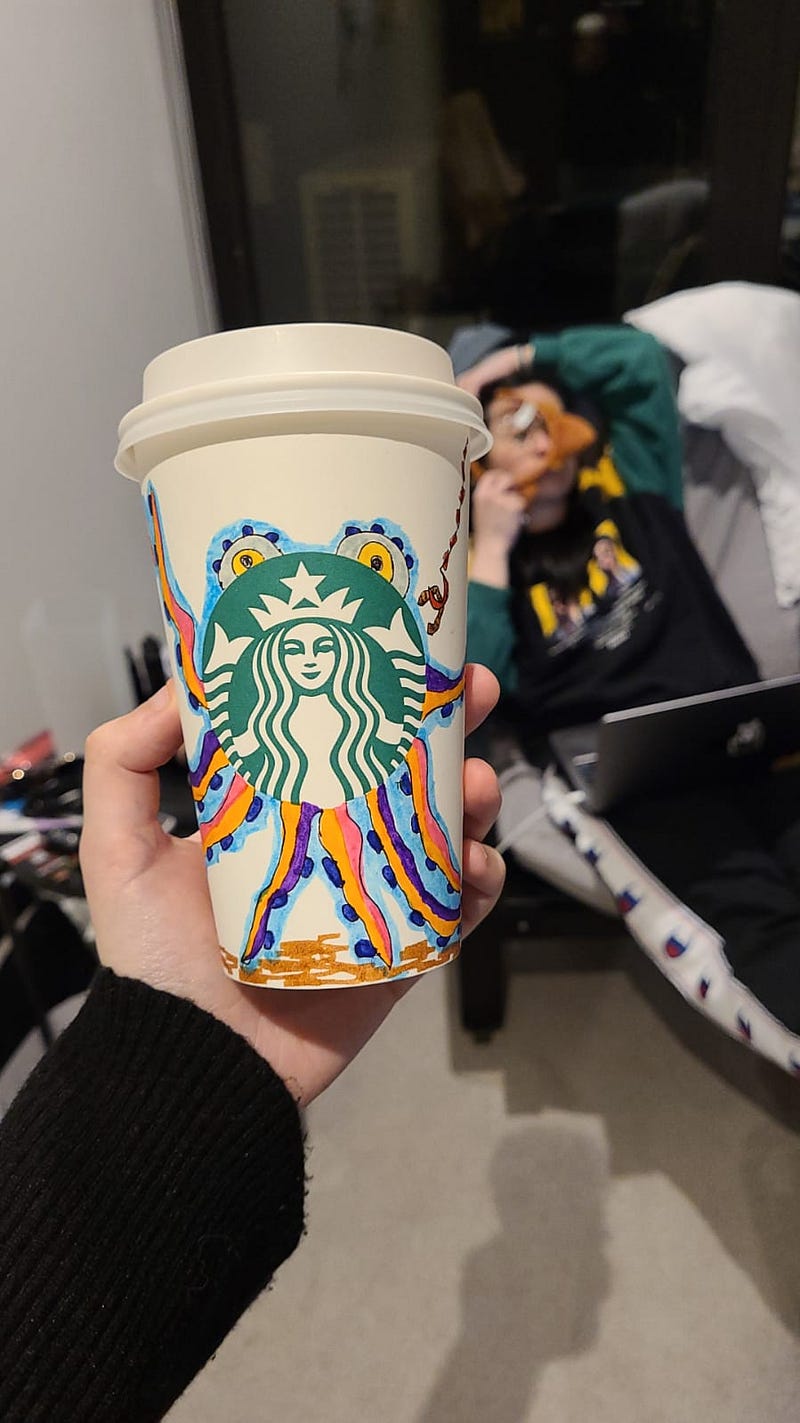
Australian coffee snobs, suck it up (through a straw or just with your mouths). The cup of single-origin, Colombian bean coffee I got at Starbucks ranks amongst the highest for best tasting lattes in Melbourne. Perhaps it might have ranked lower, if only cafés stayed opened past 3pm, or if that lady at Lorna Jane (000, as I call it) did not recoil in fear when I walked in flaunting my 5pm-coffee-drinking habit asking to buy some leggings.
A question often posed to me by my infuriatingly curious family and friends: Is that really art? has lost its once amusing charm and allure, despite their genuine interest and query, when faced with a non-traditional work of art.
I often find in private musings, that I — given my profession ; being rooted in the middle of the field/industry — ought to be the last person anyone should come to with such a question. The reasoning behind this can be aptly summarised into: irony and paradox.
Works of art surround me daily — at least, 9am-5pm, most weekdays, and the occasional weekend — and the novelty and allure of being in the presence of great works of art have slowly waned, though never entirely. The “most asked about piece” that once struck my marvel is now relegated to a directional instruction in my mind: “third floor, past the educational room”. Works of art have in effect, become commodities sold to visitors in the form of glimpses and photographs.
What is a work of art to me, then? Everything, anything, and yet nothing.
They are the remnants of an artist’s great glory, the everyday item that an acquaintance holds dear and with high regard, a commodity, a vision, an intangible source of enlightenment.
Are Replicas or “Inspired” works art?
Now that’s a question to be answered.
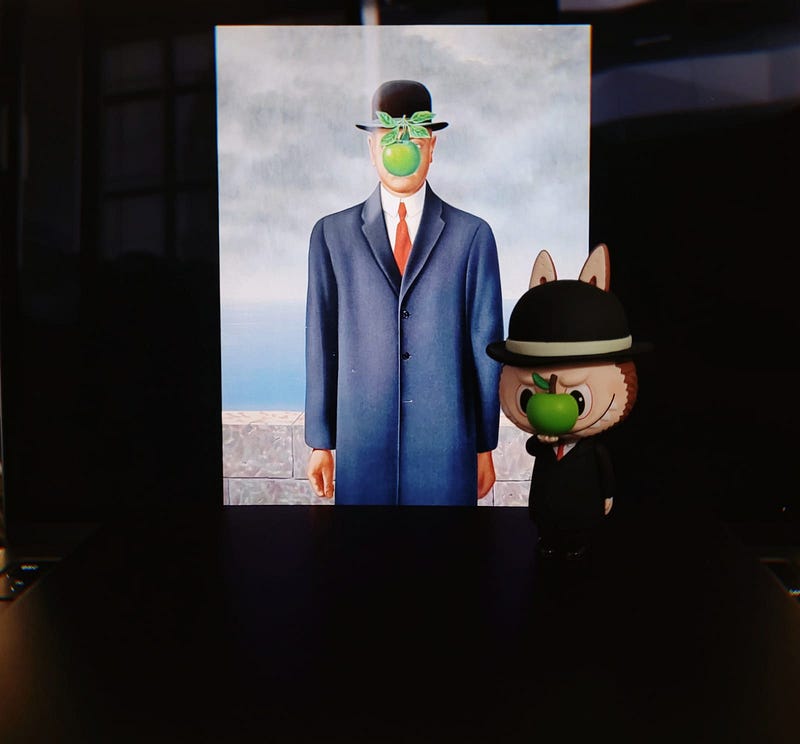
Replicas in galleries and museums are often created for pedagogical purposes. They are often created — to the team or artist replicating it — to the best ability, to mirror and mimic the original artwork’s details; colour, saturation, pigment, size, dimension, materials. Often, they are created to be displayed in place of the original artwork; some works of art may be susceptible to being exposed to the environment for long periods of time, or may be already destroyed by the very environment in which they have come from. The irony. Think: oils, pigments, paper, wood, water, clay, air.
However, they might also be created without paying much heed to the specifics of the original artwork, which, if you think about it, actually falls short of the very definition of the term replica (an exact copy). Instead, they could be created with a cheaper, more robust and resilient material like plastic, or be built twice as large, or three times smaller than the original work’s size. All of which, with the intention of enabling researchers, students, or visitors to interact with them.
See: replica of terracotta warrior figurine I purchased at work (with staff discount of course) resting on my shelf, of a terracotta replica displayed at my work place, created to the exact dimensions and materials of the original terracotta warriors.
What a headache.
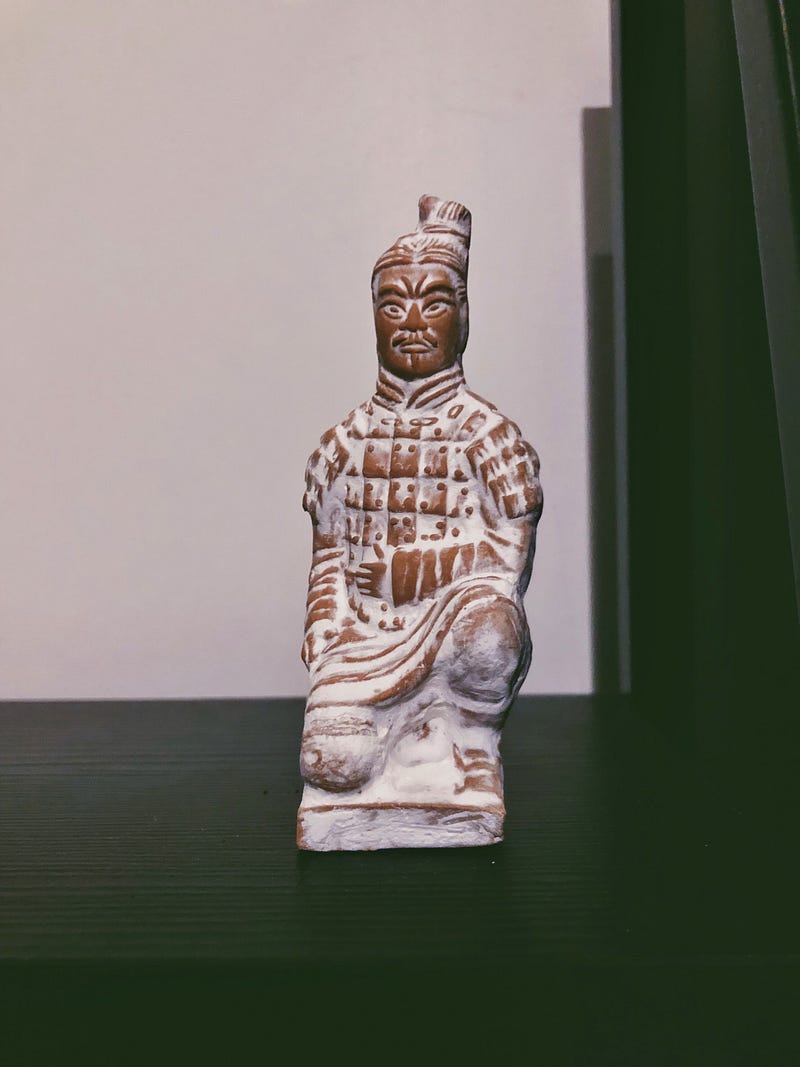
Is the $15 AUD replica of a replica terracotta warrior art? Of course it is, to me. It evokes in me feelings of admiration, a sense of their overwhelming presence. It also evokes in me feelings of anguish, almost as it’s perpetual pose (kneeling) is some sick joke the gods have bestowed upon me in my hour of invalidity; for those who are struggling to understand, I injured my knee and cannot walk, run, jump, let alone kneel without a sharp click and searing pain. This is, of course by no means on the same scale as what Emperor Qin Shi Huang would have felt upon the end of his reign, when he chartered the construction of some 8000 terracotta warriors to stand solemnly by him in death.
The Prompt
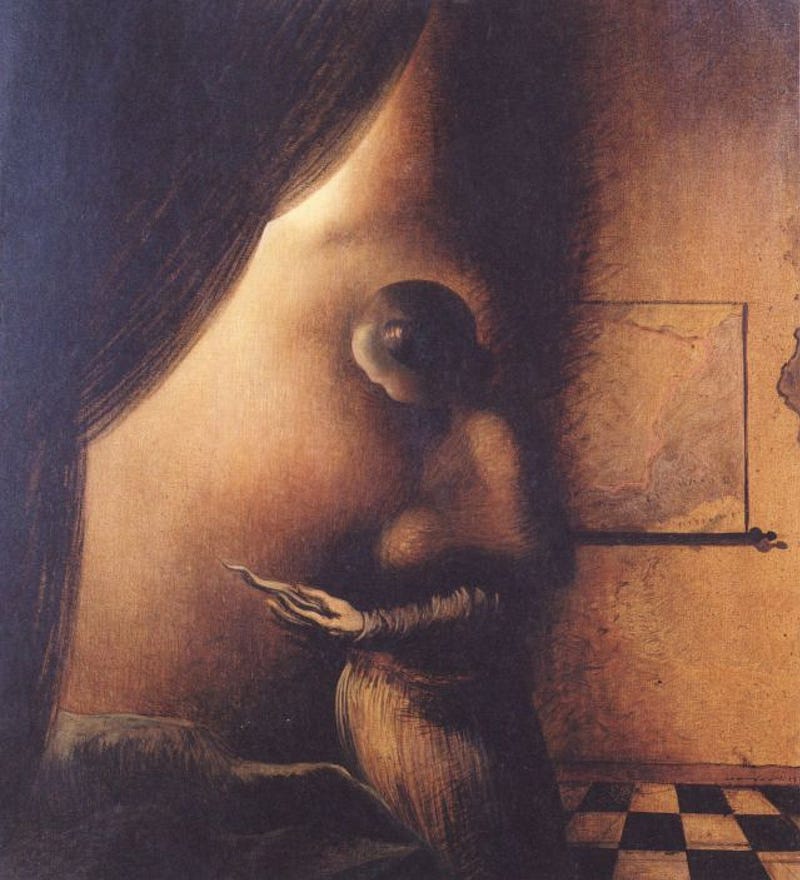
Much like how the distinction between a bearded man and a figure of a woman disappears in Salvador Dalí’s The Image Disappears, the line demarcating what is art, and what (traditionally) is not begins to fade. Perhaps then the takeaway here, is that anything can be art, as long as we recognise it to be.
Critics and skeptics of the future of NFTs, for example, would make haste to undermine the presence of artistic essence in digital art, citing an era’s old compulsion with form, techniques, mediums, etc.
Likewise, traditionalists will claim that artistic creations that have not been appraised by the relevant authorities are simply akin to that of a child’s doodles; of little historical, social, or political significance.
Yet that is not what art should be relegated to — age old traditions — bringing about a series of unfortunate queries into the matter:
What is art to you? What makes you feel the deep tremors of your soul? What evokes the nightmares or sweet dreams? What fuels you? What speaks to you?
Not the vengeful ghost of your murdered neighbour, I hope.
Note: the prompt is open to everyone who would like to participate! Also, feel free to tag others to move the prompt along, if it’s something that you’d want to do. Initially tagging: Carlos Garbiras, Christopher Robin, Will Hull, Kamna Kirti, Kabir, Angelina Der Arakelian (also thank you for the help in brainstorming the prompt), Wei Xiang, Johanna Da Costa, Marc Barham, Rainey Straus, Susan Alison, Charles G. Haacker, Mallika Vasak, Sadie Seroxcat, kasey sparks, Dr. Matthew Pate