
PART TWO (An Open Letter to Writers Who Write…)
Writing Miracles Can Happen — Just Don’t Hold Your Breath
A Sunday sermon on self-examination, writing tools, and tools that write

In Part One of this sermon, I wrote about the difference between bloggers who write and writers who blog.
It’s Sunday again, almost a month later, and I’m finally publishing Part Two of “An Open Letter to Writers Who Write to Other Writers About Writing”
At this point, all the self-help gurus would insert their profound life hack: don’t procrastinate.
But is that true?
The original reason I wrote Part One was I read something on this platform that irritated the hell out of me.
I’ll go into the reason later because it’s still valid, but I think the passage of time changed my perspective on how I wanted to write this piece.
The power of time is immeasurable, but writers forget to use it.
With online tools and the quest for instant gratification, most of us throw something together, maybe do a little editing, and then hit publish.
We pull back from our desks, stand up, and raise our arms, thinking we are Leonardo Di Caprio.
Did I neglect to mention that he was standing on top of the Titanic?
Sometimes, our brilliant hot takes are nothing more than hot air inside a big beautiful balloon.
Like the Hindenburg.
Maybe the passage of a day, or a week, or in this case, a month, was just what I needed to write something entertaining and educational instead of the sincere, tedious complaining done by so many people on Medium.
Like I always say, if you’re going to rant, at least make it funny.
Today, in PART TWO, I want to share different ways we might analyze writing quality.
The Scientific Method, versus My Method
The scientific method is as follows: question; hypothesis; prediction; experiment; and, analysis.
My method is as follows: angry reaction; a desire to rant; researching to avoid coming off as a complete idiot; discovering information that changes my views, and; ranting anyway but rationally.
And that brings me to the self-awareness portion of this program where I reveal what I learned from using Grammarly.
I started with the intention of analyzing articles by mega-popular writers to prove that their writing is crap, by comparing their work to great writers.
As I immersed myself in research, I realized that I needed to establish a baseline for comparison, so I ran several different online news and magazine articles through Grammarly.
Remember, these are small sample sizes (about 10 articles per publication), and poor speech in quotes will negatively affect the overall score of the publications.
Also, differences in format, areas of coverage, and staff size affected these rough scores.¹
The Ringer, 83.8 BBC News, 82.7 INC., 81.5 Fox News (with AP), 81.3 The Athletic.com, 80.1 Fox News (opinion), 78.8
Armed with a standard for comparison, I ran articles through Grammarly for individual writers.
Three of Medium’s mega-popular writers scored between 77 and 80 and were rated as “bland,” instead of engaging.
No surprise there; self-help articles are pretty tame (and lame).
Even though most of us can’t stand the treacle and snake oil, I have to credit them for having an editor or putting in the time to polish their work.
Unfortunately, this doesn’t apply to the second-tier writers who push out three articles a day. They are averaging between 71 and 73.
Then, I had to turn that spotlight on myself, and you know what happens when you point the proverbial finger.
Man, talk about self-inflicted wounds.
In the two months before I started to examine myself as a writer, my average score was only 68.2.
While it’s a problem to spell “three-pointer” without a hyphen in a 3,000-word essay on basketball, even correcting the repeated typos would have only raised my average to the low 70s.
However, I’m learning to embrace the gain, instead of looking at the gap.
Since I started “THE 500-WORD RANT,” and begin using Grammarly, my average rant score rose to 86.7.
With longer articles, it’s more difficult to maintain focus.
My scores dropped off, bringing my average on 22 articles down to 82.6. Not counting all the quotes, this article came in at 98, which shows how much I was able to clean up basic writing errors.
But the real gain has nothing to do with reducing spelling and punctuation errors; it’s all about engagement² and finding an active writing voice.
I‘m pleased to say that half of the articles I’ve written over the past three weeks have been rated “very engaging,” or “engaging.”
Are you not entertained?
After eliminating the vast majority of “word choice” and “passive text voice” errors, I write with fewer qualifiers, adverbs, and all those junk words we use as filler.
Suddenly, you know, it’s like, really amazing how I literally went from, like, always adding very large writing filler things, to maybe never including big stuff like that in, like, a sentence, you know?
My narrative voice must be growing stronger, as the 500-word essays don’t allow me to go off on a stream of consciousness flight of fancy.
Of course, there will always be a place for this kind of madness.
The last part of my original sermon was to examine a statement a shyster content marketer made about their favorite authors.
To protect the innocent, I will paraphrase the quote.
“I’m inspired by great writers such as [Shyster Content Marketer #1], [Shyster Content Marketer #2], [Shyster Content Marketer #3], [Shyster Content Marketer #4], Malcolm Gladwell, and [Shyster Content Marketer #5].”
Look, you have every right to be inspired by whomever you want.
But you have no clue about writing if you think a person quoting a famous writer has the same skill as the famous writer being quoted.
It’s kind of like comparing apples to a photo of an orange.
Malcolm Gladwell is a professional journalist and international bestseller whose specialty is taking multi-disciplinary deep dives into every manner of scientific study, interviewing experts and then coming up with unique perspectives.
If you haven’t read his books, you need to.
I’m currently reading “David and Goliath,” which presents a surprising perspective on the nature of difficulties.
Every person who feels overwhelmed by the challenges in their life needs to read the book to learn how these stories of “underdogs, misfits, and the art of battling giants” might help them.
Whether it is due to ignorance or arrogance, the comment I paraphrased above makes me want to shout, “Go read the fucking book!”
Just like the lead singer of Axis of Awesome:
Finally, I want to illustrate the difference between intelligent writing and self-help hogwash.
Here are two short passages from successful writers.
One has been on the New York Times Best Seller list five times, and the other is a social media superstar, blogger, and author who later earned a Ph.D. in organizational psychology.
Malcolm Gladwell, Journalist and Author, from the NY Times Bestselling non-fiction book “David and Goliath”:
The idea of desirable difficulty suggests that not all difficulties are negative. Being a poor reader is a real obstacle, unless you are David Boies and that obstacle turns you into an extraordinary listener, or unless you are Gary Cohn and that obstacle gives you the courage to take chances you would never otherwise have taken. MacCurdy’s theory of morale is a second, broader perspective on this same idea. The reason Winston Churchill and the English military brass were so apprehensive about the German attacks on London was that they assumed that a traumatic experience like being bombed would have the same effect on everyone: that the only difference between near misses and remote misses would be the degree of trauma they suffered. But to MacCurdy, the Blitz proved that traumatic experiences can have two completely different effects on people: the same event can be profoundly damaging to one group while leaving another better off.
In the sample above, the author argues that difficulties, like dyslexia and the bombing of London during WWII, can affect the people within a population differently.
Earlier, Gladwell referred to the work of Canadian psychiatrist J.T. MacCurdy in his book, “The Structure of Morale.”
MacCurdy studied the effects of the London Blitz.
He found three groups: the dead; the near misses (wounded, or direct witnesses to the destruction and death), and; remote misses (hear the sirens and bomb explosions but are untouched by the damage).
The near-misses often suffered from shock, while the remote misses gained courage from overcoming their fear of being afraid.
Benjamin Hardy, Ph.D. and Medium superstar:
So, I’m choosing to remember the gain, not the gap. I’m choosing how I remember that experience. And as a result, I’m choosing my narrative and my past. Your past is whatever you ascribe meaning to. You can remember the gains, or you can remember the pain. Post-traumatic growth is the opposite of PTSD. You could have any negative experience imaginable and become better from it. This may take time, but if you are conscious about your emotions and conscious about your future, then you can turn any negative experience into a lot of gain.
Your painful experiences become the doorway to growth and experience, as well as service to others dealing with similar problems.
Your biggest failures and problems can be — if you let them — your greatest drivers of success, learning, and joy.
But you need to choose how you see and how you remember them.
It’s entirely up to you.
You can remember the gain or the gap.
How you choose to remember determines your past.
In the sample above, Hardy, an organizational psychologist, argues that people can choose how they view their past.
He refers to the idea proposed by Dan Sullivan (a strategic coach) in his short ebook “Gap and Gain.” And there is value in viewing your life from a place of gratitude instead of envy.
We all need to learn to be more grateful, as evidenced by my search on Medium that yielded 1300 articles on gratitude.
But is changing the view of your life enough to overcome PTSD?
Here are the results of a 2-minute online search:
Bridges to Recovery: “Like most mental illnesses, PTSD is not strictly curable. This condition is caused by trauma and causes serious symptoms that make normal functioning challenging or impossible. Treatment with special types of therapy and sometimes medication can make a big difference, but it is not a cure.”
Web Md: “When you have PTSD, it might feel like you’ll never get your life back. But it can be treated. Short- and long-term psychotherapy and medications can work very well. Often, the two kinds of treatment are more effective together.”
American Psychiatric Association: “Psychiatrists and other mental health professionals use various effective (research-proven) methods to help people recover from PTSD. Both talk therapy (psychotherapy) and medication provide effective evidence-based treatments for PTSD. One category of psychotherapy, cognitive behavior therapies (CBT), is very effective. Cognitive processing therapy, prolonged exposure therapy and stress inoculation therapy (described below) are among the types of CBT used to treat PTSD.”
Does any of that sound like the following quote?
Hardy: “This may take time, but if you are conscious about your emotions and conscious about your future, then you can turn any negative experience into a lot of gain.”
If the author had written a disclaimer stating his advice is for people trying to get ahead in their careers, there’s no problem with presenting the idea of Gap and Gain.
What I object to are self-help writers who ignore scientific literature, speak in generalities, and try to sell their own branded version of “The Secret.”
I’m sorry, but the “Laws of Attraction” don’t get a seat at the same dinner table with evolution, gravity, and relativity.
It doesn’t even get to order at the drive-thru of rational thought.
If you want to become a better writer, you can do it if you use the right tools, put in the work, and read intensely.
Never forget: be a writer who blogs, instead of a blogger who writes.
Let me end this Sunday Sermon with some alliterative advice on actualizing articles:
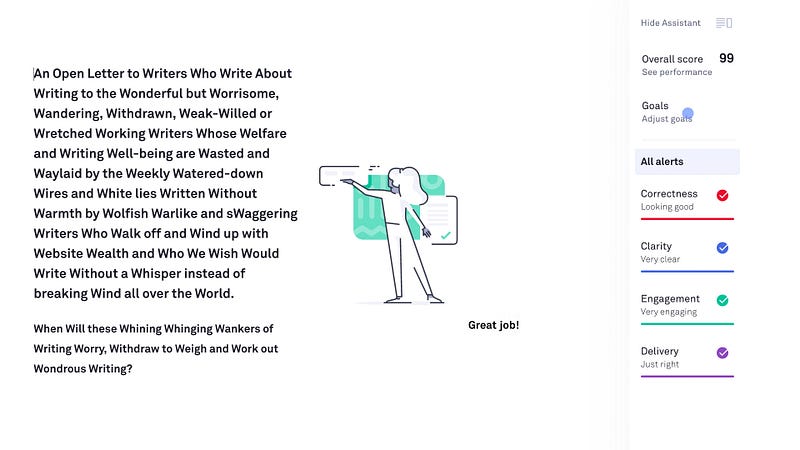
An Open Letter to Writers Who Write About Writing to the Wonderful but Worrisome, Wandering, Withdrawn, Weak-Willed or Wretched Working Writers Whose Welfare and Writing Well-being are Wasted and Waylaid by the Weekly Watered-down Wires and White lies Written Without Warmth by Wolfish Warlike and sWaggering Writers Who Walk off and Wind up with Website Wealth and Who We Wish Would Write Without a Whisper instead of breaking Wind all over the World.
When Will these Whining Whinging Wankers of Writing Worry, Withdraw to Weigh and Work out Wondrous Writing?
The alliterative abomination above was my original headline.
Feel free to laugh, but not mock, my headline — it got a score of 99 from Grammarly.
Here’s to better writing.
Footnotes:
¹The Ringer has a small centralized staff, and built along the lines of Grantland, perhaps the best online sports writing web site ever developed. Their articles are not as time sensitive as a news source.
BBC News seems to have a stronger editorial staff.
INC articles had more variation, with the features scoring above 90. But they also republish posts of far lower quality (60s and 70s) from other online publications.
Fox News articles usually included contributions from AP, so it’s hard to know who gets the credit for their editorial quality.
The Athletic.com is a high end subscription-based sports site that also suffers from a wide variation in quality. Part of this is the result of the enormity of their operation, as they have local writers covering every team in North America. In addition, with so many sports to cover, I assume the highest quality writers are covering the NFL, NBA and Major League Baseball, while less experiences writers cover NASCAR and Women’s Soccer. Again, some feature articles scored above 90, while the minor sport articles all came in below 70.
Fox News Opinion, without the help of AP, scored in the same range as Medium’s most popular bloggers. I’m not surprised.
²Grammarly’s free version rates your article’s level of engagement, while the premium version explains it.
As I’ve played around with sentences to see how to minimize those annoying premium warnings, simple, direct writing changes the engagement rating, even when discussing scientific research.
The paragraphs I wrote dissecting Gladwell’s passage were rated “a bit bland.”
After my rewrite, the paragraphs were rated very engaging.


