
This happens very rarely. We have a direct image of a planet from another star system
Scientists have tracked down an extrasolar globe in an unusual way. First, they detected an alien planet just by observing the motion of its star, and then this exoplanet was directly photographed.
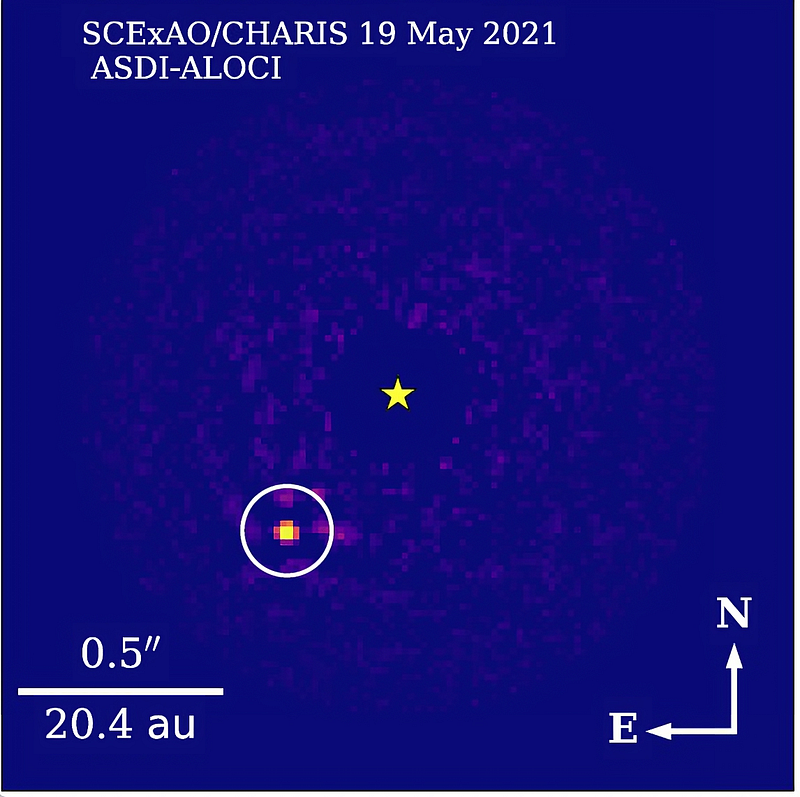

“We have entered a new era of imaging alien worlds,” exclaims Thayne Currie, an astrophysicist working with the Subaru Telescope in Hawaii.
This is her way of commenting on an entirely new way of detecting and studying extrasolar planets, described in a paper published in the prestigious journal Science. A team working under Currie’s direction has discovered a new exoplanet designated HIP-99770b. It was detected by observing the motion of the star the globe orbits, and then photographed directly. This is an efficient new way to search for extrasolar planets.
“Using direct imaging and astrometry [i.e., the study of the motion and position of space objects — editor’s note] simultaneously allowed us to fully characterize an exoplanet for the first time. In one go, we were able to study its atmosphere, estimate its mass and orbit,” Currie says.
“This new approach to searching for exoplanets promises future methods. With them, we will one day identify and study Earth’s twins around nearby stars,” the scientist adds.
How exoplanets are detected
The quest for exoplanets in distant stellar systems poses a major obstacle, as they are significantly tinier and fainter in comparison to their host stars. Their direct observations are extremely difficult to make.
At the moment we know of the existence of about 5300 extrasolar globes. Most of them have been detected indirectly. How?
The first is the transit method. We find out about the existence of an exoplanet because when it orbits a star, the light of that star periodically darkens. We can measure these changes in light brightness. On this basis, scientists infer the existence of a planet orbiting a star.
The second approach pertains to alterations in the properties of the star’s radiance. Contrary to appearances, the star does not remain stationary relative to the planet. A globe, especially a massive one, interacts with the star gravitationally, setting it in slight motion. This motion results in the Doppler effect, or, in simple terms, changes in the frequencies of the light waves emitted by the star.

Stars are in constant motion
However, this slight movement of stars caused by the presence of an exoplanet can also be detected in other ways. Suns are not stuck motionless in galaxies. They orbit their centers, just as planets orbit the Sun. If an exoplanet orbits around a star, this translates into the path along which the star orbits the galaxy. This method can be used to pick out globe candidates that are farther away from their stars.
The authors of the paper in Science looked at data on Milky Way stars collected by the Gaia and Hipparcos probes. They obtained records of the positions of stars over a period of 25 years. After analyzing them, they singled out stars that “swayed” in their path in an unusual way. This swaying could have been a signal indicating that a massive exoplanet was orbiting the star.
Direct observations of the exoplanet
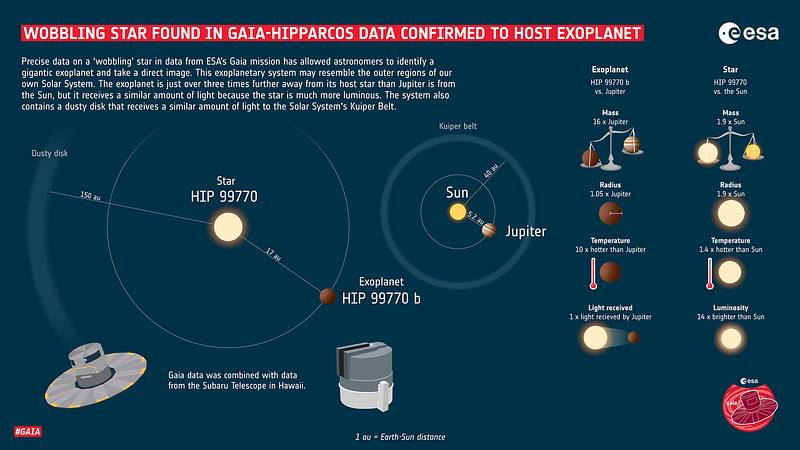
The scientists then began making direct observations of the selected stars with the help of the Subaru Telescope and the Keck Telescopes in Hawaii. Taking a closer look at the star HIP-99770 proved to be a hit. A large exoplanet was directly observed around it, at a distance of as much as 17 astronomical units (that is, 17 times farther than the Earth-Sun distance): HIP-99770b.
This globe has the radius of Jupiter. However, it is as much as 14–16 times heavier than it. It is also three times farther from its sun than Jupiter.
“This is only the first of many discoveries made through a combination of astrometry and direct observations with the help of the Subaru and Keck Telescopes,” — Currie announces. — “We already have several other discoveries that will be made public this year and next,” he adds.
Cool that you made it to the end of this article. I will be very pleased if you appreciate the effort of creating it and leave some claps here, or maybe even start following me. It would be nice if you also left a tip! Thank you!