
This Easy One Minute Test Reveals If Your Thinking Lacks Flexibility
Can you solve this simple puzzle?

I came across a video of Ray Dalio mentoring Sean Combs (Diddy) on YouTube the other day.
The whole video was eye-opening.
But one sentence from Ray Dalio stuck out in particular:
“The worst tragedy of mankind, and almost any individual, is getting attached to opinions that are wrong.”
Dalio goes on to talk about how people dig in their heels and resist opening their minds to alternative perspectives.
And yet the “tragic” part really comes down to this:
You usually don’t know when you’re stuck in a limited mindset, or when you lack flexibility in your thinking.
This often happens when you accept the rules and limitations placed on you.
Or you spend too much time around like-minded people and only seek out information that confirms what you already believe to be true.
As a result, you think yourself into a corner and lose the ability to see new ideas and opportunities unless they already fit into your existing worldview.
And that’s a shame because staying “stuck” in a fixed mindset is the fastest way to stop growing as an individual.
So here’s a simple test you can use to gain some insight into how you think about limitations.
This is not a scientific approach by any means, but it is an interesting thought experiment that will help you learn a thing or two about yourself.
The 9-dot puzzle
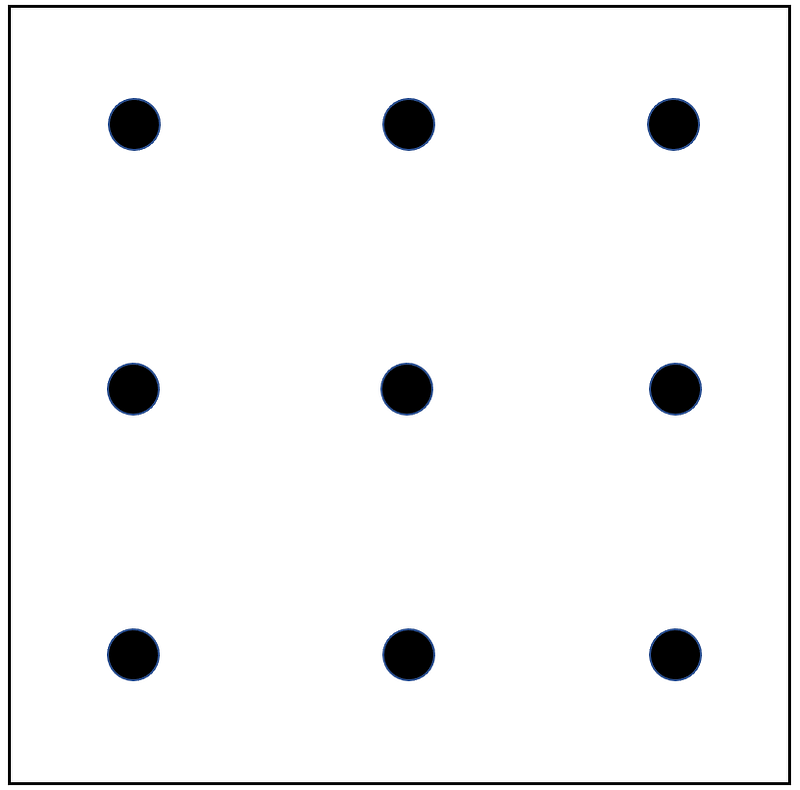
Look at the drawing below (copy it on a sheet of paper if need be).
Here’s the goal of the puzzle: using only 4 lines, connect all the dots without lifting your pencil.
That’s it.
The answer appears at the bottom of the post.
How to escape a rigid mindset
Your brain receives billions of data points every second.
For example, your retina transmits data at roughly 10 million bits per second, and your skin alone has millions of nerve cells detecting pressure, pain, temperature, and location at every moment.
The only way your brain can handle so much information at once is by filtering out the stuff that’s not important.
It has to, otherwise, your brain would collapse. However, that also means your worldview is necessarily limited.
But that doesn’t mean you can’t find ways to stretch your mind and expand your perspective.
Here are a few ways you can do that.
1. “Investigate” your thoughts using these 3 questions
“The difficulty lies not in the new ideas, but in escaping from the old ones.” — John Maynard Keynes
One of the most profound discoveries of my adult life was that I don’t have to believe every thought I have.
Just because I think it, doesn’t mean it’s true.
So much of what you think and believe is a byproduct of your upbringing, the people you spend time with, and what you read or see on the internet or TV.
There’s nothing wrong with that, as long as you’re aware that you’re getting a very small slice of reality.
After I realized how limited my own perspective was, I got in the habit of questioning my thoughts by asking these 3 questions:
“Can I absolutely know this is true?”
“What is the opposite of this thought?”
“Is there another way of thinking about this?”
Once you let yourself entertain other points of view, you’ll usually realize there’s more than one way to think about anything.
2. Increase your cognitive flexibility
Your habits and behaviors influence your thought patterns and beliefs.
If every day looks exactly the same, then your thoughts will start to fall into predictable patterns, too.
One of the best ways to let go of rigid thinking is to switch up your day-to-day routine. Traveling, trying out a new hobby, or even going to work a different way can enhance cognitive flexibility, inspire you, and boost creativity.
Here are a few other ways you can nudge yourself towards new ideas and perspectives:
- Go for a walk in a new part of town
- Cook up a dish you’ve never tried before
- Read or watch something you would normally skip
- Engage and get to know more people of different ages and backgrounds
- Try out a new hobby like learning a different language, making art, or dancing
3. Pay attention to your physical body
Your body often reflects how you feel before you’re consciously aware of it.
Like when you feel a tightness in your chest. Or you get a nervous feeling in the pit of your stomach.
These feelings are often automatic reactions to something in your environment. As a result, your mind jumps to conclusions and assumptions without leaving space for a different point of view.
Pay attention to moments when you feel a sudden tension, stiffness, or anxiety.
A rigid body is often a sign of a rigid mind. And these kinds of reactions are a clue that you could end up reacting instead of listening with an open mind.
How to solve the 9-dot puzzle
Okay, the moment you’ve been waiting for.
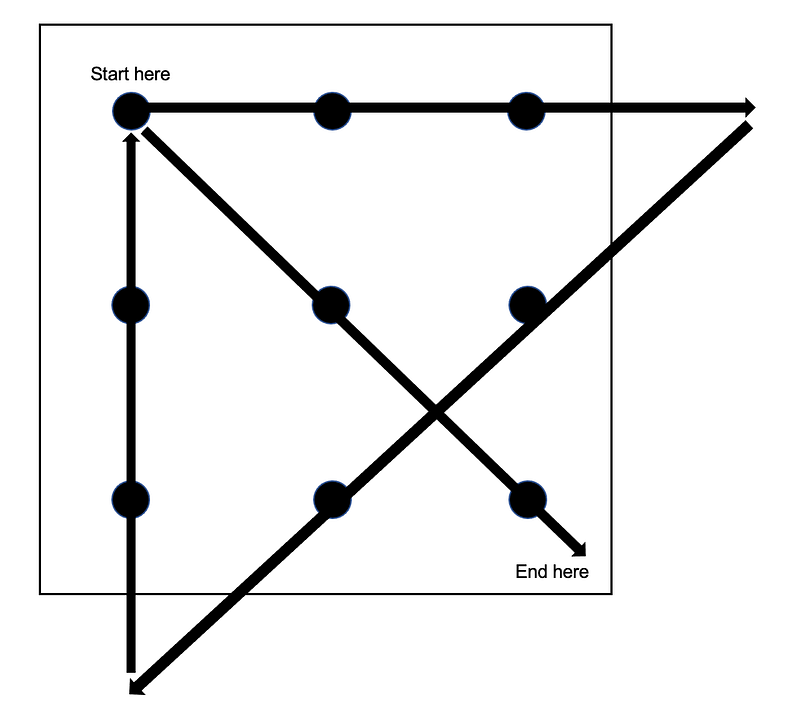
Here is the puzzle solution:
How did you do?
Final thoughts
Most people assume the square around the dots is a constraint.
Even though the rules don’t say you can’t go outside the box, most people assume this is true anyway!
This is what happens in many real-life situations, too.
You see roadblocks, limitations, and rules where none exist.
They’re placed there by you, voluntarily.
And that’s a shame. Because you end up missing out on new ideas, opportunities, and fascinating people when you stay stuck in a limited mindset.
The good news is that even simple puzzles like this one can remind you to push yourself outside of your comfort zone.
After all, that’s where all the good stuff happens!


