
Think of Our Government as a “System”
The Knowledge Of Government System Performance is invaluable to assess if our government is working as designed

This next statement has to do with a lot that has been done to our system of government.
“Improving the performance of parts of the system taken separately will NOT improve the performance of the whole.”
For example, The Car
Think of a car. A car is a system, its purpose is to transport people and things from one place to another.
When you take a new car out of the lot, you expect it to do what you bought it for and moreover, you expect reliability — to last you a long time without major problems as long you give it its regular maintenance. The car was designed for that.
The car is a “balanced system.” However, one day you decide to build the best car in the world. For efficiency, you bypass designing the car and buy the best parts from all the best cars in the world to build “the best car in the world.”
The car will not work. The best parts of the best cars in the world will not build the best car in the world, the parts won’t fit together. It is not effective.
Effective and Efficient
The car won’t work because, Ackoff,
“The value of the objective pursued is not relevant in determining efficiency. It is rather, efficiency multiplied by value. It is efficiency for a valued outcome.”
When a system is designed for a specific purpose and performance, the system is “effective.” Effectiveness = η x Value. Eta (η) is the symbol for efficiency. Nothing in our reality is 100% efficient.
A jet aircraft is more efficient than a propeller aircraft. And since the invention of jet engines, their efficiency has gone up (they burn cleaner and are not as noisy). It is measured by looking at the ratio of “useful output to the total input.”
What about our Government system?
In the case of the Supreme Court. The only evaluation that counts is its “effectiveness in the application of the Constitution, the ‘Law of the Land,’ to the law at hand.”
However as Ackoff continues,
“These evaluative principles are impersonal. We can speak of the efficiency of an act independently of the actor. Not so for effectiveness. A judgment of the value of an act is never independent of the judge, and seldom is the same for two judges.”
What about SCOTUS?
In the case of SCOTUS, the valuation of a nominee has to be based on their knowledge of the Constitution. Every mind is a universe. So any President, wanting to “pack the Court,” is looking for much lower efficiency. More people, more arguments, and the longer it takes to achieve a decision. If the candidates chosen, are ignorant of the Constitution, we will never be able to achieve wisdom from such a court (they are like computers that can only store knowledge). For example, the effectiveness of a court cannot be supplanted by Artificial Intelligence (AI).
Ackoff,
“From all this, I infer that although we are able to develop computerized information-, knowledge-, and understanding-generating systems, we will never be able to generate wisdom by such systems. It may well be that wisdom — which is essential for the pursuit of ideals or ultimately valued ends — is the characteristic that differentiates man from machines.”
So far and for 100+ years, they have been afraid to declare the Administrative government unconstitutional. Can we say they have achieved wisdom?
SCOTUS is the weakest branch of government because they are constituted by members chosen by the president and blessed by congress. They have been acting like needy children forever.
What about Congress?
The purpose of Congress is the “Legislate.” It is the tool our founders created for “transformational leadership.” Just like they did by creating the Constitution, they expected similar results from a legislative body that understood the Constitution and followed that roadmap. As discussed here, they expected “Compromise.” This is NOT what we have today. That body of people has no knowledge. They are only pursuing control of the “masses (serfs).”
What about the President?
The president bypasses the law of the land by writing Executive Orders when he does not “like” Congress’s actions. He vetoes the bill and does his own. You can say they can be an autocrat for a day. However, the orders they write can have derelict consequences for the rest of us. They can also be derelict in their oath of office.
For example, Nixon had to be impeached and almost was until he resigned because of all the lies and actions he took as president that violated the Constitution.
When Franklin D. Roosevelt, signed Executive Order 9066 for the internment of American Japanese during WWII, he was in violation of the Constitution.
During the pandemic under Biden, the CDC created, and as usual, put into effect an “Eviction Moratorium Order” with the rise of the Delta variant of COVID-19, it was due to expire in October 3, 2021. Biden, using his Presidential authority and knowing the CDC order was unconstitutional, extended the duration of the order.
Like that, there are many examples of different magnitudes for other presidents that have exceeded the authority of the Constitution.
Striving for Humanity we, the people, have to relearn the act of charity. Not all the solutions of the world sit below the pen of the president or congress. We have a role to play, we are not doing that anymore. Are we forgetting what are we here for?
How did we get here?
We have been wandering in the desert, like Moses in the good old Book, for over 100 years now. Without realizing who affected our effectiveness.
What was it that Woodrow Wilson said when he “created the administrative government, 4th branch of government” out of thin air, the biggest albatross around our voter’s neck?
Please read the following if you are interested in the history of a decision that is affecting us today in the most catastrophic way.
Everything Woodrow Wilson thought was wrong and we are still under the yoke of the administrative government he created, in the worst way, today. This is the biggest fear SCOTUS has. It is their third rail. How to declare the entire administrative machine UNCONSTITUTIONAL.
In an 1887 paper titled, “The Study of Administration,” in “Political Science Quarterly.” The paper goes from page 197 to page 222. Quote,
“It is the object of administrative study to discover, first, what government can properly and successfully do, and, secondly, how it can do these proper things with the utmost possible efficiency and at the least possible cost either of money or of energy.”
For this, he goes about an oversight review of the “old world” describing how Germany, England, and other countries were operating in the “modern world.” This is barely 100 years after our independence (1887). The thinking was “modern then,” maybe we can wake up today, 100+ years after Wilson, for us, the people, to go back to the unique and never repeated system of government our founders had created.
“Judging by the Constitutional histories of the chief nations of the modern world, there may be said to be three periods of growth through which government has passed in all the most highly developed of existing systems, and through which it promises to pass in all the rest. ….”
He goes on the explain the three periods.
“The first of these periods is that of absolute rulers, and of an administrative system adapted to absolute rule; the second is that in which constitutions are framed to do away with absolute rulers and substitute popular control, and in which administration is neglected for these higher concerns; and the third is that in which the sovereign people undertake to develop administration under this new constitution which has brought them into power.”
However, he argues, that with constitutions there will never be an end to tinkering with them to keep them up to “modern times.”
“Once a nation has embarked in the business of manufacturing constitutions, it finds it exceedingly difficult to close out that business and open for the public a bureau of skilled, economical administration. There seems to be no end to the tinkering of constitutions. Your ordinary constitution will last you hardly ten years without repairs or additions; and the time for administrative detail comes late.”
Other conclusions Wilson arrived at,
“The weightier debates of constitutional principle are even yet by no means concluded; but they are no longer of more immediate practical moment than questions of administration. It is getting to be harder to run a constitution than to frame one. …”
“There is scarcely a single duty of government which was once simple which is not now complex; government once had but a few masters; it now has scores of masters. Majorities formerly only underwent government; they now conduct government. Where government once might follow the whims of a court, it must now follow the views of a nation.”
Wilson forgot or he was really looking for a national central government in charge, the USA is a conglomeration of 50 states, each having its own government. Our founders were looking for an up-and-out small government. Wilson wanted the opposite, a down-and-in large government to run society, NOT INDIVIDUALS. He got his wish. Today the federal government is THE LARGEST EMPLOYER in the country (tens of millions of people if we include contractors) and it is only focused on the efficiency of our social systems. None are effective.
For example, talk to the VA veterans. It is but one, run by such a deep bureaucracy, nobody is responsible. Look at the total and abysmal failure that Lyndon B. Johnson’s “Great Society” has been. It has only expanded that bureaucracy to lengths unimaginable. Today, they persist in creating regulations accusing us, the people, covered like a blanket, that WE are BIGGOTS!
Wilson, whether he believed it or not, also stated that the administrative government has two important distinctions that make it valuable.
“Let me expand a little what I have said of the province of administration. Most important to be observed is the truth already so much and so fortunately insisted upon by our civil service reformers; namely, that administration lies outside the proper sphere of politics. Administrative questions are not political questions. Although politics sets the tasks for administration, it should not be suffered to manipulate its offices.”
There is another distinction which must be worked into all our conclusions, which, though but another side of that between administration and politics, is not quite so easy to keep sight of: I mean the distinction between constitutional and administrative questions, between those governmental adjustments which are essential to constitutional principle and those which are merely instrumental to the possibly changing purposes of a wisely adapting convenience.
He goes on to specify what he means by the specific nature of administration vis-à-vis the general nature of our constitution. As if one does not RULE the other.
Every particular application of general law is an act of administration. The assessment and raising of taxes, for instance, the hanging of a criminal, the transportation and delivery of the mails, the equipment and recruiting of the army and navy, etc., are all obviously acts of administration; but the general laws which direct these things to be done are as obviously outside of and above administration. The broad plans of governmental action are not administrative; the detailed execution of such plans is administrative.
Where Are We Today?
For over 100 years now, we have suffered under the injustice implanted by Wilson. His administrative government has taken us out of the system of government and rendered us impotent. He nulled our vote and enabled “Lobbying.”
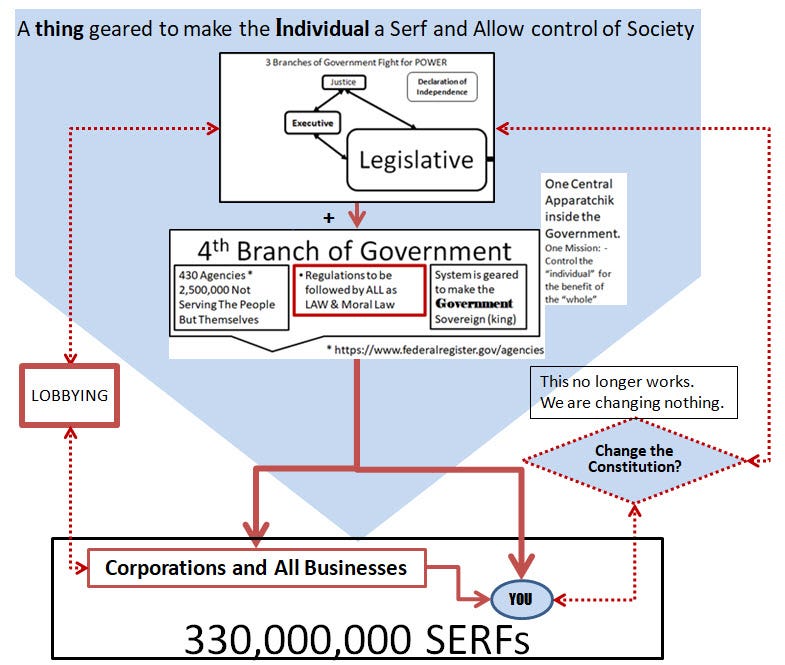
Today the government works insulated from us. They still need us to “vote,” only because in the eyes of the world that makes them legitimate, but we have no say on ANYTHING the government does.
Our government is no longer a system. It has lost its essential properties. The most important one is “working together to achieve compromise.” Rather than we getting the product of an indivisible whole, we get the results of one radical part or the other. It is the sum of the parts; what this means is, “the other party” is just there for the ride. Parts of our population are not represented in the final decision.
This is the discord we are ALL feeling today. If it was an indivisible whole, we would get the product of the parts. The “majority” of the people are represented through compromise.
THAT IS THE OPPOSITE OF WHERE WE ARE TODAY!
Errata:
May 5, 2022
[1] Changed: Under the Title “What About the President,” 4 paragraphs down, the word “CPID-19” to “COVID-19”
[2] Changed: under the title “How Did We Get Here?,” 4 paragraphs down, in the Phrase, “How to declare the entire administrative machine OFF.” The word “OFF” To “UNCONSTITUTIONAL.”