
These 7 Planning Steps Are Closely Connected to Success

Face it. You are not going to be successful every single time out. Get up to bat and take your swings. Who knows, maybe a pop fly or a long homer. You never know unless you try. The law of averages is not your friend.
Do you want money, homes, Corvettes?
Success comes in many forms. To attain whatever you desire, you will need to take specific steps. Some of your goals involve achievement. Such as earning a master’s degree, some will focus on acquiring a thing. Whether it is a car, a bank account balance, or something else.
With a plan, you have a shot. With no plan, failure is a possible outcome. That is entreprenuership!

A map is a planning tool
Say you wanted to drive from Los Angeles to San Francisco. You probably will want to take the shortest, most direct route possible. One way to get there would be to head to Las Vegas, then to Salt Lake City, then west to San Francisco. Don’t get me wrong, you will have a fabulous road trip, it just won’t be the most direct shot to the bay area.
“If something is important enough, even if the odds are against you, you should still do it.” — Elon Musk
Using a map, you could see jumping on Interstate 5 and heading north would do the trick. Even with a stop for lunch, you could make it in under six hours. Boom! You are there!
Is your goal success in another area? Say a start-up business or buying a ranch, or accumulating stocks and investing money? Read on to learn how a plan makes sense as the first step to achieving your goal.
Step One: State your objective
Use your imagination in planning your startup. Brainstorming is a useful tool to help you define your goal. Start with a list of possible outcomes. Make a word cloud to create new ideas. Create an idea page and fill it with notes, diagrams, figures, and other relevant elements. Remember, purpose, approaches, strategies, and plans.
Write down your goal and create notes to show all the paths available to you to reach your finish line. You will have no shortage of ideas. Research how someone achieved success before you and adapt their pathway to your purpose, or create your own. Clearly defining what you want to achieve will help you stay focused.
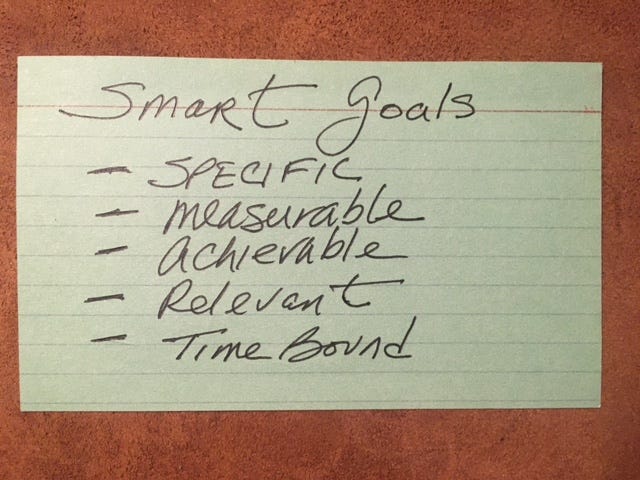
You have probably seen the popular SMART goal format.
Specific — to graduate in 3 years instead of 4
Measurable — start at point A end at point B
Achievable — even if difficult, it is something you could actually do
Relevant — closely connected or appropriate to the person
Time-Based — measured in days, months, or years
Step Two: Refine your plan
You will have a better feel of what you are undertaking once you have something on paper. Are there clear roadblocks? Will you need equipment, money, or expert help? While some obstacles will appear relatively easy, others will require research and strategy. Failing to identify real barriers will set you back. SWOT analysis can help you look at your plans from different points-of-view as you go deeper into strategic planning.
Don’t tell ANYONE. Keep your plans to yourself. You don’t need their approval or permission.
Make sure you are as realistic as possible. You are planning. You are solving problems ON PAPER. Nothing is in motion. Be bold in the face of danger.
In my experience, I have found the more I can do on my own, the better. It is natural to want to tell everyone about your project. Do the opposite. The key to understanding? You don’t need their approval. You don’t need their permission. It is your project. Keep it to yourself. Too many opinions early can derail you. You can avoid all the negative comments and doubtful remarks. Forge ahead. Stoicism is the order of the day!
Step Three: Attach resources to your roadmap
Here comes the strategy part. How will I do this? What steps will I need to take? You need answers to these questions. If you play chess, you know all about opportunity cost. If I move here, this happens, if I don’t and go that way, this other thing happens. Attaching solutions to your roadblocks helps clarify your path.
- Read
- Research
- Apply thinking
- Ask questions
There are plenty of decision support tools and reading material to help you.
A word about overcoming roadblocks. Dealing with adversity is part of life and doing something important. There is always something in the way. Look at what is blocking you as an opportunity. Is it possible to change the problem? Will a new solution be needed to continue?
You can not control every detail. It is possible to respond creatively and positively. Products evolve more slowly than services. Think of it this way. Once you are in the ballgame, you can make changes as needed to respond to challenges. Easier said than done but not impossible.
Step Four: Tools of production
If you are starting a company, the idea of owning the tools of production is an important concept. A friend of mine runs a grass cutting side hustle. He calls his pursuit little ole blue-collar me. We were in a conversation with others who run businesses. We stopped him. We reminded him he was a capitalist. That he owned the tools of production. That he was investing not only money, but his blood, sweat, and time. He was banking his cash and plotting equipment upgrades, just like a capitalist. He owned the tools of production.
Collecting tools depends on your product. In the digital age, tools are for the taking. Whether it is GSuite, Zoom, Trello, or Mailchimp, it is easy to customize and scale them to your needs. If you need a factory and suppliers, you will need to scour directories and network your way to a workable solution.
Step Five: Networking
If you are planning to buy a ranch, you will need contacts. Do you know who the ranch specialists are in your area? Do you know where you want your ranch to be? Do you have the cash now, or do you need a banker? A contact list will help you here. Send emails, make the calls, line up your team of experts.
Sources of information may surprise you. Check farm equipment dealers or the local ranch and feed store for leads. If you are struggling here, ask for help. Ask for referrals. Realize you can’t do this alone.
Step Six: Test your plan
Give your plan a test run. How does it hold up? Is there light at the end of the tunnel? Do you need to add or subtract steps to your plan? Are you starting in the right place? How do you know?
Take time to reflect on your plan. How do you feel? What is missing? Is this something you want to forge ahead with? Harden your plan. Avoid random or whimsical changes. You are the project manager. Stay your course. You need to own your minimum viable product.
“If you decide that you’re going to do only the things you know are going to work, you’re going to leave a lot of opportunity on the table.” — Jeff Bezos
Create different scenarios to see how your mission and your resources align. This will help you plan for the future. You have time to think through roadblocks and create solutions to evolve. The ability to adapt and recover quickly from adversity is the key to success. Things change rapidly.
Disruption is to be expected. Test ideas to make your operation resilient.
Step Seven: Launch
Get in the game. In professional services, it is easier to start and evolve. Get something going. Keep an eye on customer feedback. An all ears approach will help you make adjustments. It is perfectly okay to change little by little, adding here, subtracting there.
Launching a product is difficult. Having to immediately change your design after launch could be a real disaster. Planning can eliminate uncertainty. Think of the problem a carmaker has if something goes wrong with a new model. They put out a recall to make the fixes needed to keep going and correct the flaw with the next release of the model.
The rewards of entrepreneurship are storied. We have examples of visionary leaders going from nothing to riches. Fred Smith at FedEx, Micheal Dell at Dell Computer, and Jeff Bezos at Amazon are great examples of overcoming obstacles and refining their products as they went.
Make a plan, be bold in the face of danger, and never give up!

*** *** ***
Douglas Pilarski is a writer/journalist living in Portland. He covers luxury goods, lifestyle, exotic cars, CJ-CX, workplace issues, food, horology, and tech. He is a regular contributor to medium.com
sawyertms.com \\ [email protected] \\ medium.com/@dpilarski
IG: sawyertms1 \\ @realsawyertms \\ @dpatlarge
Copyright © 2020 AstonBell Media
All rights reserved.
*** *** ***