
There’s A Reason Progressives Can’t Sell Ideas — Even If They’re Worthy
Progressives should frame their policy agenda in Conservative’s language and use the right level of government to win them over

There are two major ways Progressives can win the support of Conservatives and the Centre to achieve their policy goals:
- Using the right language
- Using the right level of government
Using the right language
There are certain themes that appeal to progressives. Those like “equality”, “fairness”, “helping the vulnerable and disadvantaged”, and “the rich not doing their share”.
Progressives use these themes and related words to convince conservatives of the merits of their argument.
Arguments like:
- “Immigrants and people with criminal records are disadvantaged and need assistance”
- “Climate change is hurting animals and nature, impacting vulnerable people in far off lands”
- “A higher minimum wage is important to improve equality for the poor and make sure people get a fair share for their efforts”
The problem here is not that Conservatives are heartless, ignorant or selfish — as some might portray. It is just that the statements above don’t “trigger” many of them.
Themes that appeal to conservatives include things like purity, “patriotism”, family, spirituality and tradition. With this in mind, the previously mentioned arguments could be rephrased to be something along the lines of:
- Battling pollution is important as it helps keep our virgin forests pure and waterways clean
- Our country’s tradition has been to welcome migrants who are fleeing persecution and pursuing liberty. In line with tradition — we should continue to welcome immigrants
- Freed convicts and felons should be forgiven and helped to get back on the wagon so they can better contribute to our great country
- Raising the minimum wage would enable those earning less to better protect and look after their families
This idea is supported by empirical evidence as per the experiments done by Rob Willer from Stanford University with thousands of participants.
Using the Right Level of Government
Most countries have at least two levels of government:
- a national one which handles issues like defence, foreign affairs, and trade; as well as
- a provincial or regional government which is responsible for things like housing, hospitals, electricity and gas
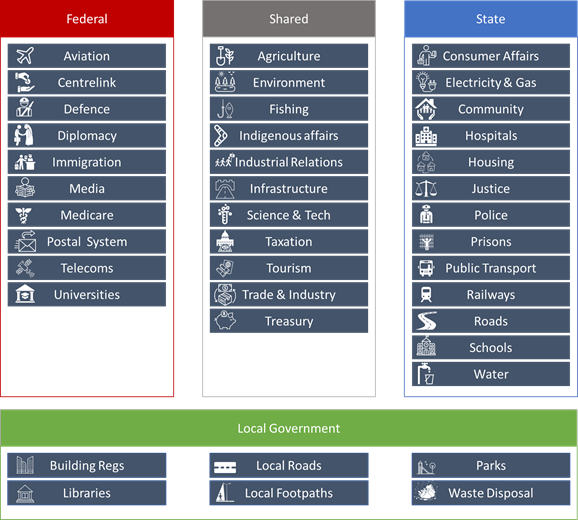
People who live in more urbanised provinces (like California in the US, NSW in Australia or Kerala in India) will experience and view life very differently to those in more rural areas.
Take the issue of climate change:
Big city dwellers experience pollution from their factories, masses of cars, and refuse that comes from a dense population of humans.
People who live in less populated areas typically don’t see these issues and thus live in more pristine areas — so for them environmentalism is a big issue.
If you were a person in Smalltown USA, the Cotswolds in the UK, or Rockhampton in Australia — who is probably on a relatively modest income as it is (when compared to your counterparts in New York, London or Sydney), and are told that you need to front up money to support green initiatives (like a carbon tax) or forgo local jobs (say in coal mining) because of some unseen pollution problem — you would understandably balk at the idea.
Why should you pay for a problem that doesn’t appear to affect you — let alone one you don’t believe you created in the first place?
The opportunity here is to have local or state governments do the heavy lifting in delivering as many of the outcomes as possible — as opposed to trying to solve it at a national level.
It is not about having an ideological war in choosing between “big government” and “small government”. It’s about only having big government solutions for things that cannot be solved by regional ones.
Conclusion
Neither Conservatives or Progressives have a monopoly on morality. They just have different values.
By using the right language and the right levels of government to pursue a policy agenda — both sides of politics will be able to build a bridge to engage with each other as well as more often deliver outcomes that would benefit everyone.
Often — the problem isn’t that either side of politics disagree on the objectives sought, only the way to go about addressing them
You may also like: