
Our Democracies are Broken— Here are Six Suggestions to Fix Them
Governments we elect must represent the majority of the people, not just those with the deepest pockets or who bother to turn up
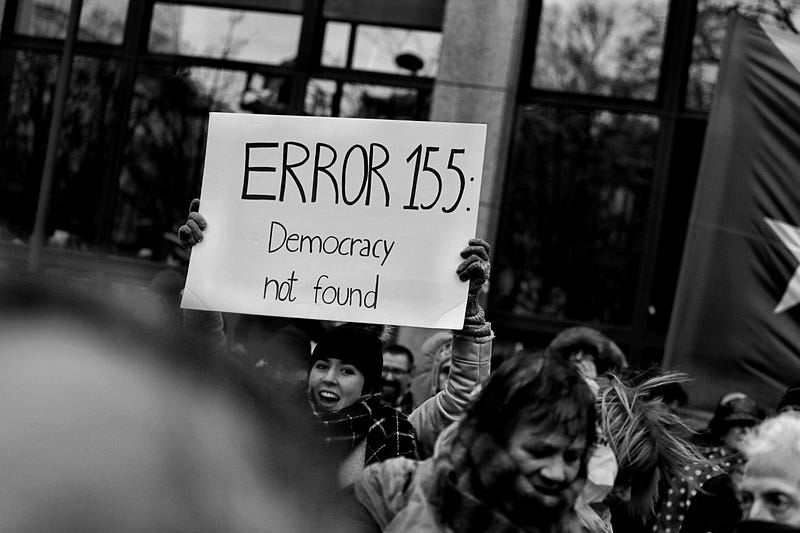
Living in liberal democracy means that our governments are chosen by the people. They should represent and execute on our society’s needs, wants, and best interests. So they say.
While that might be the spirit of the system, there is a growing divergence between the will of the people and the governments that are being elected.
Our democratic systems are no longer fit for purpose, but there are some concrete changes we can make to improve the alignment between the wants of the people and the government we elect.
How democracies came to be
Modern-day democracies have been formed in one of three ways:
- The slow devolution of power, prised away, from a central monarch over centuries. In the erstwhile British Empire, this began with the Magna Carta and the Cortes of Leon for the Spanish one
- The coming together of several independent clans, tribes, or states to form some sort of confederation. Although surrendering overall suzerainty to a central authority, they retained many powers such as the ability to select the overarching leader. The Electors in the Holy Roman Empire or the old Swiss confederacy come to mind
- The wholesale (often violent) overthrow of centralised authorities — establishing an entirely new political system — root and stem. Notable examples of this include the American war of Independence and the French Revolution
The above processes saw the establishment of a system whereby people could vote for a representative from their locale. One who would go to champion their views and interests. At The Capital.
Times have changed, however — and the model has not evolved with it.
Problem 1: Democracy doesn’t scale
Malkajgiri, a single electorate in India, has 3.2 million voters. That’s roughly the population of the entire country of Mongolia!
The weight of the Malkajigr-ian denizen’s vote has been diluted so much it effectively renders them disenfranchised.
In a similar vein, Nunavut in Canada is the largest electoral area in the world covering 1.75 million square kilometres. If it were a country, it would be the 16th largest in the world — alongside Libya. That is a massive area for one representative to cover.
Problem 2: Concentration of power
The other major problem is the ability for private interests (think large multi-national companies, industry bodies, or just billionaires) to lobby and bankroll political campaigns in order to look after their interests.
This phenomenon is further exacerbated by the fact that more and more wealth is being concentrated in the hands of fewer and fewer people. Two notable facts:
- The 26 richest people in the world have more wealth than 3.8 billion of the poorest.
- In the US for example, 1% of people have 40% of wealth.
It is not unreasonable to argue, that the top 1% of people exert more than 1% of the influence on the political agenda in our democracies.
The growth of power and influence of a small minority upon the political landscape comes at the expense of the wider populace.
Power is a zero-sum game
For many — the democratic process has been diluted to futility. To support this, a number of changes could be made.
What Democracy 2.0 could look like
There are six things we should look to institute uniformly across all the major democracies:
1. Compulsory voting
Many countries with voluntary voting have voter turn out rates of around 50–70%. Examples include the UK where it is 63% of the voting-age population, 56% in the case of the US, and 66% in India.
If governments in these countries are elected on about half the number of votes (equating to about 30% of the population), it means that almost 70% of people do not vote for the winning party. The new government then by definition has no clear mandate to rule nor a signal of the electorate’s will.
By forcing people to vote in elections, it helps counter voter suppression tactics employed in some places, drives a higher level of engagement in the political process by individuals, and results in a far more representative government.
2. Preferential voting
In most democracies — if you vote for a candidate and they don’t win — your vote is burnt. Whichever single person ends up with the most number of votes wins. This is called the First past the post system.
This again often leads to results where a candidate wins their seat with 30% of the vote. This means 70%, of those who voted, actually voted against this person.
This is even more alarming when considered in a context without compulsory voting — here only 21% of the electorate would have voted for the winner (30% of votes in an election where 70% of people vote).
Preferential voting gets around this. If you vote for a particular candidate, and they do not win outright — your vote does not get burnt but is “passed on” to a candidate nominated by the person you originally voted for.
Ideally, your candidate would only pass on votes to people whose policy platform is most similar to their own. As a result, whilst your chosen candidate might not get your vote, at least someone “similar” does.
Playing this out across the field of candidates in an electorate means that whoever wins a particular seat is far more legitimate.
3. Four-year terms
Elections every two or three years is too frequent.
Politicians are too focused on short term measures, and about winning the next election.
Four-year terms allow them to not have to be overly concerned about day to day public opinion and execute their agenda without shortsightedness.
4. Get the money out of politics
Limit the amount of money that can be spent during a political campaign — per lower house seat, and senate spot.
This reduces the barrier for new entrants to get into the system, whilst limiting the ability for well-funded incumbents to press their advantage.
Parties should still be able to raise funds to run their organisation through donations, fundraisers, fees and other measures — but only from individuals; not organisations. No exceptions. Not for listed companies, private ones, protected industries, or even for charities.
Lobbying and industry consultations are important and should remain as a feature of our political ecosystem. The amount of money they can spend directly or indirectly upon a politician should be tightly regulated. Gifting $1M of tickets to the world series finals is a no-no, whereas they should be able to spend $1M on policy research and development to support their cause; or in efforts to change public opinion.
5. Direct representation
You vote at the election once every few years. Then, your opinion on every issue debated in congress/parliament is ignored until the next set of elections.
Our elected representatives pass around 100–200 bills a year (a number I based on a sample on Australia, the United States). Surely you as a citizen should be able to weigh in on some of them.
Providing a mechanism (online, or otherwise) through which citizens of a particular electorate can voice their support or opposition to a matter being debated will better enfranchise the populace.
You should even be able to influence your particular MP to introduce new bills on your behalf (provided you have sufficient support in the community).
6. Electorates of similar size
The size of each electorate should be approximately the same in terms of population (not just citizens). This allows places with larger proportions of non-citizen or children under the voting age to not be penalised.
This might still result in geographically ginormous electorates in sparsely populated regions. To overcome this — where an electorate is significantly larger (area wise) than the average electorate, it should be split into a smaller one.
While this results in voters of these regions having their vote “magnified ” -it does help ensure that representatives elected from this area are able better cater for the interests of the region — not just of the voters themselves but the landscape itself including national parks, natural resources, border security and other non-human assets.
Conclusion
Combining the above measures will result in more people turning up to vote, the election of parties more closely aligned to the general electorate, and a set of politicians not beholden to moneyed interests — yet having a continuous open dialogue with the citizens they represent.
What do you think? Are our democratic systems outdated? Are there any other measures you think should be adopted?
Let me know in the comments below.
You may also like:


