avatarKesh Anand

Free AI web copilot to create summaries, insights and extended knowledge, download it at here

3533

Abstract

ir daily existence (think farting) — which is <a href="https://www.onegreenplanet.org/animalsandnature/methane-vs-carbon-dioxide-a-greenhouse-gas-showdown/">100 times worse than CO2</a> as a greenhouse gas.</p><p id="7da0">Housing and feeding these animals also requires a significant amount of water, and about <a href="https://www.theguardian.com/environment/2018/may/31/avoiding-meat-and-dairy-is-single-biggest-way-to-reduce-your-impact-on-earth 1kg">83% of all Agricultural land</a> currently in use — not just for the animals to stand upon, but to grow the plants they eat.</p><p id="d83c">Now while some might advocate giving up meat, this is not going to happen.</p><p id="e562">We, the people, on mass, do not have the willpower to resist these tasty temptations; nor do large burger and steak chains have the mercy to spare us from their advertising or to change their business models.</p><p id="0fcd">This is where synthetic meats come in.</p><p id="005a">Grown in laboratories today, and likely in factories tomorrow — feeding mankind on synthetic meats avoids the need for the huge amount of land and water to raise these animals, the methane they would produce, and placates those morally opposed to the slaughtering of animals to satisfy our taste buds.</p><p id="908e">This prevents the bulk of the 18% of emissions ever entering our atmosphere in the first place.</p><p id="ba99">Further, now that we would have removed our reliance on 83% of agricultural land as mentioned above — these vast tracts can be allowed to “re-wild”. Once returned to nature, these forests will serve a significant role in reabsorbing the CO2 floating around the atmosphere.</p><p id="66f3">Given synthetic meats address both the unnecessary creation of emissions and sequestering of them from the atmosphere; this is a key area that we should be focusing on to tackle climate change.</p><p id="55ba">We’ve proven it can be done, but now our focus should be on driving down the cost of producing it as well as being able to create and distribute them in commercial quantities.</p><p id="2929"><b>Air conditioning and refrigeration</b></p><p id="5d7e">Air conditioners and refrigerators utilise and leak halocarbons, notably Chlorofluorocarbons (CFCs) and Hydrofluorocarbons (HFCs). They comprise about <a href="https://www.vox.com/energy-and-environment/2016/10/12/13250202/hfcs-air-conditioning-montreal-protocol">8% of the global warming</a> impact and are about 10,000 times worse than CO2.</p><p id="9c51">As you could imagine — these home appliances are particularly useful in hot climates — places like India, China, much of the rest of Asia, and Africa.</p><p id="5c8a">Unfortunately, as these countries bring literally billions of people out of poverty (I never thought I’d say that was unfortunate); their access to these technologies will increase which will in-turn increase the impact of halocarbons on climate change.</p><p id="0780">There are less harmful alternative chemicals we could use instead of CFCs and HFCs. They are, however, more costly — a burden which would be disproportionately shouldered by those just arising out of poverty.</p><p id="7b9d">Richer countries should band together to help subsidize the transition away from halocarbons in developing countries across the globe. Some attempts are already being made in this space via the multi-lateral fund for HFCs.</p><figure id="6ad0"><img src="https://cdn-images-1.readmedium.com/v2/resize:fit:800/1*5rKwf4t9c_HZR1YdETXB0w.png"><figcaption>Family Planning |

Options

| Credit: Gerd Altmann via Pixabay</figcaption></figure><p id="5a43"><b>Female empowerment</b></p><p id="98c0">Each person alive requires <a href="https://www.scientificamerican.com/article/the-world-is-not-enough-for-humans/">54 acres</a> of land put to use in order to sustain them. More people in the world means a greater demand on resources which in turn increases the impact on climate change.</p><p id="58c8">Family planning and the educating of girls has been identified as one of the most powerful things we can look at in Paul Hawken’s book: Drawdown.</p><p id="f8fa">Educating girls means they make better choices around household consumption (they have traditionally been responsible for things like food, water and wood used as fuel), and that they have fewer children.</p><p id="9f14">This not only reduces emissions but improves the quality of life for those involved and increases economic activity as educated women are more involved in the formal workforce.</p><p id="7994">Let’s face it — female empowerment is an issue greatest in developing nations.</p><p id="831e">In addition to economic challenges, there are also cultural barriers to overcome. Tackling this will require concerted efforts by developing nations — with learnings and successes from one being passed to the other.</p><p id="9975" type="7">The time to take carrot and stick approaches to induce companies and the wider populace to reduce emissions has passed.</p><h1 id="53eb">Conclusion:</h1><p id="6b76">Climate Change is the greatest peril facing humanity at this time. The issue has been known for decades, and we have been too slow to address it.</p><p id="63c0">The time to take carrot and stick approaches to induce companies and the wider populace to reduce emissions has passed.</p><p id="ff4c">Countries need to invest in new technologies and drive solutions beyond just their own borders if we are to meet climate objectives to reduce emissions, avoid the political hoo-ha, and not impact economic productivity and growth.</p><p id="72a9"><i>You may also like:</i></p><div id="4864" class="link-block"> <a href="https://readmedium.com/why-you-shouldnt-interrupt-kids-while-they-are-watching-a-show-5635ae0d3476"> <div> <div> <h2>Interrupt your kids while they are watching a TV show? That’s dangerous parenting.</h2> <div><h3>Kids’ shows end with a moral lesson. Turning off the telly midway teaches them about the moral failure — but not its…</h3></div> <div><p>medium.com</p></div> </div> <div> <div style="background-image: url(https://miro.readmedium.com/v2/resize:fit:320/1*12eGVBXgN3wsYeauKvVUsA.png)"></div> </div> </div> </a> </div><div id="fe95" class="link-block"> <a href="https://readmedium.com/all-life-on-earth-will-be-wiped-out-and-here-is-why-23c1a155ffee"> <div> <div> <h2>All life on earth will be wiped out, and here is why</h2> <div><h3>Earth is the only place in the known universe where the existence of life has been confirmed. Over 8.7 million species…</h3></div> <div><p>medium.com</p></div> </div> <div> <div style="background-image: url(https://miro.readmedium.com/v2/resize:fit:320/1*oqsMGg4Ka-fHo5c2vyPSmw.jpeg)"></div> </div> </div> </a> </div></article></body>

Forget Renewables — The Solutions To Climate Change Are Meat, Women And Air Conditioning

Instead of shifting where we source energy from, we should tighten up where we use it
The big 3 solutions to climate change

Over the last two centuries, humans have greatly increased the emission of greenhouse gases through our various activities (such as industrialisation, transport, and agriculture).

At the same time, we have also reduced the capacity for the environment to absorb them (through deforestation, sea bed trawling, and so on).

This has given our planet a disease: high concentration of greenhouse gases in our atmosphere (notably of CO2, CH4, and N2O).

Devastating symptoms of this disease are in our future, including: the submerging of entire cities and countries under the sea; mass species extinction; and breakdown of the ocean’s conveyor belt.

“Our current approach to climate change requires personal sacrifice of our consumerist wants, curtailing of economic activity, and overcoming political challenges”

Our current approach

To date, much of our response to this has been around making vague, non-binding commitments to reduce the amount of emissions or impose economic penalties to big polluters through mechanisms like a tax on carbon, emissions trading schemes, or carbon sequestering.

Apart from not being the most direct path to solving the issue, it also hits political roadblocks from oil and gas companies, climate skeptics, and trying to align nearly 200 nations — meaning we are doing too little too late.

Our current approach to climate change requires personal sacrifice of our consumerist wants, curtailing of economic activity, and overcoming political challenges.

A better approach

A better solution might be to sidestep the debate, negotiations and machinations entirely.

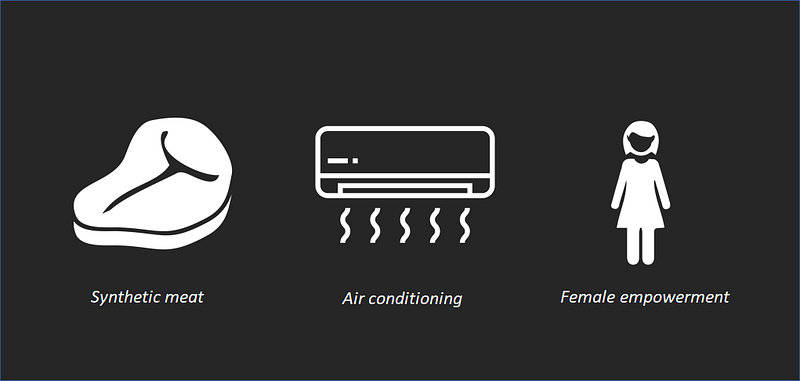
This would be done through technological and social development in some of the areas most responsible for climate change. Three big-ticket focus areas include:

  • the commercialisation of synthetic meats
  • replacement of hydro-fluorocarbon gases in air conditioning and refrigeration
  • empowering girls and women
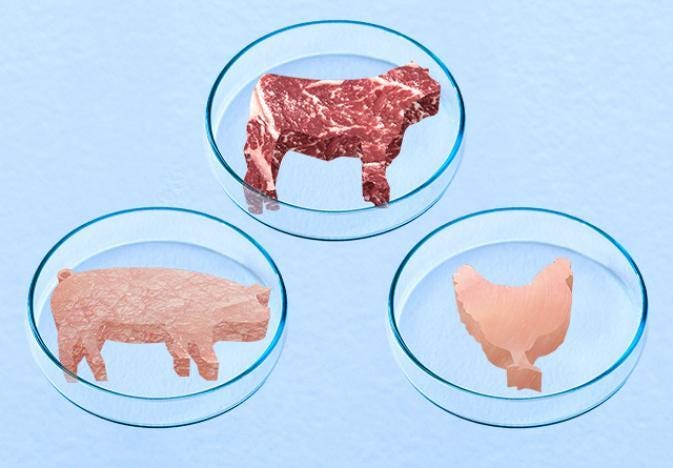
Mmm, carbon neutral steaks || Credit: Lindsey Benne via geneticliteracyproject.org

Synthetic meats

Farming Livestock to support our needs for meat, eggs and milk is thought to contribute about 18% of global greenhouse gas emissions. In fact, 1KG of beef results in up to 300kg of greenhouse gases.

Think about that for a moment.

A third of a tonne of these gases are produced each time you have a kilo steak (or if you and the fam go out for a few 200–300 gram slabs). That is an insane amount.

These animals emit a lot of methane simply through their daily existence (think farting) — which is 100 times worse than CO2 as a greenhouse gas.

Housing and feeding these animals also requires a significant amount of water, and about 83% of all Agricultural land currently in use — not just for the animals to stand upon, but to grow the plants they eat.

Now while some might advocate giving up meat, this is not going to happen.

We, the people, on mass, do not have the willpower to resist these tasty temptations; nor do large burger and steak chains have the mercy to spare us from their advertising or to change their business models.

This is where synthetic meats come in.

Grown in laboratories today, and likely in factories tomorrow — feeding mankind on synthetic meats avoids the need for the huge amount of land and water to raise these animals, the methane they would produce, and placates those morally opposed to the slaughtering of animals to satisfy our taste buds.

This prevents the bulk of the 18% of emissions ever entering our atmosphere in the first place.

Further, now that we would have removed our reliance on 83% of agricultural land as mentioned above — these vast tracts can be allowed to “re-wild”. Once returned to nature, these forests will serve a significant role in reabsorbing the CO2 floating around the atmosphere.

Given synthetic meats address both the unnecessary creation of emissions and sequestering of them from the atmosphere; this is a key area that we should be focusing on to tackle climate change.

We’ve proven it can be done, but now our focus should be on driving down the cost of producing it as well as being able to create and distribute them in commercial quantities.

Air conditioning and refrigeration

Air conditioners and refrigerators utilise and leak halocarbons, notably Chlorofluorocarbons (CFCs) and Hydrofluorocarbons (HFCs). They comprise about 8% of the global warming impact and are about 10,000 times worse than CO2.

As you could imagine — these home appliances are particularly useful in hot climates — places like India, China, much of the rest of Asia, and Africa.

Unfortunately, as these countries bring literally billions of people out of poverty (I never thought I’d say that was unfortunate); their access to these technologies will increase which will in-turn increase the impact of halocarbons on climate change.

There are less harmful alternative chemicals we could use instead of CFCs and HFCs. They are, however, more costly — a burden which would be disproportionately shouldered by those just arising out of poverty.

Richer countries should band together to help subsidize the transition away from halocarbons in developing countries across the globe. Some attempts are already being made in this space via the multi-lateral fund for HFCs.

Family Planning || Credit: Gerd Altmann via Pixabay

Female empowerment

Each person alive requires 54 acres of land put to use in order to sustain them. More people in the world means a greater demand on resources which in turn increases the impact on climate change.

Family planning and the educating of girls has been identified as one of the most powerful things we can look at in Paul Hawken’s book: Drawdown.

Educating girls means they make better choices around household consumption (they have traditionally been responsible for things like food, water and wood used as fuel), and that they have fewer children.

This not only reduces emissions but improves the quality of life for those involved and increases economic activity as educated women are more involved in the formal workforce.

Let’s face it — female empowerment is an issue greatest in developing nations.

In addition to economic challenges, there are also cultural barriers to overcome. Tackling this will require concerted efforts by developing nations — with learnings and successes from one being passed to the other.

The time to take carrot and stick approaches to induce companies and the wider populace to reduce emissions has passed.

Conclusion:

Climate Change is the greatest peril facing humanity at this time. The issue has been known for decades, and we have been too slow to address it.

The time to take carrot and stick approaches to induce companies and the wider populace to reduce emissions has passed.

Countries need to invest in new technologies and drive solutions beyond just their own borders if we are to meet climate objectives to reduce emissions, avoid the political hoo-ha, and not impact economic productivity and growth.

You may also like:

Climate Change
Environment
International Development
Science
Future
Recommended from ReadMedium