
SERIAL FICTION
Then The Military Rushed In To Help
Shadows Of Mayday #16: Recovering the victims #2: Teams worked to salvage the victims and secure the scene
Start reading here
Captain Clarke shook his head as he walked down the line of victims, knowing this was only the beginning. It would take a lot of work to identify the victims before they could be returned to their next of kin.
Hearses arrived from both towns. Moving bodies from the crash site could finally start. They ran into the problem that there was no mortuary in Swakopmund, meaning all victims had to be taken to Walvis Bay. However, there was no way for the hearses from Swakopmund to help take the victims to Walvis Bay, as the crashed plane blocked the road and it would take days, possibly weeks, before the road would be open for traffic again.
The team leader called the military base in Walvis Bay and arranged for an improvised mortuary where all victims could be taken.
“I have already sent several vehicles your way,” the commander of the military base informed Captain Clarke. “Air traffic control in Windhoek called and asked for the military’s assistance.”
While discussing the situation, the commander suggested detouring the road between Swakopmund and Walvis Bay into the desert with the use of pontoons. If the wreck was here for weeks, there would be no way for people who lived in the one town and worked in the other to get where they needed to be.
Captain Clarke was barely done with the phone call when he saw the lights and then heard the roar of the big military trucks approaching from Walvis Bay. It was too dark to see the trucks until they switched off their lights and bathed in still the flashing red and blue of the emergency vehicles.
The army had arrived.
Without disturbing the crash site and with trained precision, the soldiers started work8ng. They placed power generators on the border of the crash site and connected wires to it. Stands with enormous lights appeared from the truck.
Within an hour after the five military trucks had pulled up to the crash site, light flooded the entire area.
Suddenly the tragedy was all that clearer.
Lumps formed in big men’s throats.
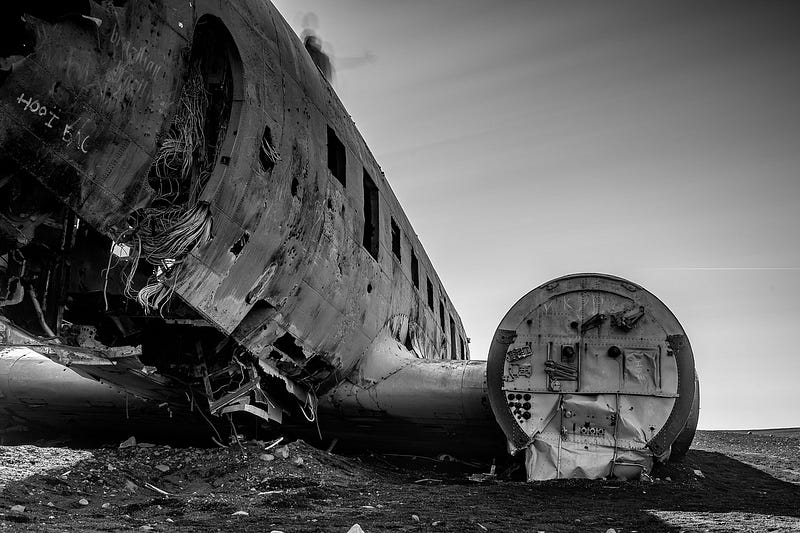
The dignity of the aircraft was gone as it lay there, broken and disgraceful. The eerie sight of the broken wings and intact nose sticking up in the air humbled the people below. Huge tears in the plane's body resembled giant open mouths.
The teams worked and hearses drove to and from Walvis Bay throughout the night. The undertakers from Swakopmund helped to get the victims into the hearses from Walvis Bay. As soon as the military personnel had the pontoons in place, the Swakopmund hearses could also drive to Walvis Bay.
An army truck joined the hearses in transporting the victims. They wanted to get the bigger part of the bodies from the scene before the break of dawn in the desert and before the hearses drew too much attention from people along the way.
It was a painstakingly slow operation.
Just before the daybreak, more trucks arrived, this time with the pontoons. The soldiers worked on a detour for the coastal road. The detour would take the traffic into the desert and around the dunes, to keep the crash site shielded from view.
Just outside of Swakopmund and Walvis Bay, traffic cops blocked the road. Traffic could only use the coastal road again once the detour was ready to be used.
It took well into the afternoon before the detoured road was ready.
By then, they had transported all the victims outside the plane to the improvised mortuary at the military base of Walvis Bay.
Getting victims from inside the plane was more difficult and a longer process. Only one small team could work inside the plane and victims had to be taken out one by one. Before they could remove the deceased from their seats, they had to be photographed and tagged.
Next, they carefully lifted the victim into a rescue stretcher, the same kind used in the mountains when an injured climber needed to be transported. Rescue workers then formed a line and carefully passed the stretcher from one to the other before lowering it to the ground, where a second team of rescue workers waited to take the victim to a hearse or the army truck for transport to Walvis Bay.
While the emergency teams worked to get all the victims out and the military worked to get the detour of the road organized, another team of military men put up several tents.
One tent became the kitchen and mess, and five others had stretchers in it for emergency workers to sleep. They organized shifts.
Emergency workers didn’t want to leave until they salvaged all victims, but they needed to rest. None of them slept for over three hours before they were back on the job.
Forty-seven hours after the first emergency vehicles arrived at the scene, the pilot and his co-pilot were the last victims to be removed from the scene. Only the empty plane and the surrounding wreckage remained.
Early in the evening on the day after the crash, the air crash investigation teams arrived from Windhoek. The army put up another tent for them to use as an operation center, equipped with communication devices to keep in contact with the airports in Amsterdam, Johannesburg and Windhoek.
Not long after the investigation teams arrived, the first traffic appeared on the detoured pontoon road. Police guarded the road on the other side of the dunes from the crash site, making sure no one pulled over and climbed up the dune to see the crash site.
After all the victims were salvaged and taken to the mortuary at the military base, the emergency people left the crash site.
Only Captain Clarke and three police officers from Swakopmund remained at the scene to aid the air crash investigation team.
The investigation to find the cause of the crash started.
Continued: Shadows Of Mayday #17
Find all chapters here.
This story is a work of fiction, and the author’s tribute to all victims of air crashes. Names and characters are the product of the author’s imagination, and any resemblance to actual people, living or dead, is entirely coincidental.
🦋 About Me | 📨 Subscribe | 📚 Stories | 🔄️ Membership | 🦜 Twitter