
Theme U: The AAS Framework and its applications
AAS stands for “Anticipatory Activity System”
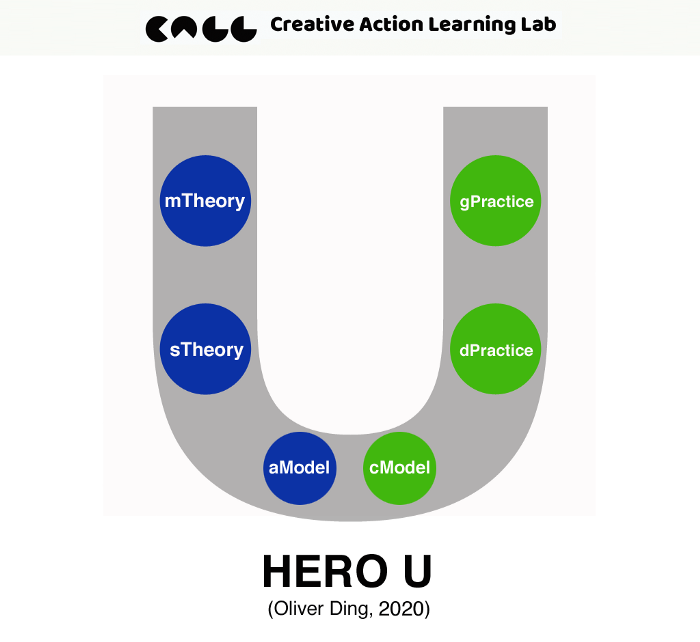
The above diagram is the first tool of the Knowledge Curation Project: Theme U. It was developed for Single-theory Curation.
Single-theory Curation is defined as a special type of activity that aims to understand the landscape of a theory, a theoretical concept, or a theory/concept-related practice such as learning, teaching, creating, etc. It is different from Multiple-theory Curation.
The Knowledge Curation project started from Single-theory Curation because it is a simple version of Multiple-theory Curation. If we can’t understand Single-theory Curation, we definitely can’t understand Multiple-theory Curation.
The HERO U diagram adopts the Width way and defines six types of objects of knowing:
- mTheory: Meta-theory
- sTheory: Specific Theory
- aModel: Abstract Model
- cModel: Concrete Model
- dPractice: Domain Practice
- gPractice: General Practice
You can find some case studies in The Knowledge Curation Toolkit #1: Theme U for Single-theory Curation.
Though the HERO U diagram is designed for curating existing theories and their applications, it can be used as a tool for developing new theoretical frameworks.
Today I’d like to share two examples of using the HERO U diagram for developing the “Anticipatory Activity System” (AAS) framework.
Life Strategy Center
Yesterday I launched the Life Strategy Center on Coda.
https://coda.io/@oliverding/the-life-strategy-center
The Life Strategy Center is guided by the Knowledge Curation approach. We are curating various theoretical resources to build new theoretical frameworks and apply these frameworks to develop new concepts, tools, programs, and environments.
One framework we are working on is called the Anticipatory Activity System (AAS) framework.
The attached diagram represents the knowledge curation approach.
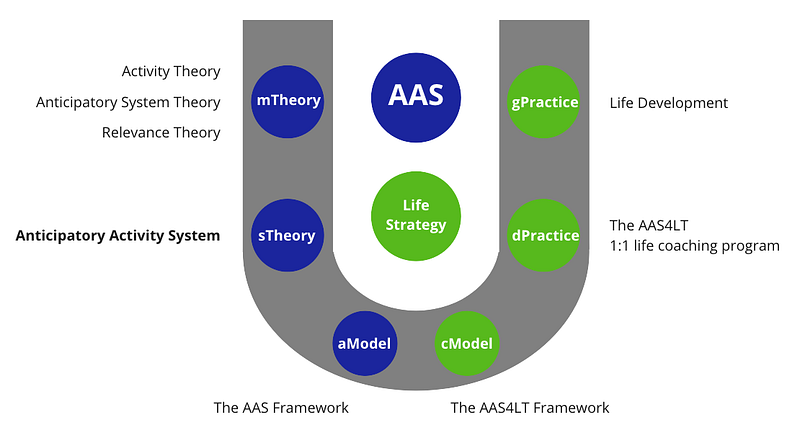
Three blue dots refer to the THEORY side while three green dots refer to the PRACTICE side.
We work on the following four levels:
- sTheory: Specific Theory
- aModel: Abstract Model
- cModel: Concrete Model
- dPractice: Domain Practice
“Anticipatory Activity System” is a specific theory inspired by Activity Theory, Anticipatory System theory, Relevance theory, etc. It defines the basic model of the AAS framework:
- First-order Activity / Second-order Activity
- The Anticipation — Performance Complexity
- The Self-Other Relevance
The AAS framework is an abstract model which highlights five movements of Anticipatory Activity System.
- Unfolding
- Discovering
- Modeling
- Producing
- Storytelling / Evaluating
The #AAS4LT framework is an 8-step framework for applying AAS to Life Transitions (LT). It considers “Life Discovery Project” as Second-order Activity and “Life Developmental Project” as a First-order Activity. This is a concrete model.
At the domain practice level, I design and host the AAS4LT 1:1 life coaching program.
You can find more details on this page:
Service Knowledge Management
The other progress of the AAS framework is the “Service Knowledge Management” (SKM) framework which was born in July 2022.
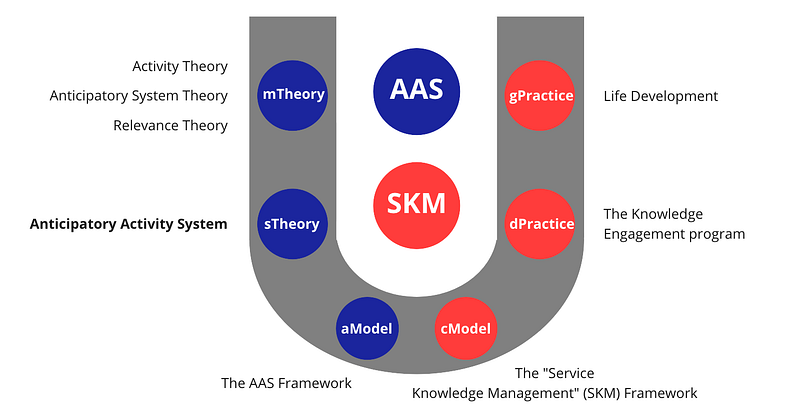
In July 2022, I developed the Knowledge Engagement Program (v1) for a client. Though the program focuses on “Service Knowledge Management”, it can be considered as a general program for applying the Project Engagement approach to Knowledge Management.
You can find a public version of the program on Milanote.
The client’s activity is defined as “Service Knowledge Management” which is a special type of activity.
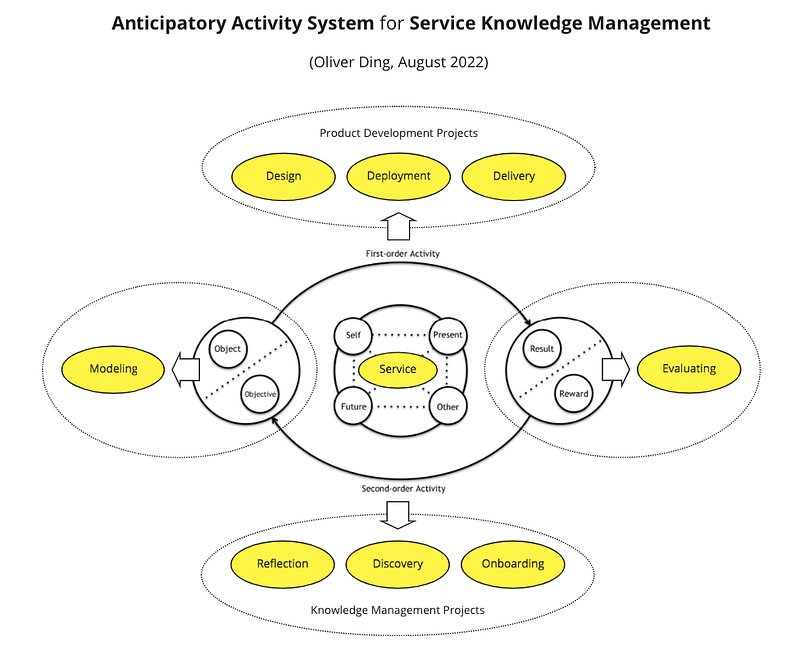
I adopt the “Anticipatory Activity System (AAS)” framework to understand “Service Knowledge Management”:
- First-order Activity: Software Product Development
- Second-order Activity: Service Knowledge Management
Why do we need to use the AAS framework? If we don’t understand the first-order activity, then we can’t understand the second-order activity.
The diagram below is the “Service Knowledge Management (SKM)” framework which is a concrete model.
I host the Knowledge Engagement Program on Milanote which is a digital whiteboard for creative curation. See the screenshot below.
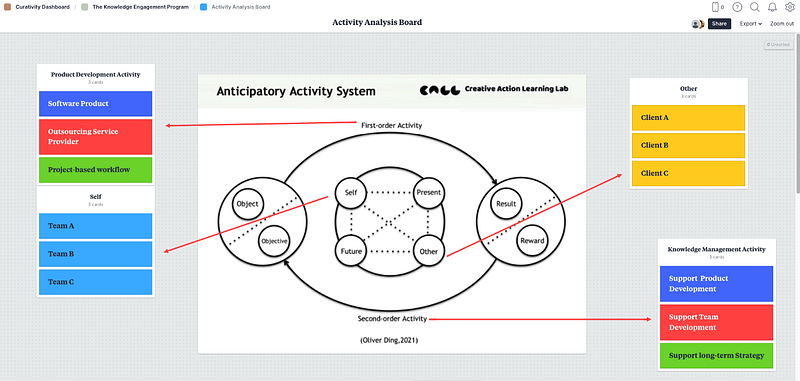
The client’s activity is understood as an Anticipatory Activity System.
The Anticipatory Activity System (AAS) framework is developed for understanding “Self, Other, Present, and Future”. It is formed by First-order Activity, Second-order Activity, and the Self — Other Relevance.
- First-order Activity: Software Product Development
- Second-order Activity: Service Knowledge Management
- The Self — Other Relevance: Self refers to a service provider while Other refers to a client.
We will use the Activity System Model (The Engeström’s Triangle) for understanding First-order Activity and use the Relevance of Zone framework to understand the Self-Other Relevance.
You can find more details in The Knowledge Engagement Program (Public, v1).
Related Links
- Life Strategy Center
- Activity Analysis Center
- Curativity Center
- Life Discovery: The AAS Framework
- Life Strategy Center > The Framework (AAS)
- Activity Analysis Center > The AAS framework for Life Strategy and Service Knowledge Management
- Curativity Center > The Knowledge Engagement Program (Public, v1)
- Curativity Center > The Knowledge Curation Toolkit #1: Theme U for Single-theory Curation


