
The world’s spiciest pepper, as recorded in the Guinness Book, is so hot that it can potentially kill a person.
Just one drop of its sauce can make an entire dish extremely spicy. This is how the world’s spiciest pepper works. Which variety has recently made it into the famous Guinness Book of Records?
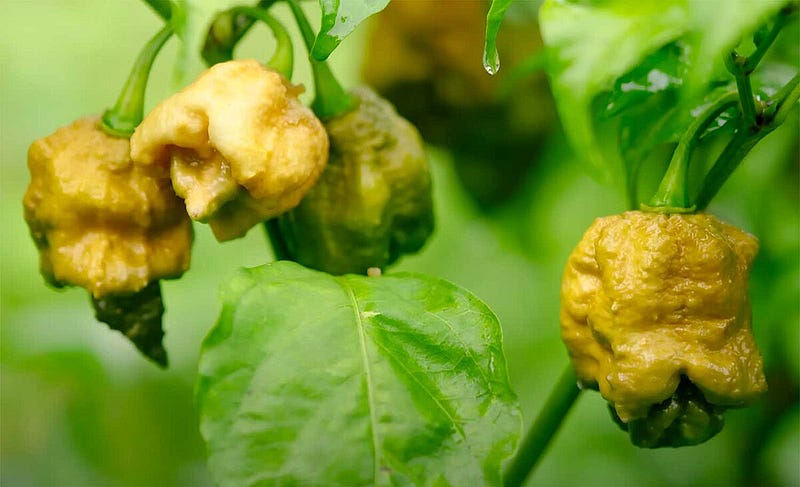
When preparing the world’s spiciest pepper, it is necessary to wear protective goggles and gloves. Consuming the entire fruit can even lead to death. The substance found in the spiciest peppers, called capsaicin, can be dangerous. In large quantities, it irritates mucous membranes, disrupts the nervous system, and causes a strong bronchial spasm.
Capsaicin is a substance produced by plants. It is responsible for the spicy flavor in many dishes and can create a sensation of heat on the skin, stimulating pain receptors.
Hot peppers, also known as chili peppers, primarily belong to two species of this plant:
- Annual peppers (Capsicum annuum) — including varieties like piri-piri, tabasco, cayenne, and jalapeño.
- Habanero peppers (Capsicum chinense) — known varieties include Scotch bonnet, Red Savina, and Trinidad Scorpion.
What influences the spiciness of peppers?
In nature, peppers are dispersed by birds. When their seeds pass through a mammal’s digestive tract, they lose the ability to germinate. That’s why the tissues surrounding the pepper seeds contain the most capsaicin. This substance, which is highly irritating to mammals, shows, at most, pain-relieving effects in birds. In humans, it produces a sharp, burning taste. Capsaicin is the main factor influencing the spiciness of peppers.
To assess the spiciness of foods, a scale developed by American chemist Wilbur Scoville in 1912 is used. He gave extracts from peppers to five tasters to sample. He diluted the extracts with sweetened water until the burning taste became imperceptible. Today, instead of tasting, liquid chromatography is used, which precisely measures the concentration of substances responsible for the spicy taste.
What is the spiciest pepper in the world?
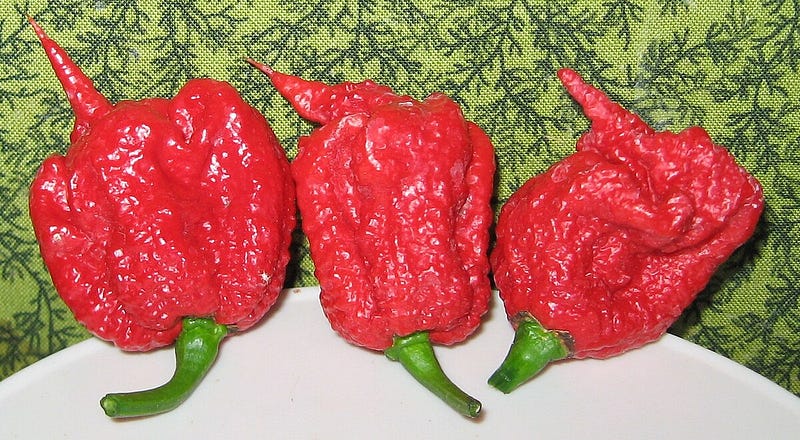
The Carolina Reaper is one of the spiciest peppers in the world. On the Scoville scale, used to measure spiciness, it reaches up to 1.5 million Scoville Heat Units (SHU). For comparison, an average tabasco sauce has 2,500 SHU, and cayenne pepper measures between 30,000 and 50,000 SHU. The Korean gochugaru pepper used for making kimchi has only a few thousand SHU.
In 2013, the Carolina Reaper was entered into the Guinness World Records as the spiciest pepper in the world. Prior to that, the Indian Bhut Jolokia pepper held the title, with a spiciness exceeding one million SHU.
Today, however, the title goes to the Pepper X, which measures over 3 million SHU on the Scoville scale. This record has been officially recognized by the Guinness World Records, even though the recorded measurement in the book is “only” 2.69 million SHU. Pepper X is a crossbreed of the Carolina Reaper and took about 10 years to develop.
Nevertheless, breeders continue their work, and they may soon surpass this record as well. It’s worth noting that both Pepper X and Carolina Reaper were created by the same individual, Ed Currie, a “mad scientist” and chef who heads the PuckerButt Pepper Company, specializing in growing various pepper varieties.
The race among chili pepper breeders
Until the 1990s, habanero varieties, including Scotch bonnet peppers, were considered the spiciest peppers, with a spiciness limit of a few hundred thousand SHU. This changed when the spiciness of the Naga Jolokia pepper from India was measured. It was the first to reach a level of 1 million SHU.
Since then, a race among breeders has begun. They crossbreed the spiciest pepper varieties, most often those from India and Trinidad. Peppers with over 1 million Scoville Heat Units are called “super-hot” peppers. Their fruits contain a high amount of capsaicin not only in the seed pods but also in other tissues. In theory, it is possible to breed a vegetable that will reach a level of 4 million SHU.
The Top 10 Hottest Peppers in the World in 2023 are as follows:
- Pepper X — approximately 3.18 million SHU, developed in 2017.
- Dragon’s Breath Pepper — approximately 2.5 million SHU, created in 2017.
- Carolina Reaper Pepper — approximately 1.5 million SHU, developed in 2010, and entered into the Guinness World Records as the world’s hottest pepper in 2013.
- Trinidad Scorpion Butch T Pepper — approximately 1.5 million SHU, developed in the USA based on a variety from Trinidad.
- Naga Viper Pepper — approximately 1.4 million SHU, developed in England in 2011.
- Trinidad Moruga Scorpion Pepper — approximately 1.2 million SHU, developed in Trinidad.
- Infinity Chili Pepper — over 1 million SHU, developed in England in 2010.
- Naga Jolokia (Bhut Jolokia, Ghost Pepper) — approximately 1 million SHU, originating from India and tested in 2000.
- Red Savina Habanero Pepper — 250–577 thousand SHU, developed in California in the early 1990s.
- Most Habanero Pepper Varieties — 100–350 thousand SHU, originating from the Amazon.
What is hot pepper used for?
The question is, what can such spicy vegetables be useful for? Seasonings made from exceptionally spicy peppers are more economical. A small amount is sufficient to give the dish an exceptional flavor. That’s why some extreme chili sauces are sold with a dropper.
Very hot peppers can also gain popularity due to the pandemic. As we know, COVID-19 can cause a loss of taste perception. An exception might be the perception of spiciness. Unlike other tastes, it doesn’t depend on taste bud receptors. Spicy sensations result from the stimulation of pain receptors in the mucous membrane.
This is why extremely spicy dishes can be the only chance for some COVID-19 patients to experience any taste. It is described as very unusual because it is detached from other flavors that usually accompany it. For example, in the case of kimchi, the salty taste of cabbage and the sourness from fermentation are also essential. But in a situation where every dish seems tasteless, spicy peppers can be simply invaluable.
Attention all readers!
As content creators on Medium.com, we face minimal compensation for our hard work. If you find value in my articles, please consider supporting me on my “Buy Me a Coffee” page. Your small contributions can make a big difference in fueling my passion for creating quality content. Thank you for your support!


.jpg)