Hidden treasures still evoke a lot of emotions. What treasures are still waiting to be discovered?
Who wouldn’t want to stumble upon treasures that would make them a millionaire? For centuries, hidden riches have led seekers on increasingly complex quests: first, mysterious scrolls, then secret maps, and finally, unbreakable ciphers and enigmatic graphics.

Between 1947 and 1956, in the caves located in Qumran on the shores of the Dead Sea, several hundred manuscripts were discovered, written in Hebrew, Aramaic, and Greek. These scrolls piqued the interest of scholars; some contained biblical texts (including entire books of the Old Testament), while others described the customs of a mysterious community inhabiting the region in the early years of our era. Among these documents, one in particular turned out to be exceptionally mysterious as it was not written on papyrus or parchment.
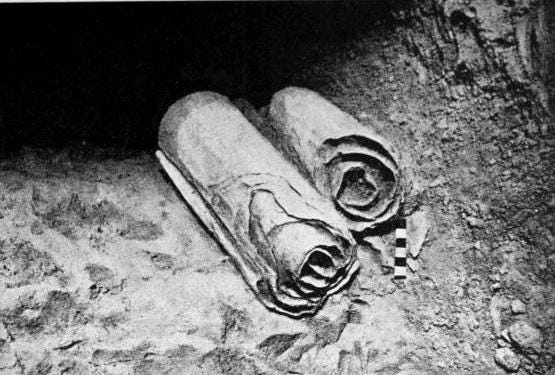
In March 1952, on a rocky shelf in cave number 3, a text was found embossed on a rolled-up sheet of copper. The scroll was unique not only in its material but also in its content. Unlike the other manuscripts, it didn’t contain literary text but rather a list of places where treasures were hidden.
The oldest clue for treasure hunters
Deciphering the list was no easy task. At the time of discovery, the scroll was heavily corroded, and mishandling could have led to its complete disintegration. It wasn’t until a few years later that the decision was made to transport it to the University of Manchester, where it was delicately cut into 23 strips. It was revealed that the scroll was originally 30 cm wide and 2.5 meters long.
The translation of the scroll was entrusted to the biblical scholar Jozef Milik. The dialect in which the list was written, unusual spelling, and specific linguistic deviations made the work take several years. Eventually, it was determined that the document was created in the 1st century CE. In several columns, it listed 63 places where gold and silver, as well as vessels, clothing, and other valuable items, were hidden (an additional point mentioned a duplicate containing further details, but such a document was never found).
Particular excitement surrounded estimates of the quantity of precious metals. After tallying the data in the list, it was believed to include 43 tons of gold and 23 tons of silver! This both ignited a strong desire to find the treasure and raised doubts about its reality. How could an unimaginable amount of gold and silver end up with a modest, ascetic religious community in Qumran? Perhaps the British metallurgist, journalist, and religious scholar Robert Feather found the answer when he suggested that Egyptian measures were used during the creation of the scroll. This would mean that the hiding places contained a total of “only” 26 kg of gold and 14 kg of silver. But the problems didn’t end there. The instructions in the scroll are not sufficiently clear. While each of the 63 places is described, finding them would likely require additional, possibly confidential knowledge.

Differing theories among scholars
It is suspected that members of the Qumran community hid the treasure during the Jewish-Roman War (66–73 CE), likely anticipating its use after the Roman Empire’s forces withdrew from Judea. They didn’t anticipate that the invasion would result in the destruction of Jerusalem and the demise of the community itself. It’s possible that someone from the community used the list and emptied the hiding places.
Contemporary researchers have many different theories about the actual locations of these hiding places. Ideas have been proposed not only related to the Qumran region but also to Jericho, Mount Gerizim, and even the Egyptian desert. However, Jerusalem is most frequently mentioned. In any case, the described treasures have not been found. The oldest “treasure map” described in words still awaits its Indiana Jones.

The First Map to the Eldorado Treasure
Regardless of the weight, the treasures described on the copper scroll could not generate as much excitement as gold in unlimited quantities marked on a real map! It was precisely in the late 15th century that the Americas began to be perceived as a treasure trove containing endless riches.
It’s no wonder, as Christopher Columbus himself declared the discovery of the route to Ofir, the land described in the Old Testament where King Solomon’s gold mines were said to be located. Tempted by such stories and the successes of the first conquistadors, Europeans set sail across the Atlantic, forcibly demanding directions to hidden wealth from the local populations. The indigenous people spun colorful tales that further fueled the imaginations of the treasure seekers.
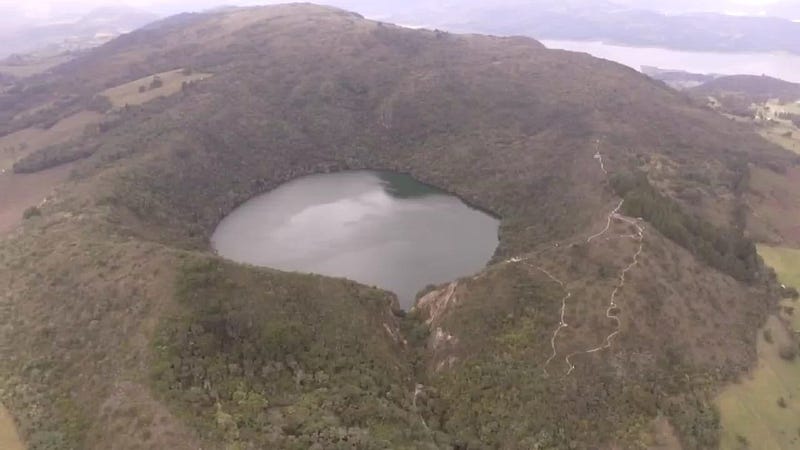
In the 1530s, there was information about a mysterious city near Lake Guatavita in what is now Colombia, which was called the “el hombre dorado” — the golden man city. The legendary land was sought after by Spaniards, Dutch, Germans, and British. The British expedition was led by Walter Raleigh, the favorite of Queen Elizabeth I. He convinced her that he would find Eldorado for her. Several ships were made available to him, which set sail for America in 1595. Raleigh did not find Eldorado, but he did not want to admit failure. To avoid losing the queen’s favor, he decided to… trumpet success.

In a book with the significant title “The Discovery of the Great, Beautiful, and Rich Kingdom of Guiana, along with the Description of the Great and Golden City of Manoa,” he presented his allegedly successful mission. In the publication, which generated immense interest, he even included a map showing the “huge and rich city of Manoa, which the Spaniards call Eldorado.” Raleigh achieved literary success, but that was the extent of his fortune. After a series of misadventures, he ended up in an English prison. In 1618, an executioner severed the head that had conceived the map indicating Eldorado.
Today, even without that map, we can find a place labeled as El Dorado. All it takes is to disembark from a plane in Bogota, where the airport has been given that very name.
Boyish Adventures
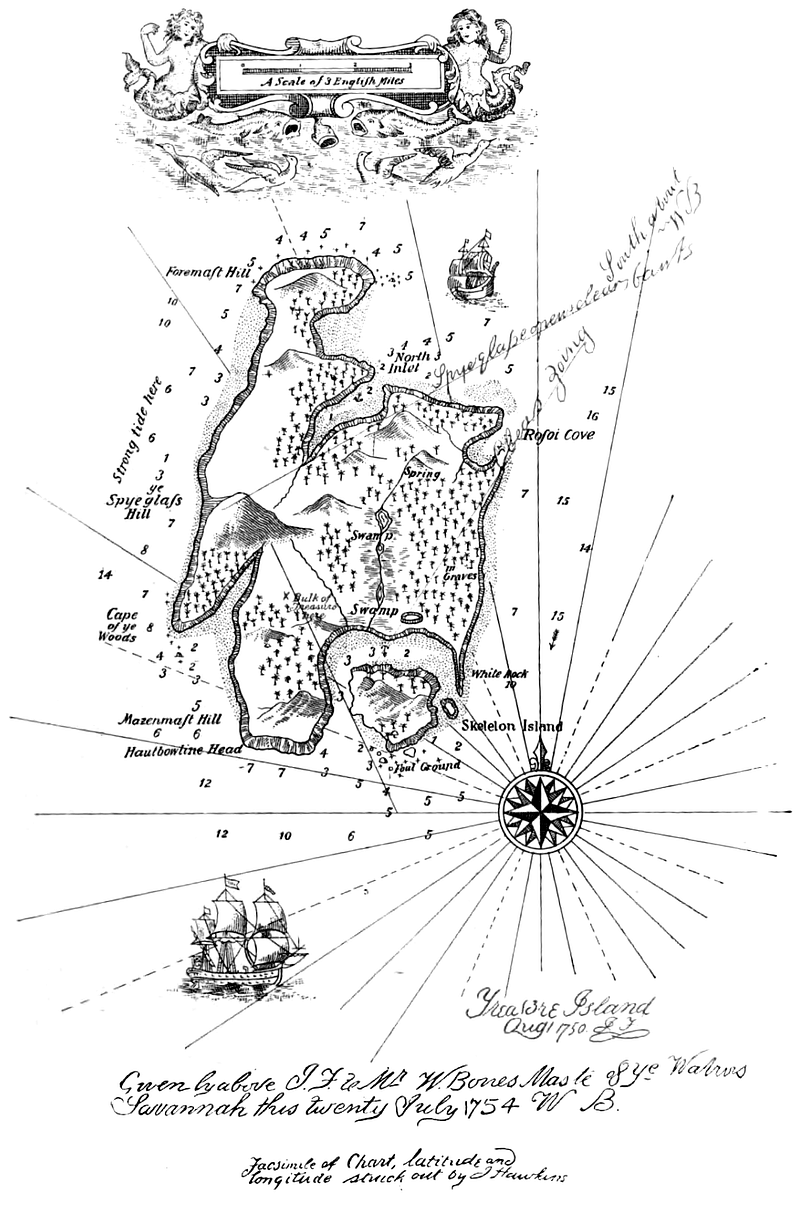
Raleigh had episodes in his life that were pirate-like. When we think of pirates, however, we don’t imagine gentlemen who reside at the royal court. Instead, we envision a bearded man with a wooden leg, an eye patch, a parrot on his shoulder, and a large chest full of gold coins and jewels. This association is both fascinating and far removed from reality, as it owes its origin to a writer’s imagination. When Robert Louis Stevenson wanted to entertain his stepson Lloyd Osbourne, he spun tales of pirates. To capture the boy’s interest, he began by drawing a mysterious map that would show the location of hidden treasure. The story added to it gradually expanded until it grew into a serialized tale in a children’s magazine, and then it transformed into the novel titled “Treasure Island.”
_-_Map_of_Treasure_Island.png)
In the book first published in 1883, the aforementioned map falls into the hands of Jim Hawkins, a young boy working in a tavern. Based on it, he devises a plan to find Captain Flint’s legendary treasure. Alongside Dr. Livesey and Squire Trelawney, he then leads an expedition to make it a reality. The deck of the ship “Hispaniola,” commanded by the hero, is filled with an array of intriguing characters, including the prototype of the most popular vision of a pirate, Long John Silver. There are also former comrades of Captain Flint who plan a cunning takeover of the sought-after treasure. This leads to numerous unforeseen events, collectively forming an extraordinary adventure. However, there can be no doubt that this adventure belonged solely to Jim Hawkins and other fictional characters — though one can still try to find Treasure Island itself.
Pirate Chests
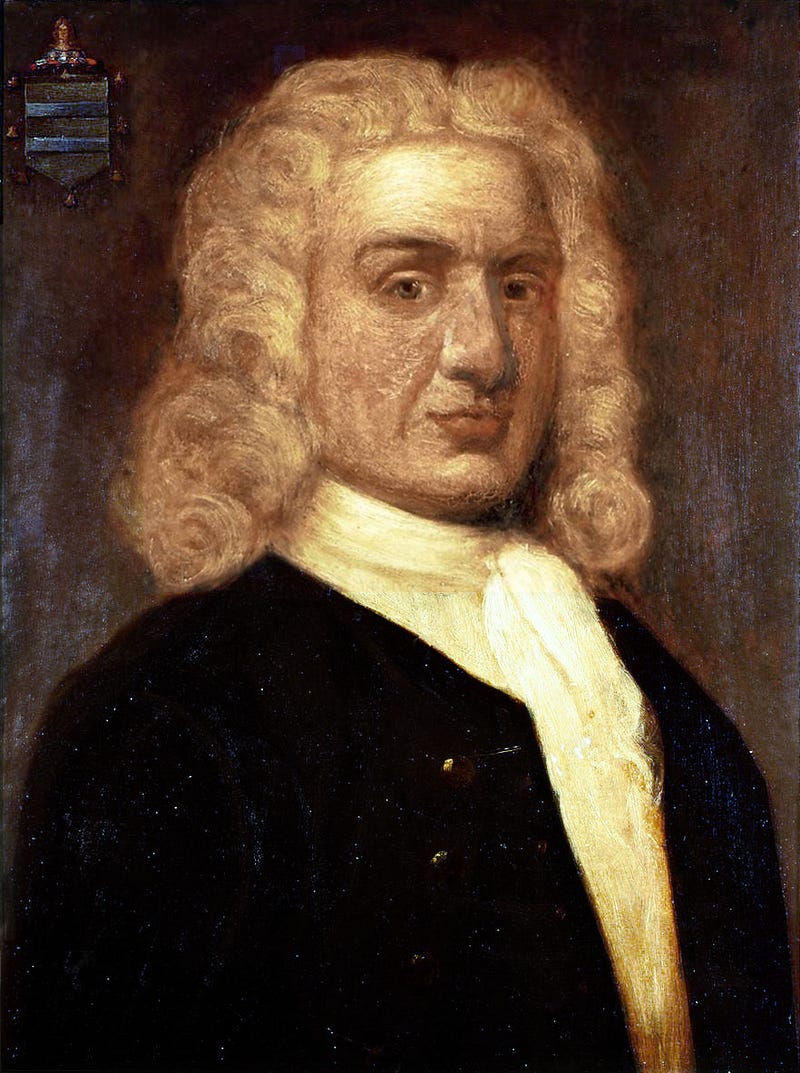
It would be more realistic to stumble upon other historical pirate treasures. For instance, that hidden by Captain William Kidd. This respected mariner (known for his participation in the English-French war) resorted to piracy toward the end of his life. After attacking several merchant ships, he amassed significant booty. When he incurred the wrath of the British East India Company, a formidable institution, it presented charges that turned Kidd into a criminal pursued by the imperial fleet.
Fearing capture, Kidd decided to cooperate with the authorities. During negotiations, he used the stolen riches as bargaining chips. Before his expected arrest, he visited Gardiners Island in New York, where in June 1699, he entrusted the treasure to John Gardiner, the island’s owner (which, incidentally, still belongs to the Gardiner family to this day!). The plan failed — the hoards of gold and silver, precious stones, silk, and other goods were soon recovered by the New York governor, and they were subsequently sent to England as evidence. Kidd was found guilty and hanged along the Thames in May 1701.

The London execution might have closed the chapter on Kidd’s treasures. However, can we be certain that a portion, perhaps a substantial one, of the loot was not hidden by the captain elsewhere? After all, the pirate did not necessarily trust Gardiner completely. It’s no wonder that the treasure continued to evoke emotions for centuries. Additionally, it was fueled by Hubert Palmer. The British enthusiast spent his entire life collecting pirate-related memorabilia with his brother, even creating a museum to display them. Nearly a century ago, he acquired several maps that he purportedly found in purchased furniture and other items once owned by Captain Kidd. These documents depicted a mysterious island. Although it was labeled against the backdrop of “the Chinese Sea,” this fact was deemed a deliberate attempt to mislead potential treasure hunters. The island was sought in other locations.
Many researchers believed that the island depicted on Palmer’s maps resembled Oak Island. This “Island of Oaks,” located off the coast of Nova Scotia in Canada, had long been a target of treasure hunters. In 1795, a group of teenagers discovered a mysterious shaft there. It was announced that the boys had found Captain Kidd’s treasure. In the following years, many individuals and even companies, who acquired search rights, conducted explorations of this object. The “Money Pit” was continually expanded and deepened, often filled or flooded. Among the treasure hunters were well-known figures such as John Wayne and Franklin Delano Roosevelt. Despite repeated setbacks and the lack of any confirmation of their endeavors, the search continues to this day.

.jpg)
Buzzard’s Provocation
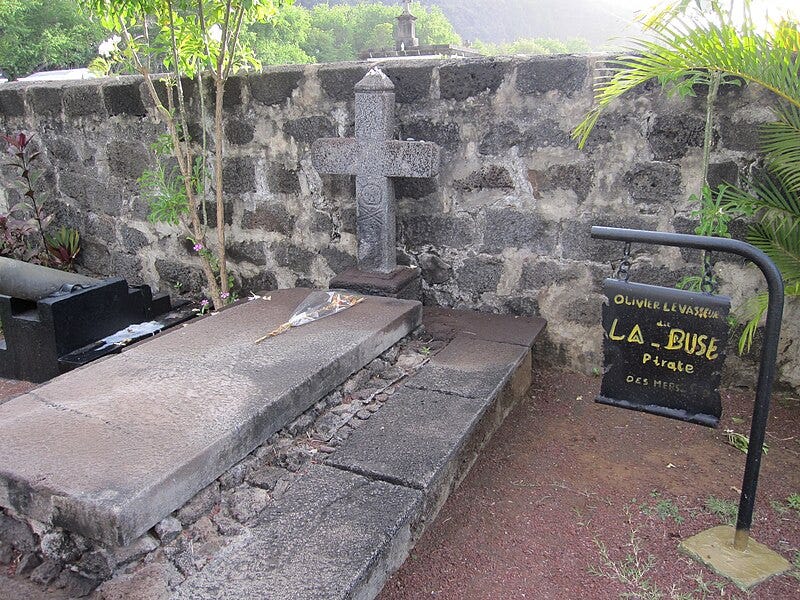
William Kidd didn’t promise anything to the contemporaries or posterity — the search for his treasure was their own initiative. It’s a different story with Olivier Levasseur. This French pirate, known as Buzzard, was a true maritime marauder for many years at the turn of the 17th and 18th centuries. It’s no wonder he became a highly sought-after figure. He was eventually captured on Bourbon Island (now Réunion). He was sentenced to hang, as expected. However, before his execution, he made a gesture that has made him unforgettable to this day. He threw a necklace with an encrypted inscription into the crowd of onlookers (according to other accounts, it was a simple scroll of paper with a cipher or a bundle of papers) and shouted, “Find my treasure, you who can read this.”
The necklace (if it ever existed) did not survive to our times. However, it can be said that it was thrown in the face not only of the contemporaries but also of modern treasure hunters. Levasseur’s cipher, written (or transcribed) on a piece of paper, has still not been deciphered.

Beale’s Cipher
Not only these mysterious signs that supposedly lead to wealth await deciphering. Many people still scrutinize a long series of numbers known as Beale’s cipher. It was presented in a pamphlet published in 1885 by James B. Ward. The booklet also contained an incredibly interesting story.
In 1817, a group of several dozen hunters was supposed to come across a deposit of gold and silver in the vicinity of Santa Fe in the southwestern United States. The gentlemen decided to hide the extracted wealth, and the task of finding a suitable hiding place was entrusted to Thomas J. Beale. He traveled all the way to the state of Virginia on the eastern coast. After safely depositing the treasure, he arrived at the Washington Tavern in Lynchburg. He stayed there for several months, and then returned there several more times. When he left for the west again after another visit, intending to hunt bison and grizzlies, he entrusted a metal box to the tavern owner, Robert Morris. He asked the innkeeper to keep the container until his return, and if that didn’t happen, to open it — but not earlier than after 10 years.
He informed that part of the documents in the box is encrypted, and a special key is needed to decipher them. This key was supposed to be secured with a friend of Beale’s, with the stipulation that it would be sent to Morris’s address no earlier than June 1832. After that, Beale left, and all traces of him disappeared.
However, after ten years, the promised key did not reach the innkeeper in Lynchburg. Morris was not overly curious and only in 1845 did he decide to examine the contents of the entrusted box. He found a letter inside, informing about the discovery of treasure and its hiding place in Virginia, along with three sheets densely covered in numbers. He couldn’t understand the documents, and before his death in 1862, he passed them on to an unidentified friend, whose name we do not know. This friend took on the task of deciphering the text. He believed it was a book cipher, which meant numbering all the words in a certain book and using that to reveal the intended words. The problem was that they didn’t know which specific book to use!
Collecting and examining successive texts consumed a lot of time and money. Finally, one of the three mysterious documents (labeled as number 2) was deciphered thanks to… the United States Declaration of Independence. That was the “book” they were looking for! From the decrypted page, it was revealed that Beale had hidden the treasure in the vicinity of Buford’s in Bedford County. In a basement there, there were said to be pots filled with gold, silver, and purchased gems. Furthermore, the document contained information that the exact location of the basement was recorded in document number 1. The problem was that, by the time they tried to decipher it, the Declaration of Independence was no longer suitable. Just like all the other texts they checked.
Attempts to decipher Beale’s writings have been ongoing for over 100 years. Some impatient treasure seekers are even searching blindly. This has led to the arrest of many individuals who unlawfully entered and dug up private properties in Virginia. These treasure hunters are not deterred by scientific analyses that cast doubt on the authenticity of the information contained in Ward’s 1885 brochure. Cryptologists and linguists have questioned not only the hidden wealth but also the existence of Thomas Beale himself. However, when faced with a treasure estimated at over 60 million dollars, the opinions of scientists seem to be worth very little.
The Abstract Deposit of the Nazis
Americans are even looking for treasures left by the Nazis on their own soil. They believe that a fortune in the form of 100 tons of gold is waiting for them! In the book “Treasure Hunter’s Manual,” published in the 1960s, treasure hunter Karl von Mueller (probably actually named Dean Miller) published an extraordinary image called the Lue map. It depicts Masonic symbols and is believed to lead to a pile of gold hidden in the vicinity of the American-Mexican border. Allegedly, 100 tons of precious metal were transported there at the beginning of World War II. The introduction of such an amount of gold into the market was supposed to destabilize the American economy and prevent the USA from entering the war.
For unknown reasons, the operation by the Nazis was not completed, and the gold remained hidden. It was allegedly taken care of by an unknown American Nazi. He was the one who supposedly created the Lue map. Unfortunately, before his death, he did not have time to reveal how to read it. Reportedly, even specialists from the CIA and FBI were unable to find the key.
Were large quantities of gold indeed in the possession of the Nazis? Were they smuggled into the USA? Are they still there? To dispel any doubts, all one needs to do is decipher a map so abstract that it’s unclear which way to even look at it.


The Silent Heads of Pink Floyd
Treasure hunters can find clues almost anywhere. They even became interested in the cover of Pink Floyd’s 1994 album “The Division Bell.” On one of the two heads shown on the cover, they spotted difficult-to-read numbers. Due to the baroque cathedral in the background, located in Ely, they believed that there was encoded information about a treasure hidden in the vicinity of this English building! Curiosity was further fueled by information spread by an unidentified individual using the pseudonym “Publius Enigma.” This person allegedly promised a reward to anyone who could decipher the code.


It appears that this was part of a promotional campaign initiated by the EMI record company to promote the album. However, Pink Floyd’s drummer, Nick Mason, did not address this issue in his book “Pink Floyd: My Life with the Band.” Likewise, the band’s vocalist and guitarist, David Gilmour, denied his involvement in the provocation in interviews.
What adds intrigue to the whole story is that the monumental heads on the cover were not created by a graphic artist. Storm Thorgerson, the designer of this and many other album covers for the band, ordered the construction of a large sculpture, which was then photographed in a field near Ely. However, there were not just two heads, but four: the metal ones are visible on the CD and vinyl records, while the stone ones are on the cassettes. Supposedly, it’s worth examining all the different covers for possible variations and drawing the appropriate conclusions.
Unfortunately, we can no longer rely on Thorgerson himself, who passed away in 2013, to unravel the mystery. Nonetheless, it’s worth trying, as the world, as it has for centuries, still belongs to the curious.
Attention all readers!
As content creators on Medium.com, we face minimal compensation for our hard work. If you find value in my articles, please consider supporting me on my “Buy Me a Coffee” page. Your small contributions can make a big difference in fueling my passion for creating quality content. Thank you for your support!