
Spiritual Quest
The World’s Largest Meditation Center: Swarved Mahamandir
What’s the underlying purpose of such a mega-structure?
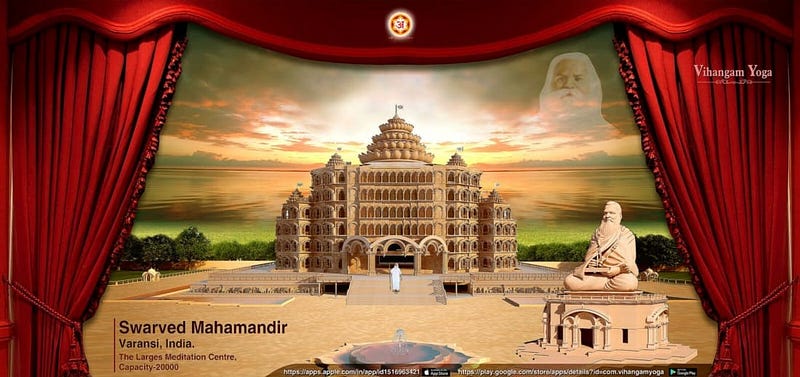
In mid-December 2021, when Prime Minister Narendra Modi visited his constituency and the spiritual capital of India — Varanasi, two events drew global attention. First, the inauguration of the Kashi Vishwanath Corridor. Second, his maiden visit to the Swarved Mahamandir — The World’s largest meditation center in the making.
Swarved Mahamandir is a meditation center without bells and whistles. Apart from being an architectural masterpiece that will amaze humanity for centuries, it also exhibits His Holiness Sadguru Sadafaldeo Ji Maharaj’s Swarved, the encyclopedia of spirituality, through imageries, art, and verses engraved on interior walls.
This blog is not about the architectural nuances of the Mahamandir, rather it talks about the very purpose of such a mega-structure.
Purpose of Swarved Mahamandir
The purpose of Swarved Mahamandir is to rekindle the immense possibilities of human endeavor. This center speaks loud and clear about the possibilities of a spiritual journey and dares worthy seekers to try the testimony of Sadguru Sadafaldeo Ji Maharaj.
मानव शक्तिक बाहरे, जगत काम कोई नाही | बाहर है सो पुरुष का, सर्व शक्ति जेही माही ||
Swarved 3.2.33
The crisp, unambiguous, and inspiring depiction of secrets of spiritual ascend sets Swarved apart. Here, I am sharing my favorite spiritual secrets based on my twenty years of immersion in Swarved.
#1 To meditate, we need nothing
No props, no eligibility criteria, no privileges based on faith, educational or financial accomplishments. Anyone, irrespective of religion, nationality, financial or literary credentials, can take a vow to walk on the spiritual journey and attain the epitome.
One requires pure surrender to know spirituality in its entirety and arduous practice to attain the universal consciousness provided one has the Sadguru by one’s side.
आतम जानन के लिये, अन्य करण नही काज |
आप आप को जानता, सुमिरन पुरुष सकाज ||
Swarved 2.10.20
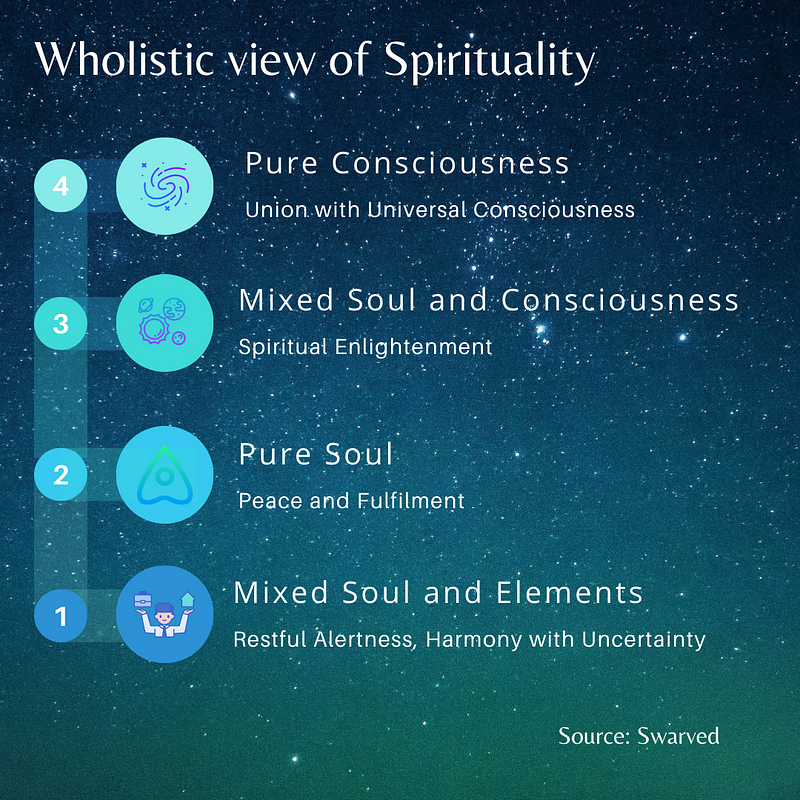
#2 Meditation has four horizons
The purpose of meditation is to know. To be restful and alert, to become conscious of the nuances of life and beyond. There are four horizons of consciousness, which are progressively more subtle than the previous one.
प्रकृति संबंधित जीव का, शुद्ध जीव का ज्ञान | युक्त जीव अरु ब्रह्म का, शुद्ध ब्रह्म का ज्ञान ||
चार भेद हैं ज्ञान के, भूमी भेद से ज्ञान | मंत्रद्रष्टु ऋषि जानही, यह रहश्य विज्ञान ||
Swarved 2.3.23 & 24
We meditate to know the materiality first. Who are we? What lies beyond the apparent piece of mass that remains intact after we die? What makes up the other part — the soul and its subtle organs. Knowing materiality puts us in harmony with nature and its randomness.
The next horizon of meditation takes us to our pure soul. While we meditate in our body form, we are now capable to witness the pure soul that sits within. There are two levels of subtleness yet to discover.
Further ascend in meditation practices takes us to the higher level of consciousness beyond our soul. Swarved says, it’s not the epitome yet. Don’t stop here. Follow the eternal master and transcend the final horizon of meditation where the soul meets the universal consciousness.
#3 Meditation sits on two pillars
Theory and Practice. Apparent and hidden. Didactic and experiential. There are two pillars of spirituality. We need to know the theory first, then comes the practice and ensuing realizations.
ब्रह्म विद्या दो भेद हैं, तत्व ज्ञान अभ्याश | प्रथम भोध तत्वन करें, अंतर भेद समास ||
परोक्ष और अपरोक्ष का, ब्रह्म विद्या दो भेद | शांति बोध पर बोध में, अंतर अनुभव भेद ||
Swarved 4.1.18 & 26
Do you get the theory right? Most people don’t. Innumerous and unending debates on spirituality across the globe never seem to conclude. Unfortunately, we get it WRONG. Can you check your weight using a meter scale? Certainly not. Similarly, debates are not the yardstick to evaluate spiritual facts.
For many, religion is spirituality. Some imagine Hindu Gods and worship Bhagavad Geeta or Shri Krishna. There is a stream of thought that relates spirituality to serving humanity and living a virtuous life.
Friends, all these are Karma, mere good Karma, says Swarved. These Karma will lead to an endless spiral of other Karma in the future. Spirituality takes us beyond Karma.
#4 Pillars of meditation rest on an eternal base
But who writes the theory and guides our practice, asks a worthy seeker? The eternal master, says Swarved. There are many names of the eternal master such as Sukrit, Sadguru, and Attri.
From time to time, this eternal master takes several body forms to disseminate the knowledge of spiritual science amongst the masses.
Know the Sadguru. It's an essential first step.
प्रेम भक्ति सद्गुरु करो, सद्गुरु अलख लखाय |
प्रथम मिलन गुरु फिर प्रभु, जनम मरण दुख जाय ||
Sadguru 2.9.14
#5 Swarved welcomes you on the journey to infinity
Be in no hurry. Spirituality is not a competition. It’s a walk to remember.
पंचक्षिति है योग कि, एक जन्म नहीं पाय |
कोई कोई गुरु के लाल हैं, अंतिम क्षिति पर जाय ||
प्रथम द्वितीय कोई तृतीय में, क्षिति चतुर्थ कोई पाय |
धीर वीर गुरु हंस जो, अंत महल पर जाय ||
Swarved 2.3.16 & 17
The five floors of the Swarved Mahamandir symbolize the five levels of meditations through which the soul navigates before it attains oneness with the universal consciousness. In the ultimate state, the Soul attains the state of perpetual bliss and happiness. This is the state of consciousness of an accomplished Karma Yogi or Karma Gyan Sannyasa Yogi, as described in Shrimad Bhagavad Geeta.
There is no comparison between any two spiritual seekers or between any two human beings. Each one has his or her own Karma, aspirations, virtues, and sufferings. Swarved declutters our minds and sets us up for a long walk.
If you like this, you may also like