
Understanding Karma and Spirituality
Our Karma drives our spiritual ascend or descend.
Summary
- What is Spirituality?
- Karma and Spirituality
- Four levels of Spirituality - #1 Ownership and Competitive Advantage - #2 Peace and fulfilment - #3 Spiritual explorations - #4 Union with the universal consciousness
- Principles of Karma
What is spirituality?
There is a lot going within that only we know. And there are many more that even we don’t know. We see our body and we feel our emotions, desires, and aspirations. But do we really understand ourselves? Who are we? What is within our body and mind? What drives our desires? Why are we the way we are, live in a certain city and not the other, follow a unique culture, and hold different beliefs? Spirituality probes us to sit back, away from the velocity of life and closer to its meaning.
Spirituality is a science and not an art, for it is untouched by the differences of religion, sect, creed, cast, or ethnicity. It is a method, a prescription to explore the self and the universal consciousness. While the principles and discoveries are universal, its application is personal (the benefits come by practice only).
कर विचार मैं कौन हूं, ब्रह्म को जगदाधार |
कैसे जग उत्पन्न है, लीन कौन विधि पार ||
Swarved 6.6.72
Karma and Spirituality
Our Karma drives our spiritual ascend or descend. Whatever we do (or just think) through our mental or physical energies is all Karma. One of the greatest scientist of our generation, Stephen Hawkins, got all his fame through his mental Karma!
Whatever we think or do, produce some action in the universe and shall produce definite reactions. Understanding this endless spiral of action and reaction is a beginning of spiritual exploration.
Internet is full of benefits of spirituality and there is no dearth of instructions on this subject either. However, very few resources depict yogi’s personal realizations as he or she traverses through the four levels of spirituality.
Swarved is a comprehensive resource on spirituality which delineates Maharishi Sadafal Deo Ji Maharaj’s spiritual realizations. This text encourages the humanity to explore spiritual science on their own.
अदभुत मारग योग विहंगम, मैं तुमको बतलाऊंगा |
यदि विधिवत तुम साधना करिहो, अमर लोक पाहुचाऊंगा ||
- Anant Shri Sadguru Sadafal Deo Ji Maharaj
Four levels of spirituality
Spirituality has a profound meaning in our life. It acts as a force multiplier when we are happy and a crutch when we struggle. It is neither a vocational healing practice nor an optional retreat, rather it is a necessity for us. Swarved talks about four levels of spirituality. These four levels impart distinct realizations to the seeker as she ascends on this path.
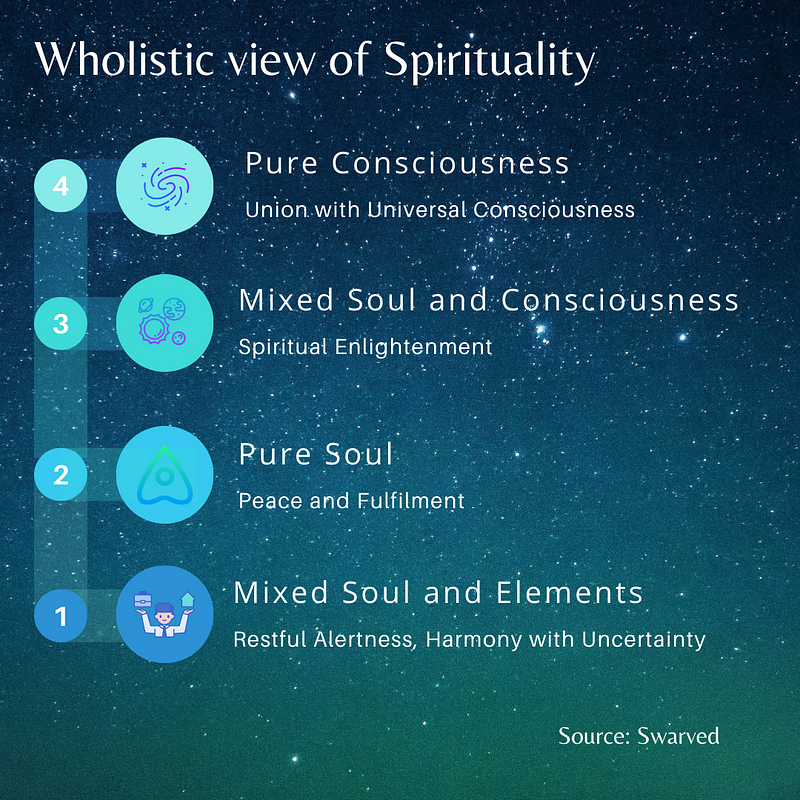
#1 Ownership and Competitive Advantage
The first level of spiritual practices strengthens the sense of ownership in the practitioner. It gives the perspective to love oneself, inculcate positivity, and fight the battles of life with rigor. Such an outlook for life empowers the practitioner to build competitive advantage for future.
This level of spirituality covers our realizations about the material life. Life comprises of conscious (soul) and non-conscious elements (the nature). These non-conscious elements impart a profound impact on the abilities of the soul and its Karma. A practitioner seeks to understand the non-conscious elements and their impact on the conscious entity (soul).
To see this in perspective, take the example of Kalam, who aspires to become famous someday and contribute to the society. Kalam represents practitioners of the first level of spirituality. They are positive and enthusiastic about life. They take ownership and focus on honing their skill so that they leverage their competitive advantage at an opportune time.
Many people feel they are born with such an attitude. But don’t mistake my friend, life can decimate your zeal unless you bolster it by building a strong wall of spirituality. Awareness, appreciation and practice of the spiritual science helps us erect this steel case for self defense.
Kalam, an eight-year-old boy, is a diligent newsvendor in his small town. Every morning he gets up 3:30 AM, finishes his morning rituals, and leaves for the duty — 14 KM milk run to distribute newspapers to over hundred homes. He loves his job because he earns enough to support his education. At his workplace, people admire him for his punctuality and commitment.
Kalam is happy and ambitious despite his underprivileged background. He leverages his position (present) to gain health, network extensively, make friends and learn from them. By doing so, he is doing two things. First, taking ownership of his life. And second, developing competitive advantages for future opportunities.
Ownership keeps him on the move — be it rain or snow. If his bicycle breaks down, he thinks about alternatives first. Can he borrow from a friend, or should he take the walk instead (14 KM that day!)?. Options pop up immediately in his mind because he has the network to hop on and the mental stamina to do otherwise.
His lifestyle boosts his competitive skills. Absence of distraction (TV, digital media etc.), consistent routine and rigorous exercise (cycling or walking) strengthen his physical and mental abilities and boost his self-confidence. Diligence at work fetches unsolicited but critical information that benefit him. One day, one of his client enquired about his interests and came to know that he loves Mathematics. Months later, when that client was collecting application for National Mathematics Olympiad, he offered him fully funded application. He did well and secured admission to a top national science school with a full scholarship.
#2 Peace and Fulfilment
Don’t we seek peace and fulfilment all the time?
Indeed, all our endeavors are directly or indirectly governed by our innate tendency to attain peace. At this level, the practitioner gains the realization of the pure form of her consciousness (soul) which is devoid of any impression of the non-conscious elements. Now she gets the special ability to perform the Karma like an average person but remains unaffected by the results of Karma. This state ensures lasting peace and fulfilment for the practitioner.
Later part of Chapter 2 of Shrimad Bhagavad Geeta talks about this level of spirituality. Shri Krishna calls it Karma Yoga — the technique in which the doer of the Karma remains unafflicted by the results of those Karma. It is not common to see the practitioners talk about this state mainly because they lack awareness and perceived difficulty to attain such a state.
The subsequent levels of spirituality cover the exploration of pure forms of consciousness.
#3 Spiritual explorations
Once the practitioner unveils her true identity (her soul) she solves the first conundrum of spirituality — to know thyself. The practitioner is now ready for a deeper expedition — to know the consciousness.
Apart from souls, there are three more consciousness entities plus one ambiguous entity for the soul (of practitioner) to explore.
a. Akshar Brahma — The executioner
b. Sadguru — The enlightener
c. Para Brahma — The universal consciousness
d. Kaal (Time) — The measuring dimension (This entity is neither conscious nor inert)
As the practitioner pierces deeper into the realm of the spiritual universe, she understands Time and witnesses Akshar Brahma and Sadguru.
गुरू गोविन्द दोऊ खड़े, काके लागूं पांय। बलिहारी गुरू अपने गोविन्द दियो बताय।।
-Kabir Saheb
#4 Union with the universal consiousness
The ultimate level of spirituality is when the soul witnesses the universal consciousness and reaches its origin.
Wondering if these realizations are achievable? Check out Swarved, in which Maharshi Sadafal Deo Ji Maharaj delineated the milestones of this entire journey.
पूर्ण रूप मैं जनता, ब्रह्मचक्र विस्तार |
ब्रह्म विद्या गुढ तत्व है, सद्गुरु कृपा अपार ||
Swarved 5.3.72
Principles of Karma
Karma lays the foundation of Spirituality. There are five principles of Karma that apply to the soul.
a. Karma will certainly produce result in the future.
b. Results of Karma will manifest to the soul in the same body from which it has performed the Karma.
c. Soul (the doer) is free to choose the Karma but wield no control over when it will get their results.
d. Result of one Karma forces the soul to perform another Karma, and the cycle continues. This is the default journey of the soul.
e. Soul cannot nullify the results of bad Karma by simply performing more good Karma.
Transcending the Principles of Karma is Karma Yoga.
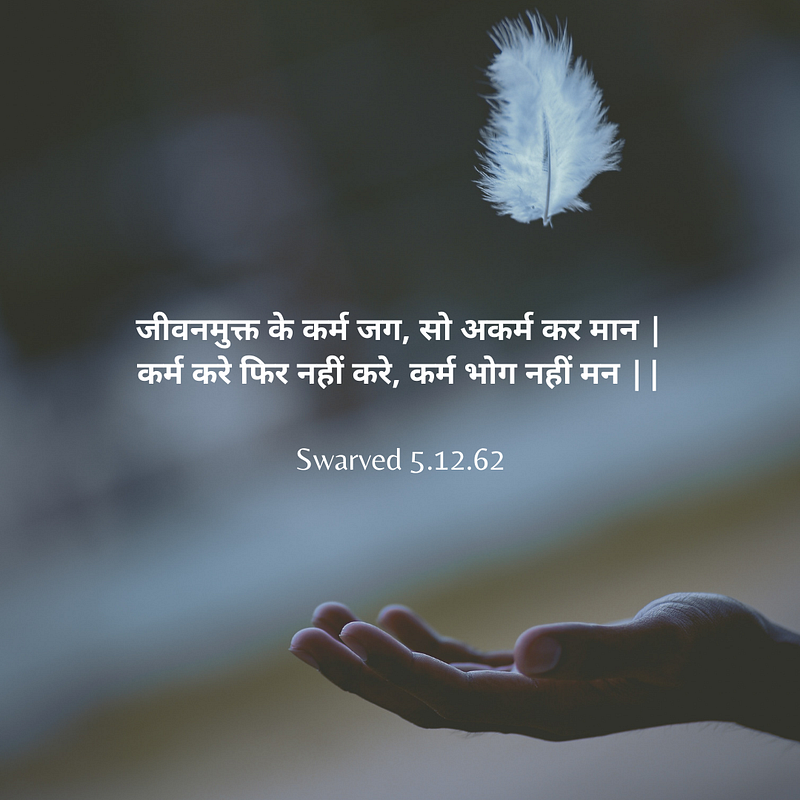
In the second half of Chapter-2 of Shrimad Bhagavad Geeta, Shri Krishna talks about the benefits of Karma Yoga and properties of Karma Yogi without unraveling the methods to attain such a state. Karma Yoga has profound implications for our personal and professional life as it paves the foundation for spiritual inquiries. A seeker when observes his/her Karma and see them in the light of these principles, his or her spiritual journey begins.
In the upcoming post I will discuss about the Karma Yoga as described in Chapter 2 of Shrimad Bhagavad Geeta. Stay healthy, seek spirituality.
These revelations are based on my over twenty years of immersion in Swarved, The Encyclopedia of Spirituality. Swarved is available on Amazon and on Google Play store in multiple languages.
Related Post: My realization on other chapters of Shrimad Bhagavad Geeta