
The World of Medium Tags
Tags are the future. What’s good about that is ...
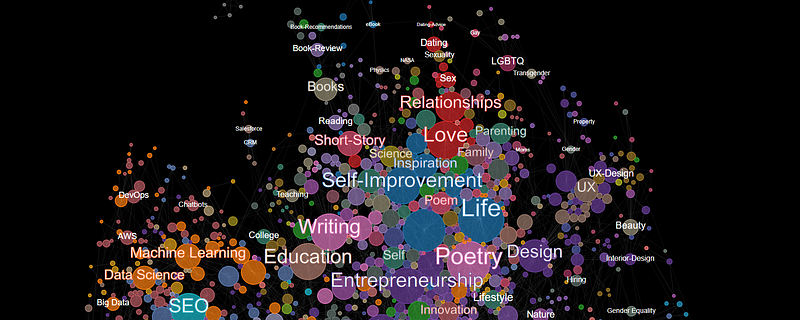
It’s been said before, but the current Medium topic list is a little strange. You can follow “Self-Driving Cars” but not “Cars”. You can follow “San Francisco” but not your home city or country. Yes, it’s weird. But let’s not dwell on it.
The sun is setting on the topic system and rising over the world of tags. ☀️
This month we’re rolling out additional functionality that will allow readers to follow Medium tag pages, which will exponentially expand the number of followable topics. — Tatiana Colligan, Product Manager @ Medium (source)
As a writer, you can tag your story however you like. According to Tatiana, there have been over 7 million unique tags used so far!
Last week I wrote an article about the Svelte JavaScript framework. Here is a screenshot of the “Svelte” tag page (medium.com/tag/svelte). Notice the list of “related topics” on the right-hand side.
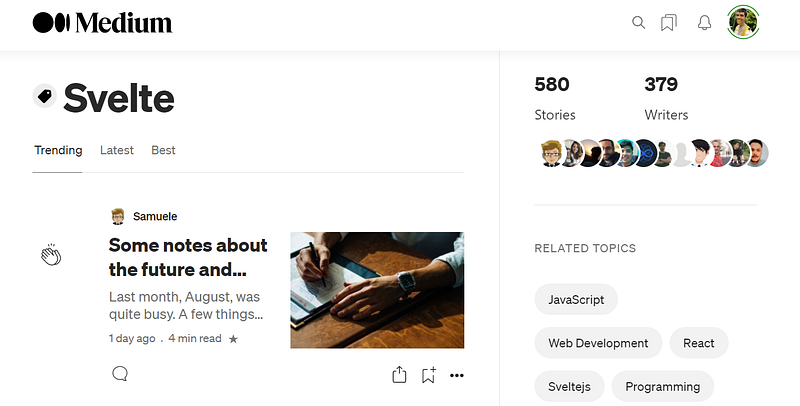
Of course, not all of these “related topics” made the list of 103 official Medium topics. They are the most common tags that appear alongside the “Svelte” tag.
I decided to do a little investigation into the relationships between tags. My process went like this:
- Visit a tag page.
- Record the number of articles published.
- Record the list of related tags.
- Visit one of the related tag pages.
- Repeat...
Essentially it was a Breadth First Search. The first tag I visited was “Life”. Then “Life Lessons”, then “Self Improvement”. Several hours later I had a list of over 10,000 tags!
The thing that amazed me is how interconnected the tags are. I only visited tag pages that appeared in the top 9 spots in a previously visited tag page. When I saw how fast the list was growing, I cut it back and only visited the top 3 related tags, and only for tags that had more than 1000 articles. Even so, I stopped well before reaching the end of the growing tag list.
Pratītyasamutpāda — The Interconnected Nature of Tags
Here is my visualisation of the network, using the d3-force module developed by Mike Bostock.
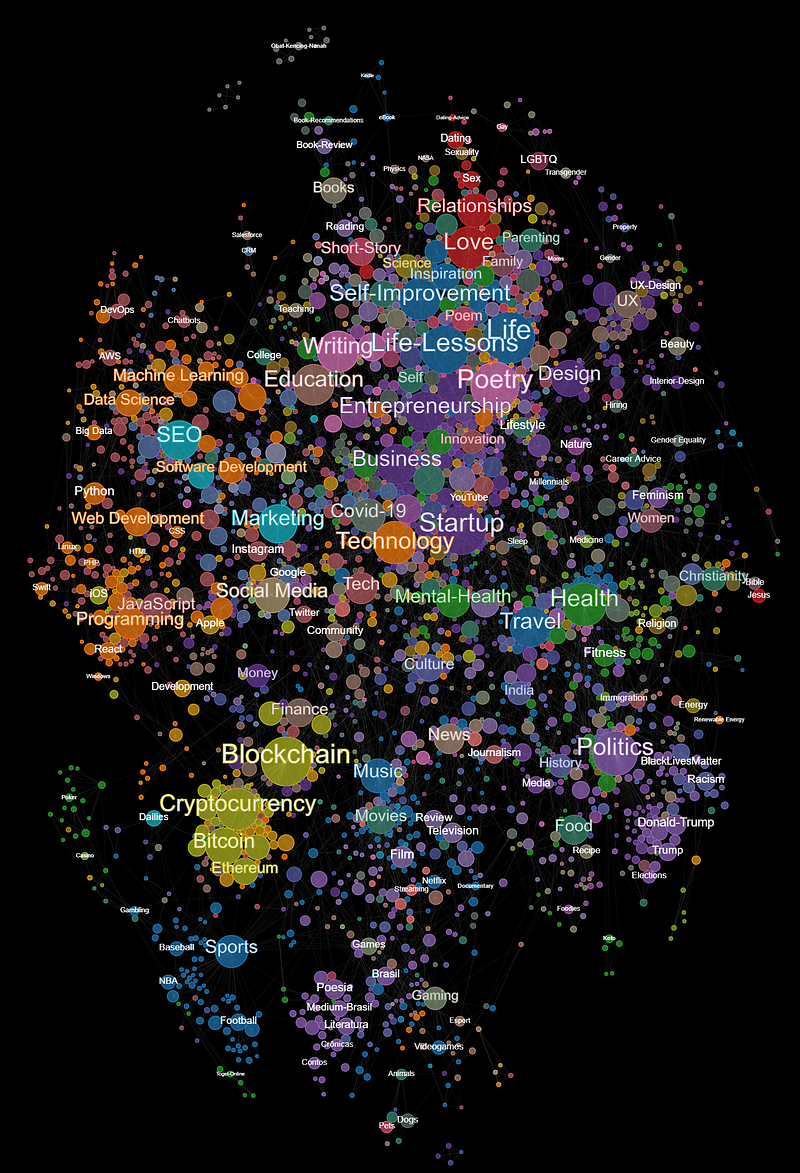
There are about 2500 tags in the visualisation above. Although only a fraction of the total, it includes all the supermassive tags and gives a high level snapshot of the tag universe.
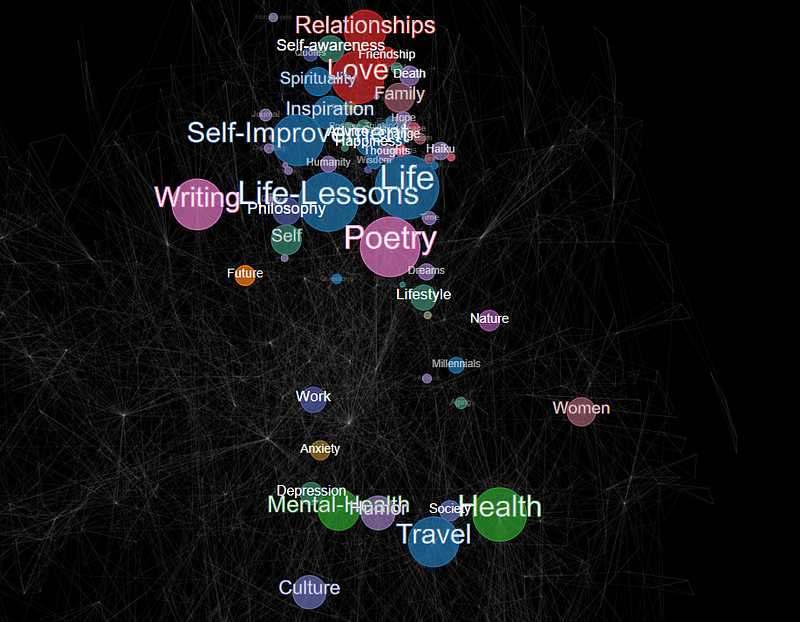
The size of each bubble (and label) is proportional to the number of articles with each tag. The colours are based on large tag categories, then blended for related tags.
Notice the group of Portuguese language tags near the bottom in purple, linked to the tag “Brasil”. This tag has been used over 60,000 times, already more than 3 times the “San Francisco” tag. I doubt the Medium team consciously planned or predicted this growth. Tags are organic. 🌱
Skandhas — Clusters of Tags
Programming
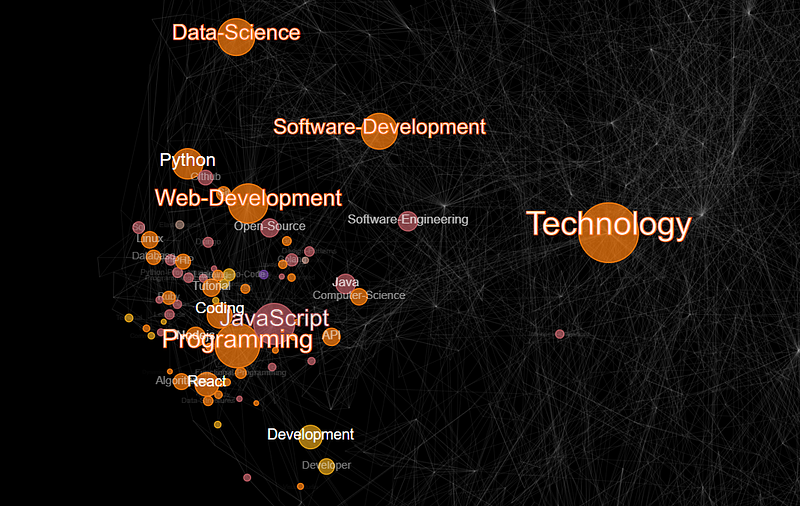
The tags shown below are all related to “Programming”. Here is where my Svelte tag fits. It’s not there yet because it has less than 1000 articles. That will change. 🧙
The “Technology” tag is further away from the main cluster because it contains links to various topics such as “Startup”, “Science” and “Virtual Reality”. Similarly, “Data Science” is linked to another cluster with “Machine Learning” and “Artificial Intelligence”.
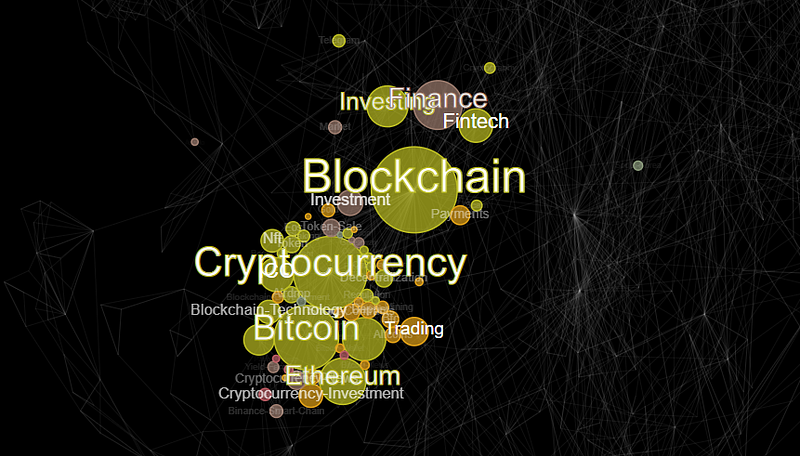
Cryptocurrency
These tags are really closely clustered together. Articles about cryptocurrency don’t tend to stray too far from the coin.
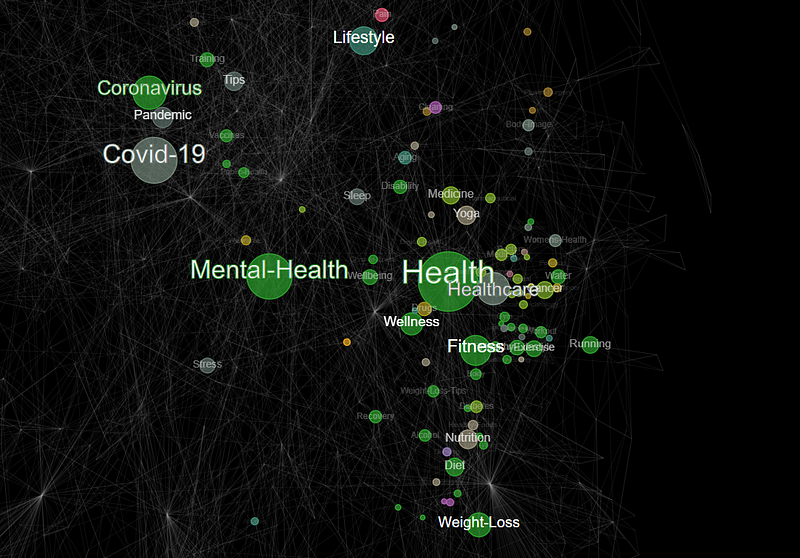
Health
The tags related to “Health” are much more spread out, indicating that these articles cover a wider variety of topics.
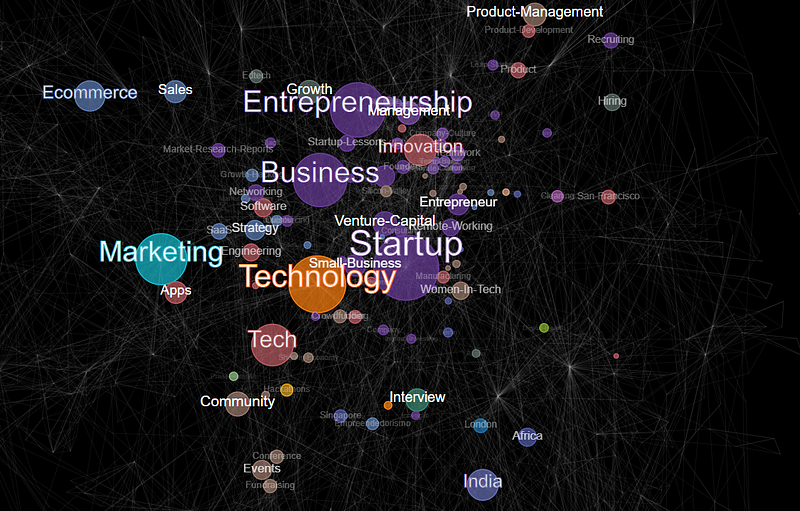
Startups
Apparently startup founders have to wear many hats. “Marketing” and “Technology” get their own colour, because they are each huge tags in themselves. Notice the location tags in the bottom right: “India”, “Africa”, “Singapore”, “London”, even our old friend “San Francisco”. 😊
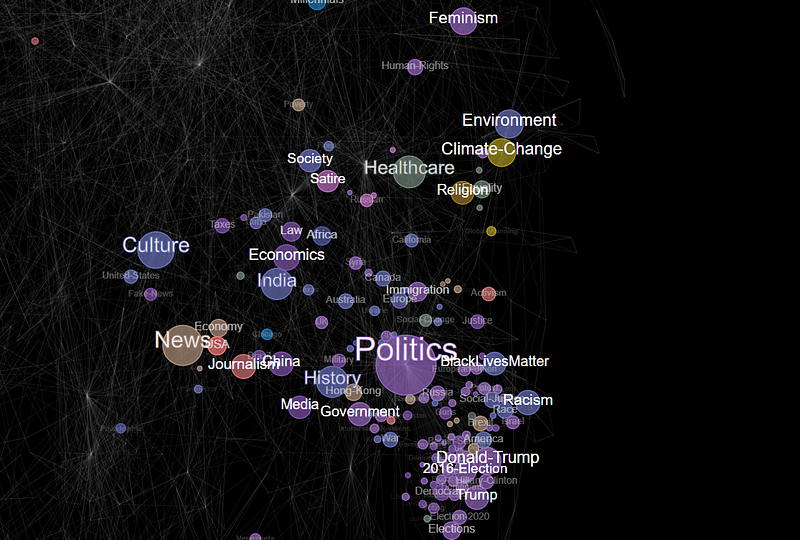
Politics
Here are the tags related to “Politics”.
Life
And finally… “Life” according to Medium writers.
Karma — Results
But apart from data viz fans, what beneficial effects can this network of tags bring to the wider world of Medium writers and readers?
1. More targeted recommendations
A successful recommendation engine is crucial for keeping readers on Medium.
Discovering new writers and publications will always be important, so we will continue to help readers serendipitously find stories they wouldn’t have otherwise, through machine- and human-driven recommendations. — Ev Williams (source)
Topics were too broad. If you follow the topic “Life”, you’re essentially telling the Medium algorithm: ‘When somebody writes about “Life”, I wanna read it!’. But a lot of people write a lot of things about life. Could you be just a touch more specific? It’s like sitting down in a restaurant and saying: ‘I think I’ll have the “Food”, please.’ 🤦
2. Selected stories from writers you follow
Just because somebody follows me, I don’t expect that they will be interested in everything I write.
Then there is the endless scroll of people that I already follow. I get the notifications when they post so again, redundant information. Wanna know what I’m not getting? New suggested reading. — Terry L. Cooper (source)
Let’s say you follow me, and you also follow the tag “Mathematics”. The Medium algorithm should be able to use both these facts, together with your reading history, to decide whether or not to suggest an article I just wrote about Zen Buddhism. If you devour everything I publish, then you’ll probably be interested. But if you have only read my Mathematics articles, it should probably shelf the Buddhism article for now.
I don’t know much about designing recommendation algorithms. Seems like an interesting problem, but certainly a very complex one. If it’s something you have interest and experience in, the Medium Recommendations Team are looking to hire now! (14/09/21)
3. Help writers to reach readers
For writers, using more specific tags should help our work better reach its target audience. In the past we might have been tempted to use a generic tags like “Programming” and “Technology” in the hope that an article would be curated under these topics. Most articles got lost in the washing machine with 1000 others.
When I write about Svelte, I’m better off using the tag “Svelte”, so people who are actually interested can find it. As the number of Svelte articles and followers grow, I’ll need to be more specific: “Svelte Actions”, “Svelte Transitions”, “Data visualisation with Svelte” etc.
When choosing our tags, we should be able to see how many followers each tag has. Right now we get the number of stories, which is only a rough proxy for what we actually want to know.
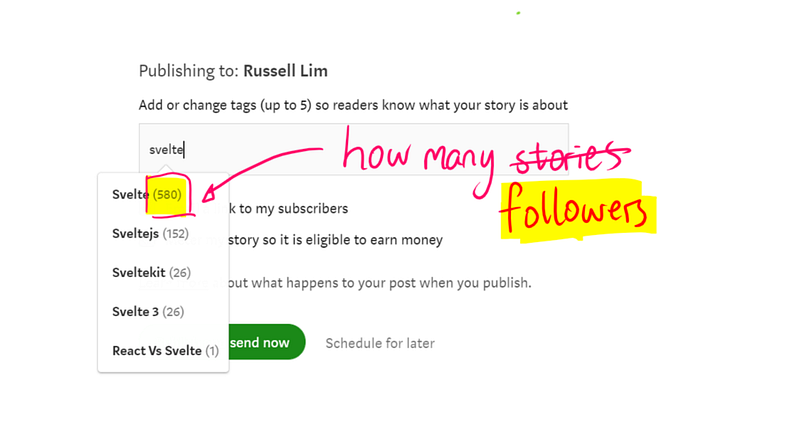
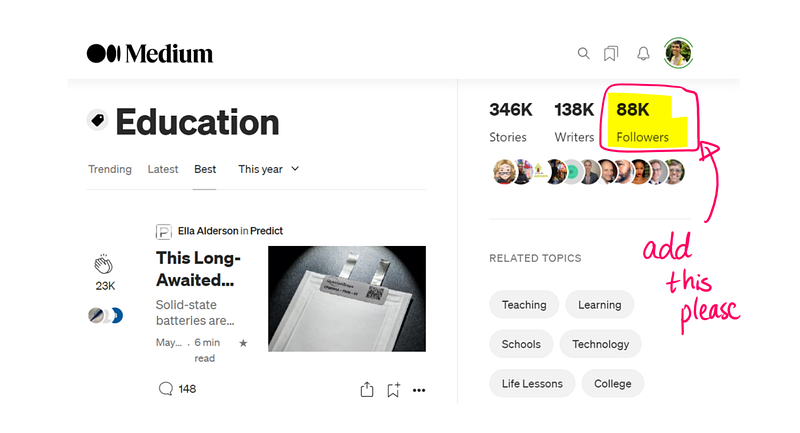
Same goes for the tag pages. Once people start following tags, Medium will have the data available and it should be a simple fix.
Prajñā — The Vision of Medium
…the overall vision is to build an even more robust network of thinkers and perspectives, where ideas get better because they’re connected to others, and where links between people and posts lead to more discovery. Where both the content and the network evolve into greater density and complexity over time. — Ev Williams (source)
I see the vision. Let’s give it a chance and see where this goes. 🙏🙏🙏