
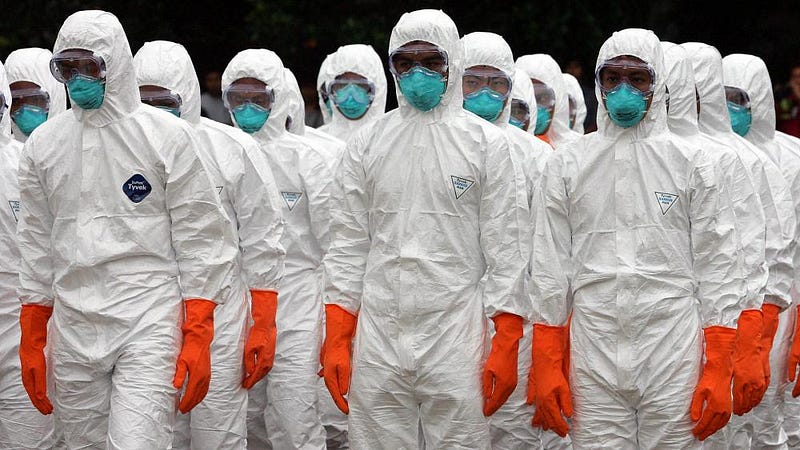
The World is not ready to deal with a Pandemic
According to a report from the Global Health Security (GHS) Index, none of the 195 countries is fully prepared
Despite some major breakthroughs in treating deadly diseases like Cancer and controlling pandemics like Ebola & HIV/AIDS, the problem is still at large as we saw with the last Ebola epidemic which killed thousands in West Africa between 2014–16. Others like SARS (severe acute respiratory syndrome) & MERS (Middle East respiratory syndrome) also provided a wake-up call for health authorities around the World. While many countries took steps to bolster their preparedness in response to these outbreaks, the steps were more reactionary than precautionary.
It is pretty evident that not enough is being done to battle pandemics like Ebola & HIV/AIDS, which have taken millions of lives since their discovery about four decades ago. Even more chilling is the revelation by a recent report from the Global Health Security (GHS) Index that concluded that not even a single country out of the 195 nations assessed was ready to effectively respond or ward off any of the existing or future pandemic threats.
What is GHS Index?
The GHS Index assessed countries' health security and capabilities across 6 different categories — Prevention, Detection, Responsiveness, Health facilities, Norms & Risk factors. In addition, 34 indicators & 85 sub-indicators were used to collect information from the 140 questions across the different categories for the assessment.
The Index is a collaborative effort between Nuclear Threat Initiative — a D.C.-based nonprofit organization, and the Johns Hopkins Center for Health Security under the guidance of an international panel of experts from 13 countries. More than 100 researchers were involved in collecting & validating publicly available data. The Index scored countries on a scale of 1–100.
Data Highlights
The detailed ranking of different countries highlights the scope of the problem. Listed below are some of the biggest data takeaways.
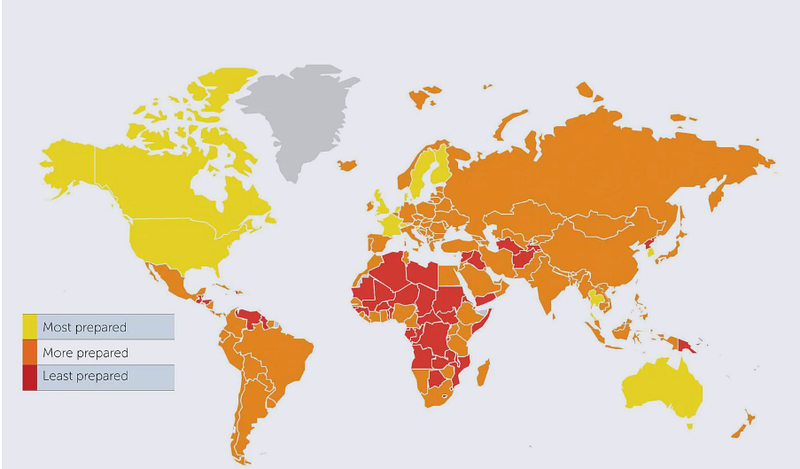
- None of the countries assessed was fully prepared for epidemics or pandemics. Of the 195 countries, only 13 countries were most prepared to tackle the problem. 98 were somewhat prepared while 84 countries were least prepared for a global health catastrophe.
- Generally, high-income countries scored well on the Index. However, some non-high income countries like Thailand ranked in the top-tier as well — sixth overall. At the same time, some rich countries like Saudi Arabia & the United Arab Emirates showed below-average preparedness — scoring below 50 out of 100.
- The overall global GHS Index score was a disappointing 40.2 out of 100, which showed very weak preparedness for pandemics & epidemics. High-income countries scored relatively better with an average score of 51.9, however, a whopping 116 high & middle-income countries couldn’t score over 50.
- The most well-prepared countries were — United States(83.0), United Kingdom(77.9), Netherlands(75.6), Australia(75.5), Canada(75.3), Thailand(73.2), Sweden(72.1), Denmark(70.4), South Korea(70.2), Finland(68.7), France(68.2), Slovenia(67.2) & Switzerland(67.0).
- 92% of the countries showed no evidence of security checks for personnel handling dangerous biological materials.
- 81% of the countries scored in the bottom tier for biosecurity risks.
- The lowest-scoring category was the lack of health system capacities which can respond to epidemics & pandemics — an average score of only 26.4 was recorded for all the countries with 131 countries in the bottom tier of this category.
:max_bytes(150000):strip_icc():format(webp)/difference-between-epidemic-and-pandemic-2615168-01-c829c2e4591f47f9a3e5cd39687be4a7.png)
Main Recommendations
The full report outlines a detailed set of 33 recommendations to address the global problem, but the main recommendations were as follows:
- National health security is weak around the Globe and governments should be actively involved in actively addressing important gaps in their preparedness.
- Countries were least prepared for biosecurity risks & should develop capabilities to address fast-moving global biological threats.
- Health security capacities should be analyzed annually to recommend improvements & updates to fight emerging threats.
- More funding from national budgets should be allocated to fill in the preparedness gaps.
- Countries should develop basic health systems that can effectively respond to health emergencies. A majority of the countries lack such a structure.
- Better coordination & training among healthcare professionals & policymakers to devise better policies to tackle outbreaks.
- And finally compliance of global health & security standards with a need to establish national & regional protocols to address public health emergencies.
You can download the Full Report & Data Model of the GHS Index here.