Sustainable Future
The World in 2050. Why This Strong Focus on a Magic Number?
We are transitioning now towards a more beautiful world. It’s urgent! And 2050 is our milestone.

Transition. We’re in the midst of it. And o, how scary and out of our comfort zone and frustrated we feel! It’s throwing us off-balance. We have to deal with a shitty virus. And every day we’re making choices now that are difficult and painful.
Our unconscious is shouting. Go back! Go back to when it was safe.
Our heads are overflowing with thoughts. Fear, grief, and anger are crowding our hearts. The bucket is full. The chaos is spilling over the brim. Only breathing deeply helps to regain focus.
And through it all, deep inside, we know that it’s right.
Our inner wisdom knows this needs to happen.
And we hope that in 2050 a new balance has arrived.
Why?
Simply because we cannot go on like this.
The problems are too big. We have drifted apart from nature. From the planet’s nature and from our own nature. And that’s a problem because those two natures are one.
We have tried to play God with our aggressive technologies and patriarchal power games. And look at what mess it got us in.
We built a card house economy that’s now falling down at the invisible threat of a tiny virus. We have to scream #MeToo to keep our women safe. We are chopping our trees, destroying our rainforests. So some rich people can become even richer.
And all this effort, all this display of power, hasn’t even solved hunger or war or freshwater shortages. We try and try and try with force. Fighting, controlling, bullying. It might be time to take another road.
“We cannot solve our problems with the same thinking we used when we created them” — Albert Einstein
The first step on this road has been taken when we created the Global Goals.
It’s a vision shared by all countries. It’s a dot on the horizon to show us what the world will look like when we have transitioned. It keeps all the noses in the same direction.

The Global Goals fuel discussions about the right road to get there. And that’s good. We need a diversity of solutions. From all cultures, from all roads of life. Not just technological, monocultural, machine-like half-solutions that create new problems at the other side of the wall.
We need systemic, nature-based solutions to unleash abundance again. They’re not so difficult to find! We need physics, biology, and healthy chemistry to find solutions on all fronts.
Only when we focus on systemic solutions in line with natural laws, we’ll have enough food, drinking water, shelter, protection, etc. for all species. Stop the focus on money as our only savior. Start thinking in values. Money is one of them, yes, but the others are just as valuable…
In short, we need to restore ecosystems and learn as human beings how to live within the boundaries of our planet.
In every transition, there’s chaos first. This is how the laws of nature work, folks. Everything is connected. Nature knows evolution. Change. Movement. Progress. And these dynamics are working out on different levels.
Right now, our thoughts and emotions are going haywire because the world is a tangled mess. Confusion within our bodies. Mayhem among the human species. And shambles between all species on our planet.
- Microlevel: thoughts and emotions are overflowing
- Macrolevel: the world is in turmoil
Personally, I don’t think it’s a matter of God or Mother Nature taking revenge. Here are just the laws of nature at play.
We created destruction. We wanted to maximize profit for just one species: human beings. But that’s not the way nature works. Nature needs diversity and optimization to be in balance.
That’s why the transition is necessary and why we need to go for nature-based solutions. I wrote about it (see link below), using the work of David Quammen. This scientific writer researched the ebola virus and came up with some very strong conclusions.
There are many viruses in the world that belong to unique species. These hosts will never get ill from the virus. But now that we are wiping out those animal hosts, the viruses need new hosts. And voila, there we are. Humans are the next prey for viruses.
They choose us because we are with many. Enough humans to invade. And that’s just what viruses do. Invade. It’s their nature.
Okay, so what can we do? And why the focus on 2050? As said, we are in a big transition on many levels. On a macrolevel, we see the following trends.
- We are transitioning our economy from hardcore, neoliberal capitalism to an economy aligned with ecology and the human spirit
- We are transitioning from just masculine values to include feminine values
- We are transitioning from purely rational thought to a place where our hearts get a voice too
- We are transitioning from reductionism to systemic thinking
- We are transitioning from purely rational science to include spiritual intuition and connectedness
- We are transitioning from human-centered to all-species-centered
In short, we are creating ‘a more beautiful world’ as Charles Eisenstein so accurately puts it.
On a microlevel, a personal level, we also see trends:
- We are awakening, combining rational thought with our hearts and spiritual intuition
- We are becoming aware that our bodies are our natural vehicle with which we can balance thoughts and emotions
- The new generation is very sensitive and wants a purpose in life
Hopeful, my friends. Hopeful!
The remaining question is: why 2050?
Well, it’s rather simple. We humans need a goal. We need a perspective, an end of the line, to keep our hopes up.
Generations make 30-year-jumps. Our children will be exactly our age in 2050. We can imagine such a timespan. We have hopes for our children. We have dreams. So it’s reassuring that in 2050 we’ll have regained balance.
Of course, we need to take action for that balance to become a reality. And we can do it. All of us. No one excluded. We can make it happen.
I mentioned chaos theory before. The laws of nature are non-linear. And there’s one great metaphor to illustrate this fact.
“A butterfly flapping its wings in China can cause a hurricane in Texas” — a metaphor from Chaos Theory
Well, we’ve seen it in a negative way. Why not use it in a positive direction?
- We can spend our money where our hearts are and create a new economy
- We can rewild our souls and connect to nature
- We can build our community and be kind to others. Especially kind to unkind people, they need it most…
- We can train our bodily awareness
- We can train to live in the present moment instead of in the past or in the future
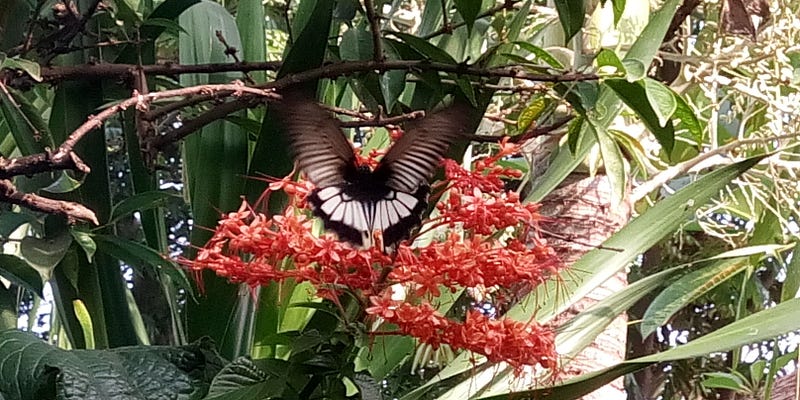
Please, my friends, flap your wings and cause a hurricane of love, awareness, and positive action. We need it, before we can arrive in a balanced, more beautiful 2050.
Thank you, Mike, for adding your wise energy to my words on transition.
If you want to connect, you can find me on LinkedIn, Facebook or somewhere in nature rewilding my soul…
This article has been inspired by Alexandra Cousteau, ocean expert, and Fritz Neumeyer, architect. We look back upon a great lunch in Ubud, Bali when we discussed the work of Alexandra’s grandfather Jacques Cousteau, my own work for Green School Bali and regenerating ocean ecosystems.
Jacques did great work in his time (1910–1997). His underwater films are famous! Alexandra and Fritz are stepping in his shoes and are doing their bit with the Oceans 2050 Foundation now. Inspiring couple!
Further reading
About the author
About the ReGeneration
About rewilding and why it’s so important