
The Wondrous Ruins of the White Horse
My epic exploration of an Iron Age hill fort
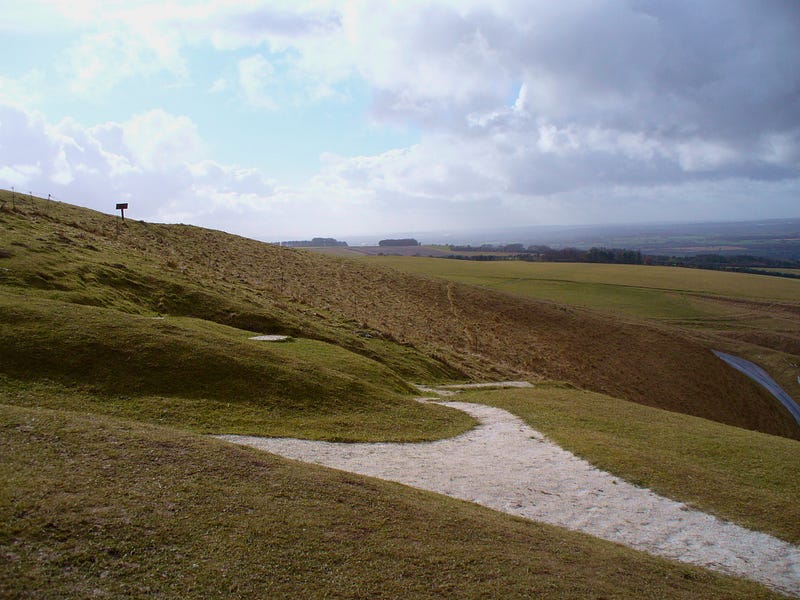
Throughout this month’s Ruins of the World challenge, we writers at Globetrotters have written a host of articles about fallen, decaying, and abandoned buildings. Landscapes that people have altered, though, can also be “ruins.” In Europe, people have been doctoring landscapes for millennia on scales that take my breath away.
When I was a student at Oxford University in 2005–06, I excitedly planned a day trip to the Uffington White Horse in the tiny town of Uffington, Oxfordshire, two bus connections away.
The White Horse, carved out of a hillside perhaps three thousand years ago and filled with crushed white chalk, had fascinated me since before I came to England. Scholars think the horse represents a tribal symbol, and from the time of its making, even as the area transitioned through different cultures and religions, the local inhabitants have cared for the horse and insured it remained intact.
Another American student, Christy, expressed interest in coming with me, which made my heart sink. The White Horse was a place I longed to visit alone, to let my thoughts wander where they may and let the place settle upon my soul. I couldn’t do that if I was talking to someone all day. Christy was a nice person, but she was a chatterbox.
Ultimately, I went without her, and as it turned out, I had the hill all to myself. The White Horse figure wasn’t even the highlight of the trip.
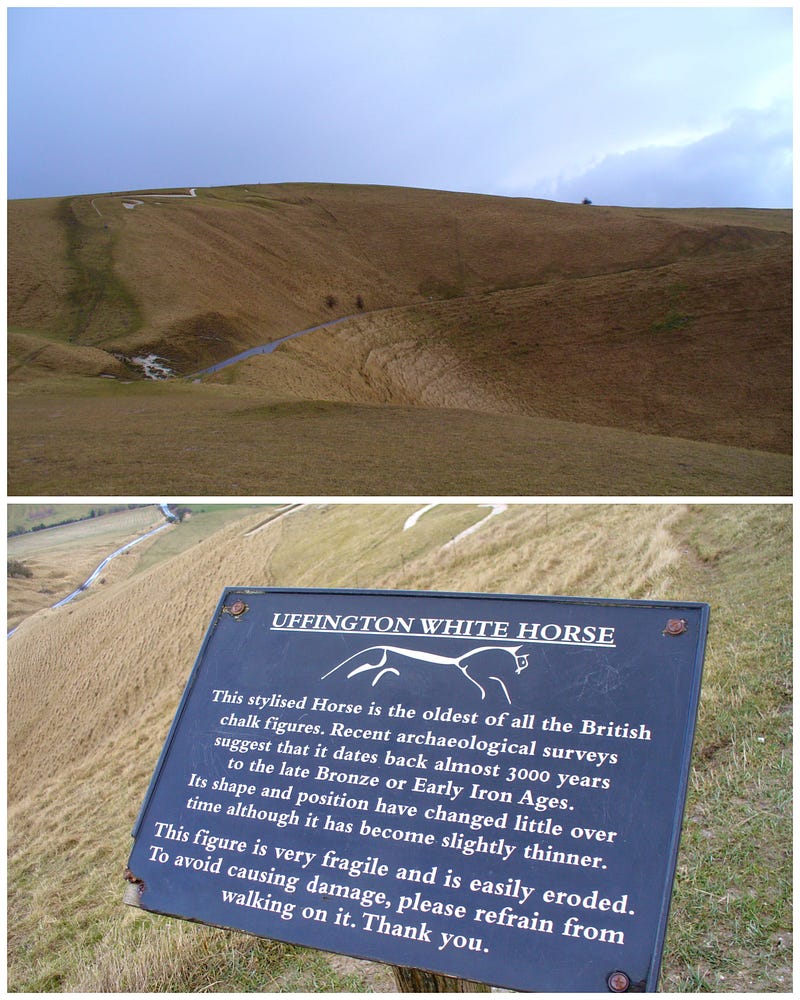
The hill, as I discovered, was an Iron Age hill fort! In my travels throughout southern England, I had become obsessed with these grand earthen structures — or rather, with the ruins of them.
Hill forts, built across Europe around 900–100BC, had roles similar to those that medieval castles took on millennia later. They held food stores, served as meeting places and possibly religious centers, and provided safe spaces for the local populace to gather when they were under threat.
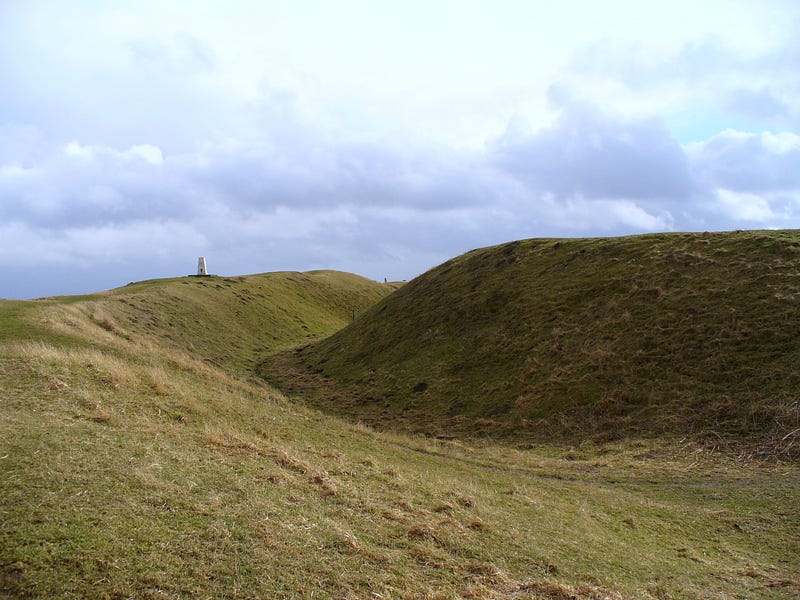
People defended these hill forts with banks and ditches. They piled up soil in massive banks and dug out it in ditches, as you can see in the photo below.
When they had multiple layers of these banks and ditches going up a large hill, such as at the White Horse, it made it extremely difficult for an enemy army to attack. As you can imagine, hill forts required a huge coordinated effort of the population to build.
I climbed high up the hill, legs pumping and working up an appetite, for I’d already walked a good three miles up from Uffington town. A storm was brewing, its winds picking up, so I hunkered down in an Iron Age ditch and ate my lunch.
It was one of the most thrilling meals of my life, sitting there eating my sandwich with my bitter cold hands, my heart soaring. I was conscious that I ate where people had shaped the land for thousands of years.
That is the glory of a ruin — communing with ancient people through the commonality of place, not merely reading about them in a book from far away, but breathing the air they breathed, planting your butt in the soil that they touched (and maybe planted their butts in, too).
After my lunch, fully satisfied, I continued up the hill — and got no more than a hundred feet when the thunderstorm started, lightning flashing. Being exposed far up on the tallest hill within many miles was definitely not safe!
I scampered down and jumped back into my ditch like a hobbit fleeing from the Black Riders. Crouching as near to the ground as I could, flattening myself in the ditch, I felt not fear but a galloping thrill.
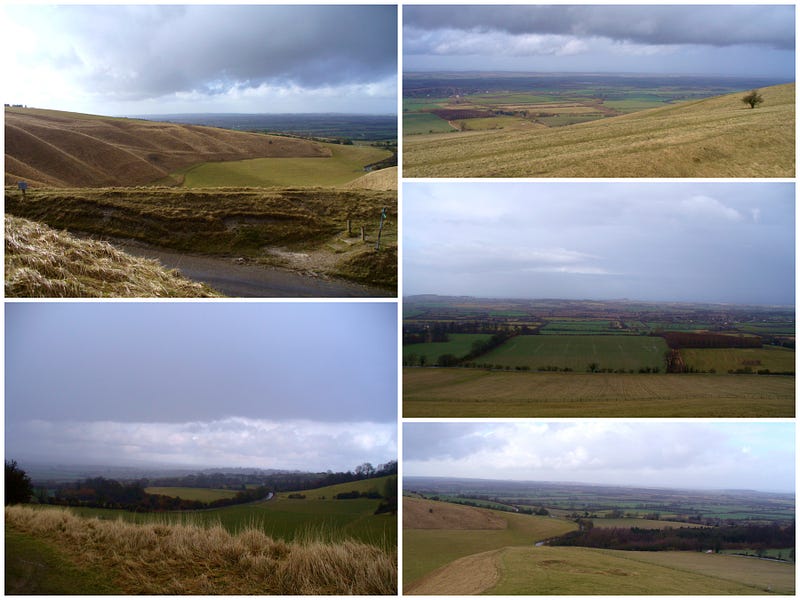
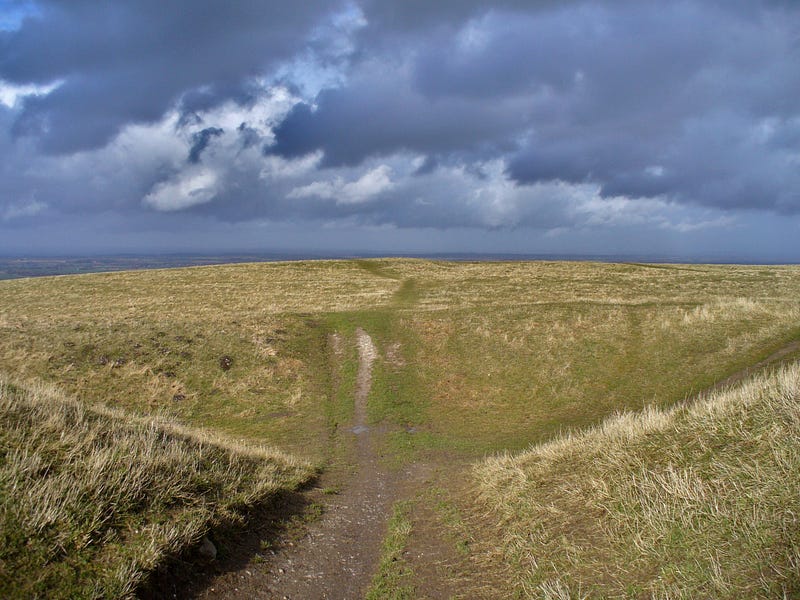
After the storm, my perseverance won me spectacular views of the farmland below. The boundaries of the fields themselves, as is often the case in England, are the same as they were in the Iron Age, and maybe even from an earlier period.
Thus, even the fields are a sort of living ruin from the time of the hill fort’s construction. The people who tilled this land are the very ones who would have taken refuge on White Horse Hill when under pressure from neighboring tribes.
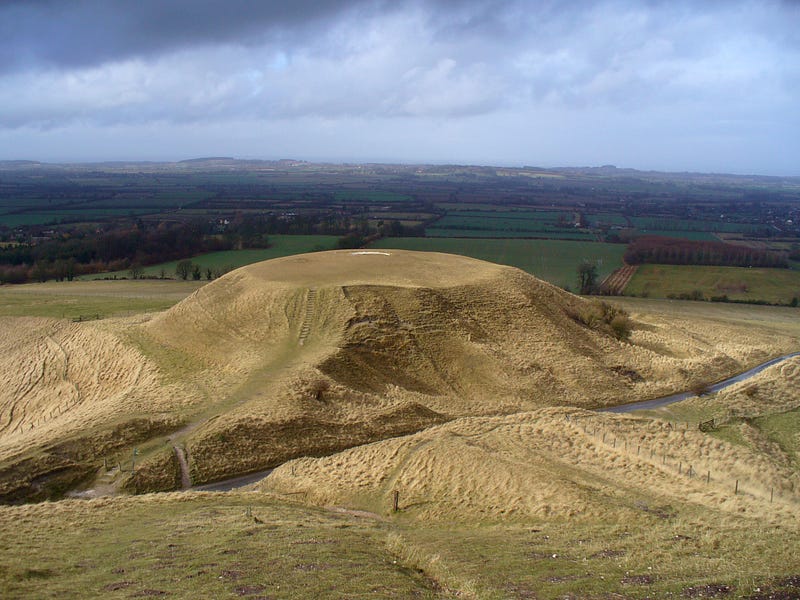
The knoll in the photo above is gorgeous. With that perfectly flat top, people certainly sculpted it. It’s a bit lower down the hill from the White Horse and level with some of the banks and ditches, so I’m guessing it was a watchtower of some kind. Maybe in the hill fort’s heyday, it housed a wooden house for guards and some sort of armory.
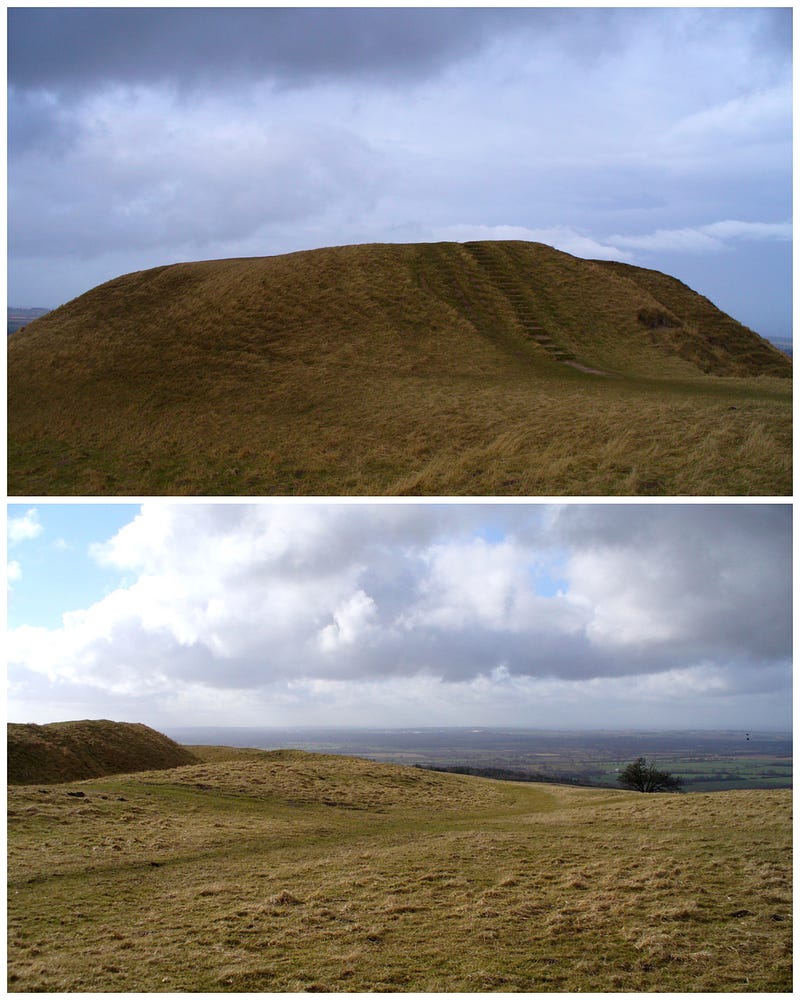
As I walked toward the sky, I was starting to worry whether I’d make the last bus back from Uffington to Faringdon, my connection from here to Oxford. It left at 4:30 pm and I was spending so much time on White Horse Hill, combing over every inch of it with my imagination.
But how could I not, in such a place? I was lucky I was the only person I’d seen all day, for if anyone had caught a glimpse of me running and prancing around, dreaming up Iron Age stories in my head, they’d have thought me mad. Well, they wouldn’t have been far off.
I was so glad I hadn’t asked Christy to come with me. Sometimes you have to make your pilgrimages alone.
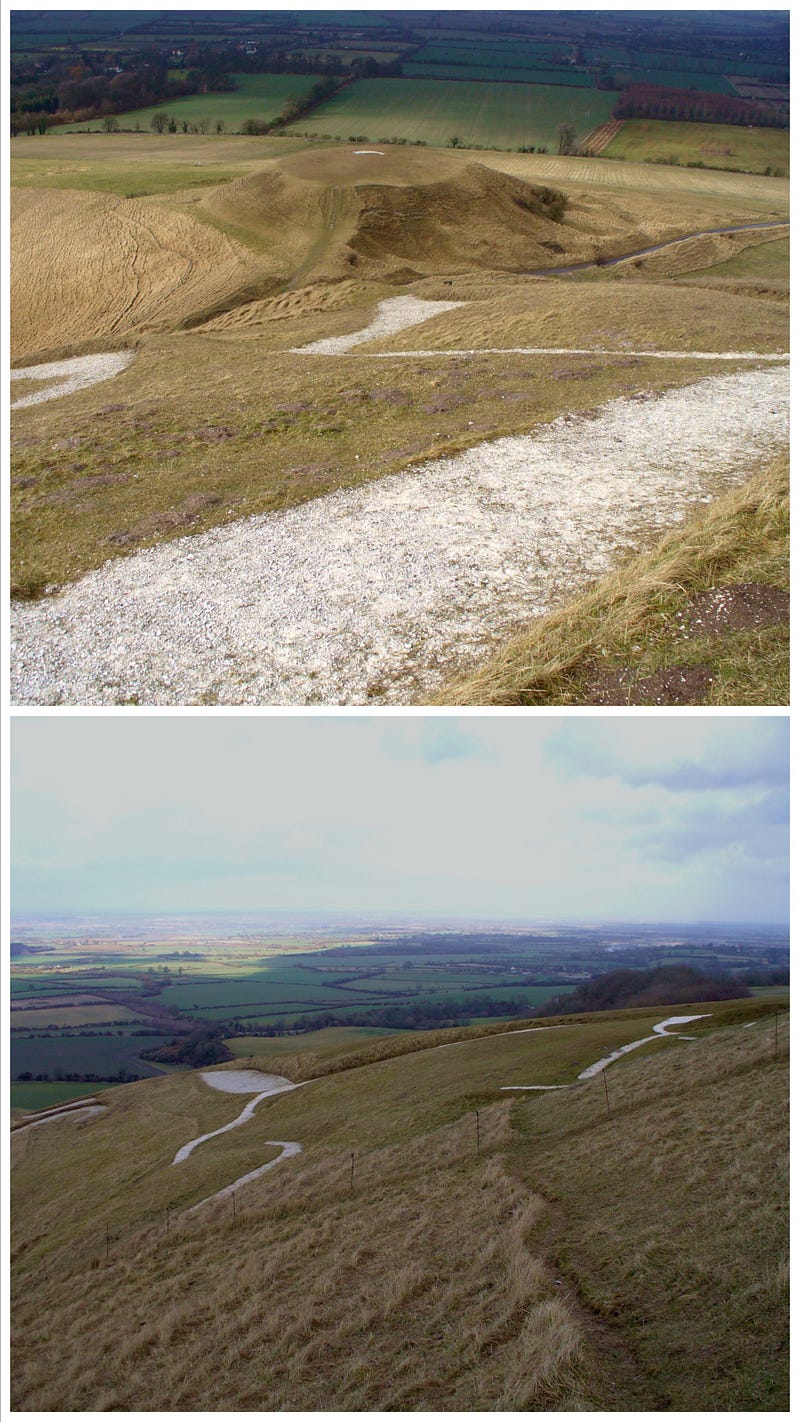
Finally, I reached the flank of the White Horse. I couldn’t get a photo of the entire figure because the horse is so vast that you can only see the whole of it from the bottom of the hill or from the air.
Still, I was in awe to be that close to it. It felt like a sacred object, put there so long ago. The dramatic climb through the thunderstorm, my heightened state of mind, and the epic views from the hill made it all the more special.
I could see why people had chosen this site as sacred to horses three thousand years ago and wondered if a special ritual was connected to this very spot.
Perhaps the warriors would ride their horses up the arduous hill, struggling through storms and letting the winds buffet them and nearly knock them off their feet. Maybe they would ride on and on as the clouds cleared and they reached the top of the hill and would keep on riding into that white, white sky.
Incidentally, I did miss the last bus from Uffington. I sprinted the three miles back to town and arrived at 4:20 pm, immensely proud of myself that I’d arrived in time, only to be told that the bus had left at 4:10!
“Nobody was waiting,” said the lady at the combination post office/grocery store. “So he just went.”
Seriously?! I wasn’t waiting because it wasn’t 4:30 yet. Luckily, when I called up a taxi company — which was out of cars! — the owner came out to get me in his personal vehicle and drove me back to Faringdon, where I caught the bus to Oxford.
Immediately after supper, I staggered to my dorm and fell into bed, asleep before my head hit the pillow. A couple of hours later when my mom called, I was so groggy that at first I didn’t know where I was and, if asked, I probably couldn’t have told her my own name. It was all worth it, though, to see the magnificent White Horse and the grandeur of Iron Age ruins.
Thanks for reading, and thank you to the editors at Globetrotters (JoAnn Ryan, Anne Bonfert, Jillian Amatt - Artistic Voyages, Adrienne Beaumont, Michele Maize) for supporting us writers.
I’m always a sucker for Rome. Krasi Shapkarova wrote a fine article about the Roman ruins in her native Bulgaria:
Wow! Sh*t Happens - Lost Girl Travel posted some stunning photos of marine life in her article about swimming with sharks:


