
The Women of Royaumont
Scottish female doctors tending to World War I soldiers in a French abbey
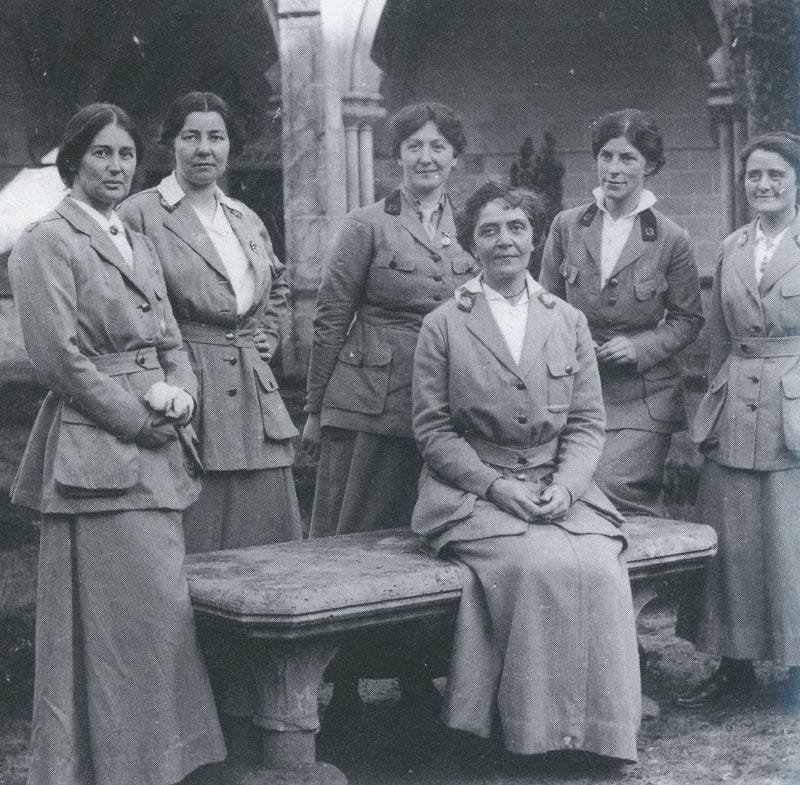
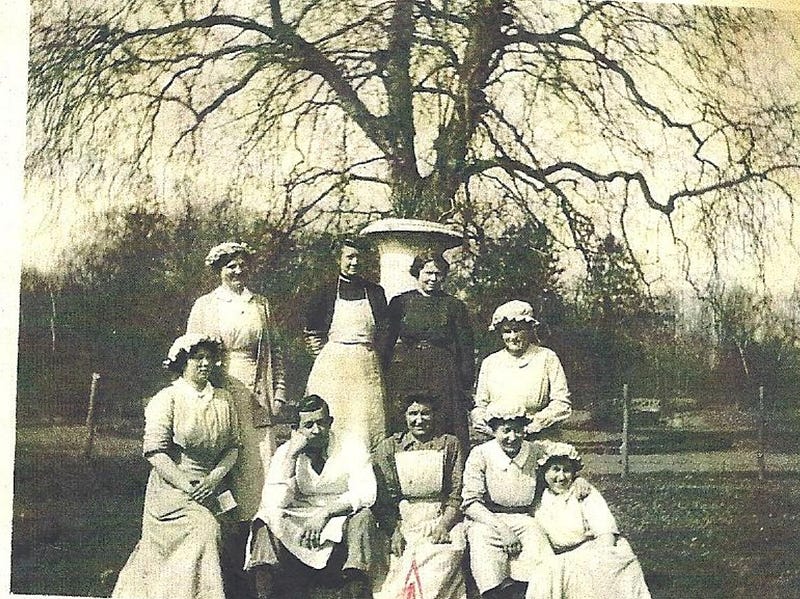
My great-grandmother was among them. Not as a doctor, she was a cook and one of the only French women among the Scottish doctors, nurses, and orderlies in this all-women hospital.
These were brave women these Scottish women and I would like to honor their memory by telling their too little-known stories.
So let’s dive into the fascinating story of these feminist icons!
An abandoned French abbey turned into a war hospital
Situated 30 kilometers north of Paris, the abbey of Royaumont was a Cistercian abbey founded in 1228 by Louis IX and his mother Blanche de Castille. The abbey was dissolved in 1791 during the French Revolution and it was later used as a factory, then disused and uninhabited for some time.
From January 1915 to March 1919, the Abbey was turned into a military hospital, Hôpital Auxiliaire 301, operated by Scottish Women’s Hospitals (SWH), under the direction of the French Red Cross.
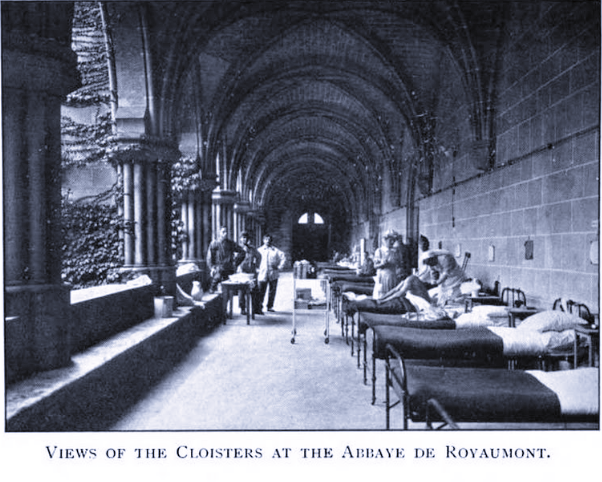
A tireless team of Scottish suffragettes turned the neglected abbey of Royaumont into a five-star war hospital
They were well-educated, high-society suffragettes who wanted to play a part in the war effort. Having been denied this request by the British government with a “go home and sit still” rebuttal, they turned to France and were granted the abbey of Royaumont, a then desolated, dirty place, without running water, heat, or electricity, to turn it into a war hospital.
They went quickly and courageously to work and in a few weeks transformed the derelict premises into a top-notch hospital that admitted its first patients in January 1915.
The hospital was run by Frances Ivens (who was the third woman to obtain the degree of Master of Surgery) and her all-female team of surgeons, orderlies, radiologists, and ambulance drivers.
Let’s not forget that before the First World War, women didn’t have the right to vote and the few female doctors only tended to women. These Scottish women were real pioneers and opened the way for women’s rights. Women’s right to vote was obtained in 1918 in the UK, but only in 1944 in France.
Other women-run hospitals would be deployed by the Scottish Women’s Hospitals for Foreign Services in Belgium, Serbia, and Russia. The idea came from Dr. Elsie Inglis, who was Honorary Secretary of the Scottish Federation of Women’s Suffrage Societies and thought that if these hospital projects were successful they would push the women’s movement forward “by a hundred years”.
And Royaumont was indeed a success:
- The staff at Royaumont treated over 10,000 patients during the War and reported better mortality rates than its military-run equivalents. For their remarkable contributions, Frances Ivens and thirty of her SWH colleagues were awarded the Croix de Guerre medal in 1918.
- The SWH movement gave medical women a unique opportunity to widen their expertise and doctors at Royaumont Abbey made significant advances in the treatment of gas gangrene using a combination of radiology, bacteriology and surgery to diagnose and treat wounded soldiers.
- Dr. Weinberg from the Pasteur Institute in Paris, a frequent visitor to Royaumont, said he had seen hundreds and hundreds of military hospitals, but none the organization and direction of which won his admiration so completely. He added that he could not imagine any activity on the part of women that would so effectively further the cause of the women’s movement as the work of the Scottish Women’s Hospital.
- In addition to its excellence in the medical field, Royaumont became widely known as the best-fed and best-managed hospital in France.
“Best fed”, was it because Jeanne Desborbes, my great-grandmother was a cook there?
And what was this Auvergne villager doing there anyway?
I really don’t know how she landed there.
Jeanne Desborbes, my great-grandmother, was born in 1884 in a small village in Auvergne in the center of France. Married at seventeen, she had three children (one of whom, my grandmother, I wrote about, see link below) when she became a widow at 27. She had been running a small restaurant with her husband and now she was alone with three children. And, oops, a fourth one just a year after her husband’s death. Albert, the illegitimate child. She never said who his father was. But her own father didn’t like that at all and would not speak to her again.
To flee the scandal, she had to go to Paris with Albert, leaving her other children to her sisters’ care. Then she had to send Albert back to Auvergne, because she couldn’t keep him while working at Royaumont. But how she began working at Royaumont, I really have no idea. Of course, she didn’t speak English, but the Scottish Ladies, if not all the staff, spoke perfect French.
In her well-documented book “The Women of Royaumont — A Scottish women’s hospital on the Western Front”, Eileen Crofton mentions the fact that the Scottish women didn’t like working with French women. For example, when a former patient, chef Michelet, made his way to the kitchen for the greater pleasure and benefit of both patients and staff and managed to stay at Royaumont after he had recovered and should have been going back to the Front, a staff member wrote:
“There is a very happy and hopeful spirit prevailing in the kitchen just now with Michelet at the helm. There is no doubt that our cooks and orderlies prefer working by themselves with a capable chef at the head to having these French women of a different class from them.”
Yet my great-grandmother still worked as a cook there, probably the only French person with Michelet. She is even mentioned once in Eileen Crofton’s book as “Madame Jeanne (a French cook trained by Michelet)”.
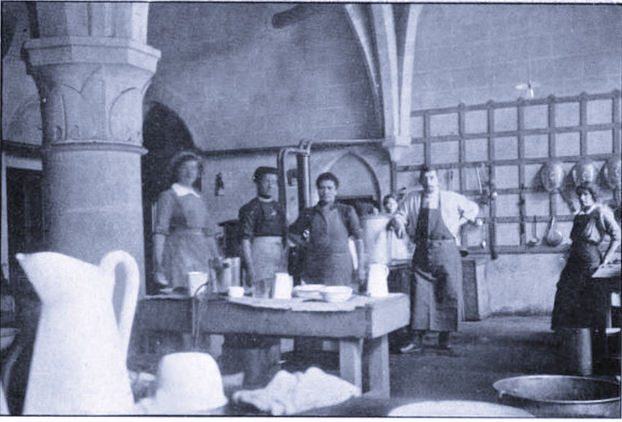
So how did “Madame Jeanne”, a simple uneducated woman, find favor in the eyes of the Scottish ladies, these pioneers of aristocratic feminism? I wonder, but one way or another she proved worthy of working with them. And she stayed there until the end of the war, away from her children, in the midst of all this turmoil, in this old abbey full of sick and dying soldiers, with bombings sometimes so close that they had to evacuate.
When the war came to an end the Scottish ladies didn’t forget “Madame Jeanne”. They helped her to establish herself afterward. She ran boarding houses, first in Grasse or Nice on the Mediterranean coast, then in Saint-Jean-de-Luz on the Basque coast. It seems the Scottish ladies went back to France on vacation after the war and stayed at my great-grandmother’s boarding houses.
It was only in 1923, when she was 13, that my grandmother went back to live with her mother in Saint-Jean-de-Luz, where she had to help as a cleaner and waitress in the boarding house.
Today, the abbey is a tourist attraction and also serves as a cultural center.
So this was my tribute to these forgotten heroines from a troubled past. I’d be curious to know if you had ever heard about these extraordinary women.
Sources : The Women of Royaumont — A Scottish women’s hospital on the Western Front by Eileen Crofton https://amzn.to/3ZlKG36 (affiliate link: If you click on this, I get a small commission at no additional cost to you). Some interesting links : https://rcogheritage.wordpress.com/2017/07/21/pioneers-ruth-nicholson-frcog-1931/ https://archive.org/details/cihm_65037/page/n3/mode/2up https://www.royaumont.com/decouvrir-labbaye/histoire-de-labbaye/


