In My Grandmother’s Memory
Precious memories from my grandmother
She would come to visit us on weekends. She always had a nice word for us kids and although she was rather poor, she never left without discreetly handing over a coin to each of us. For her, it was a lot, and we didn’t really need it, but those little coins, directly passing from her hand to ours, while we were saying goodbye, were and still are invaluable to my heart. They felt like the poor widow’s offering in the Bible, an act of pure generosity, a sacrifice of her comfort to make her grandchildren happy.
My grandmother was a stout woman born in 1910. She had been raised on a farm, in a small village in the center of France, growing up in a simple, rural way of life. I suppose it is what gave her this matter-of-fact, down-to-earth ability to cope with anything. She probably knew how to kill a chicken or a rabbit, she definitely knew how to skin and cook them. Having grown close to nature and being empowered with some surviving skills gave her the calm, reassuring aura of someone who is not afraid and knows how to deal with whatever comes. After all, she had to go through two world wars during her lifetime.
As I am now a 60-year-old woman, reflecting on these memories, I realize how important her connection to nature was. She transmitted it to me as we spent many vacations and weekends at her house in the country with my little brother and sometimes my two older cousins, playing in the vegetable garden, walking in the fields, fishing in the pond.
The fishing part was my grandfather’s contribution. He died when I was seven, so I don’t recall much, but I remember he gave us small fishing rods, kept some rotten meat in the garage to breed worms for bait, and took us fishing with him by the pond across the street. We had to keep still and quiet and it was boring. I wasn’t really into fishing. Whereas wading into mud puddles for hours, observing newts swimming in an old well, or picking yellow primroses and buttercups made my heart burst with pure childish bliss. Life was teeming around us and we were free to observe and discover its dazzling various shapes. Quite a change from the fourth-floor apartment we lived in the rest of the time and where the tv was the only window on the outside world.
But back to my grandmother, Mamie as we called her. Her large bosom was a welcoming, comforting place to alleviate any childish sorrow. She would bake some apple pie or give us hot milk with biscuits and all pain would go away. In winter, the fire burning in the hearth would warm and fascinate us. And on these cold winter nights, my grandmother would put us to bed well tucked under a heavy pile of eiderdown.
I can still hear her protective, warm, sometimes rough voice with her distinctive, weird to us, provincial accent. How she pronounced my name when calling me was unique and felt so affectionate. It still rings and vibrates in my ears sometimes.
Another aspect of my grandmother was that she loved books and was eager to learn and study. Sadly, she had to stop going to school at thirteen to work with her mother. My grandmother was two years old when her father died from pneumonia, just before world war I. She was then raised by her aunt while her mother had to leave to find work elsewhere. When my grandmother finally went back to live with her mother, who was then running a hotel restaurant in Saint-Jean-de-Luz on the Basque coast, it was only to work at her service. Only boys were entitled to education then, and her mother favored her sons who could go to trade schools while she had to clean rooms and serve dinner at the hotel. She would have liked to become a nurse and move to the French colonies. Instead, she married, had two children, and helped her husband in his construction business, which never thrived.
She never told me much about her life. I learned more about it long after she died, when I became interested in my family tree. Until after her death, I had not really been aware that her relationship with my mother was complicated and unsatisfactory for both of them. From her mother to mine, motherhood had not been a given. Aloofness, disappointment, and frustration were its main ingredients. I think I can say my grandmother has been much better at being a grandparent than a parent. Maybe she tried to compensate for her failures.
She had yearned to educate herself and would rather spend the little money she had on books than on anything else. She was interested in many subjects and even began studying graphology. I witnessed her describing people from their handwriting to my parents. I showed my boyfriend’s letters to her after he broke up with me. She mentioned his selfishness and immaturity. It still broke my heart, but it triggered my curiosity.
She was also driven by a spiritual quest which made her explore different religions and spiritual paths before turning back to her original Catholicism. I inherited some books illustrating her exploration of Indian spirituality.
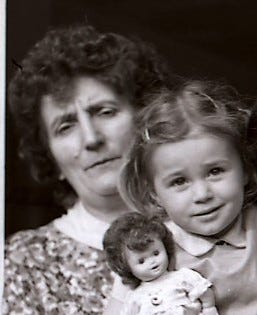
As I am writing this, I look at her picture on my desk. She’s standing on her porch, a solid woman with short brown hair, and a stern look on her face as if she was scolding the photographer. She’s holding me on her left side, a two years old beaming kid. I like the contrast between our faces, she looks a little rugged while I just seem to enjoy myself, feeling safe and confident in her arms. At the top of the photograph, a metal salad basket is hanging, adding a quaint old-fashioned touch to this picture. She was a mother-like figure to me. I always felt she was on my side and I think this photograph shows it.
I was nineteen years old, when alone at home, I answered a phone call. It was the police, informing me that she had been found dead at her place, a very small house where she had moved after my grandfather’s death. A neighbor must have been worried because of her cats meowing and called the police. A few days before, she was staying with us for Christmas. She was seventy-one years old and probably died of a heart attack. I had to break the news to my parents when they came back. I was stunned, but strangely I remember I couldn’t cry.
Life felt more lonely after she died. Probably becoming a graphologist was a way for me to keep her memory alive.
Her life had not been easy, but she brought some warmth and joy to mine, and I am grateful for that.