
The Woman Who Glowed At Night
Anna Monaro’s strange luminescence intrigued Guglielmo Marconi
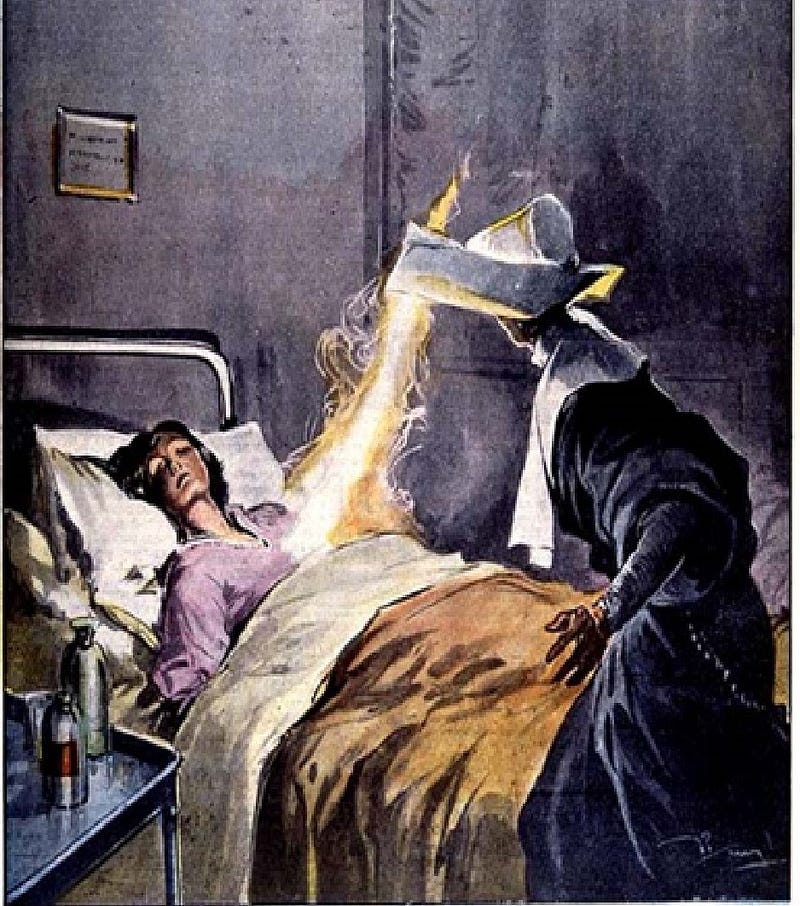
It’s March 1934 and Anna Monaro, a patient at Pirano hospital in Italy (now on Slovenian territory) is sound asleep. Nothing seems out of the ordinary until a fellow patient sees an intense blue flame-like light emanating from her body, strong enough to light up the entire room.
Several nurses and a doctor witness the bizarre event, and Anna is transferred to a much larger hospital in Rome, where the perplexing phenomenon can be studied. The story of the “luminous woman” is too juicy to remain a secret for long: soon the account of Anna’s strange glow is all over Italian newspapers. The unusual tale is also picked up by the foreign press, appearing on German, Hungarian, and British publications, and even ending up on the New York Times.
It all starts on the night of March 8, 1934: Maria Gherardi, a woman lying sick in the small hospital of Pirano, Istria, is tossing and turning in her bed. She can’t sleep and at some point, she can’t help but notice an intense light emanating from the bed next to hers: it doesn’t come from a bedside lamp or a flashlight, though: it seems to radiate directly from the sleeping body of her neighbor.
Alarmed, Maria calls a nurse. She, in turn, summons the other nurses and they all agree to inform the head of the hospital, Dr. Domenico Sambo, about the strange occurrence.
Initially skeptical, Dr. Sambo goes to see the patient for himself: he is sure there must be a perfectly reasonable explanation for what the nurses think they are seeing. Human bodies don’t glow, he tells them.
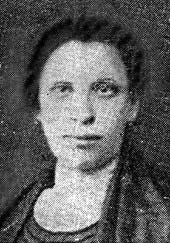
But after a quick exam of the sleeping woman, he is forced to admit he is wrong: the patient, 42-years old Anna Monaro is, in fact, emitting a bright bluish light. When the doctor wakes Anna up and explains to her why they’re all gathered around her bed, she looks confused: after the initial surprise, though, she doesn’t appear particularly interested in the fact that her body glows. She doesn’t get anything out of it, nor does it bother her — and as for the cause of the phenomenon, she simply attributes it to some kind of divine intervention.
After all, if God wants her body to glow blue, who is she to argue?
But who’s the glowing lady? Anna is an ordinary woman, the wife of a fisherman and mother to no less than twelve children. She is a small, quiet woman who does not show much emotion in any circumstance. On the other hand, she is intensely religious and wears a cross around her neck at all times. Anna is in the hospital to recover from a serious flare-up of her chronic asthma, exacerbated by the fact she had deprived herself of food for a long time during Lent, and the prolonged fast has compromised her health.
Dr. Sambo calls two colleagues, Dr. Contento and Dr. Parenzan, along with the local high school’s headmaster, Professor Mulino, a magistrate, Mr. Genovesi, and Count Bruno de Furgoni, a nobleman: he hopes their combined efforts will be able to make sense of the strange incident.
Between March 9 and March 19, all of them are able to witness the appearance of the blue light. Sometimes the luminescence appears as a luminous globe over Anna’s breasts, sometimes in the shape of a cone originating from her heart, and sometimes as several beams of light shooting from her chest, lasting for a few seconds at a time. The glow resembles that of a Geissler tube, the precursor to modern neon lights.
The light is intense enough to be visible through the blankets, and during all of that Anna just keeps sleeping: the only sign that something’s out of the ordinary (apart from the fact that her breast shoots rays of blue light, I mean) is that Anna’s breathing and heart rate double for a short time during the experience, and she sweats profusely, groans and appears exhausted when it is over.
Doctors converge from Trieste, Padoa and Milan and bring a variety of devices with them, including an X-ray machine, a galvanoscope, an electroscope, and a camera: all sorts of tests are carried out on Anna, and a short video of the mysterious glow emanating from her body is filmed. But all tests prove to be useless: there’s absolutely nothing wrong with Anna, nothing abnormal or even remarkable in her body.
Anna’s story hits national news, attracting the interest of several research institutes. The National Research Council asks for Anna to be transferred to Rome, where other tests are performed on her.
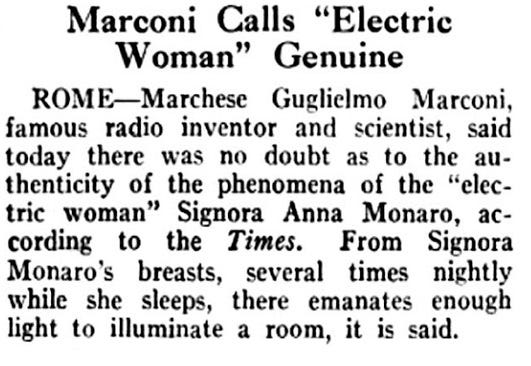
Clinicians, psychologists, and even clergymen examine her without finding anything out of the ordinary; some sources say even world-famous physicist Enrico Fermi was summoned to her bedside. Among the many witnesses of the strange occurrence is Italian inventor and electronic engineer Guglielmo Marconi, who appears very interested in what he considers to be an unknown electrical phenomenon.
When interviewed, Anna is able to recall at least one other instance when her body had emitted some kind of light: when she was a child of 7 or 8, she had heard her concerned parents talk about “taking her to the doctor” because her skin was “glowing.”
She also claims that, several years earlier, she had given birth to a stillborn child and also expelled what she described as “a human heart” that, according to her, “glowed like an open flame.” She insists a doctor named Percolt (also spelled Percault or Perco, depending on the source), who at the time had examined the “glowing heart,” had taken it to be preserved in spirits. She also claims to sometimes be able to see the spirits of dead people, and to witness battles being fought thousands of miles away as if she was there. Her dreams are often unusually vivid.
A psychiatric evaluation concludes Anna is subject to some kind of self-hypnotic or hallucinative state, but she doesn’t suffer from psychosis and is certainly not insane. Her ‘visions’ are often of religious nature and are not all that uncommon among illiterate and very spiritual people like her. Physically, Anna is a healthy woman in her forties whose only serious ailment seems to be her chronic asthma.
When Anna makes her recovery from the asthma flare-up, the mysterious glow stops appearing and, as far as we know, never comes back. She is released from the hospital in June 1934, and in September a 52-pages long report of all the exams performed on Anna is published on the Italian medical magazine La Ricerca Scientifica.
The essay offers a number of theories about the strange phenomenon— from the then-popular “mitogenetic radiation” to electromagnetism, from “certain compounds in her skin” or an unusual amount of sulfides in her sweat, to bioluminescent bacteria — all fancy ways to say “we don’t really know”. Other, less scientific publications suggest a supernatural origin of the glow, thought to be “ectoplasm” or “spiritual energy” connected to supposed medium powers Anna possessed. Many think the whole thing was a hoax.
The reason why Anna glowed blue is still a mystery today, and it is likely to remain so.
Anna Monaro is not the only “luminous person” to ever be observed: similar cases of luminescence were reported over the years, both before and after hers. Curiously, the vast majority of them are women.
In 1869, English Mechanic published the letter of a woman whose foot started emitting a bright glow one night. The glow increased when she rubbed the skin, could not be washed off with soap and water, and lasted for about an hour before disappearing spontaneously.
Death, Its Causes and Phenomena (1911) reported the case of a child who had died from acute indigestion, and whose body emitted a faint blue light.
In 1935 another Italian woman suffering from ankylosing spondylitis (a long-term inflammation of the joints of the spine) noticed her fingertips were glowing. After examining her and confirming her observations, her family doctor made her case public, and several Italian newspapers picked up the story.
In Anomalies and Curiosities of Medicine (1937) by Gould and Pyle, a cancerous sore on a woman’s breasts glowed blue, and the light was bright enough to read the face of a watch several feet away.
For other random tidbits of history, vintage true crime stories and the occasional anecdote about my home country, use my referral link to become a Medium member.
Sources:
Anna Monaro, la donna luminosa (Aldo Cherini, 2008) Archives of Italian newspaper Corriere della Sera (1934–1950) Unexplained Phenomena: A Rough Guide Special (J. Michell, B. Rickard, J. M. Rickard, 2000) Istria On The Internet


