
Girolamo Segato, Petrifier Extraordinaire
Why be embalmed when your body can be turned to stone?
Warning: pictures of petrified body parts ahead
From painters Giotto, Caravaggio, and Botticelli to sculptors Donatello, Bernini, and Canova, Italian history has its fair share of artists. Italian museums and churches are littered with their masterpieces: frescoes, oil paintings, Greek gods carved in white Carrara marble.
But sticking to the classical arts was not for Girolamo Segato: RIP to Raphael and Titian, but he was different.
Ante Litteram Indiana Jones
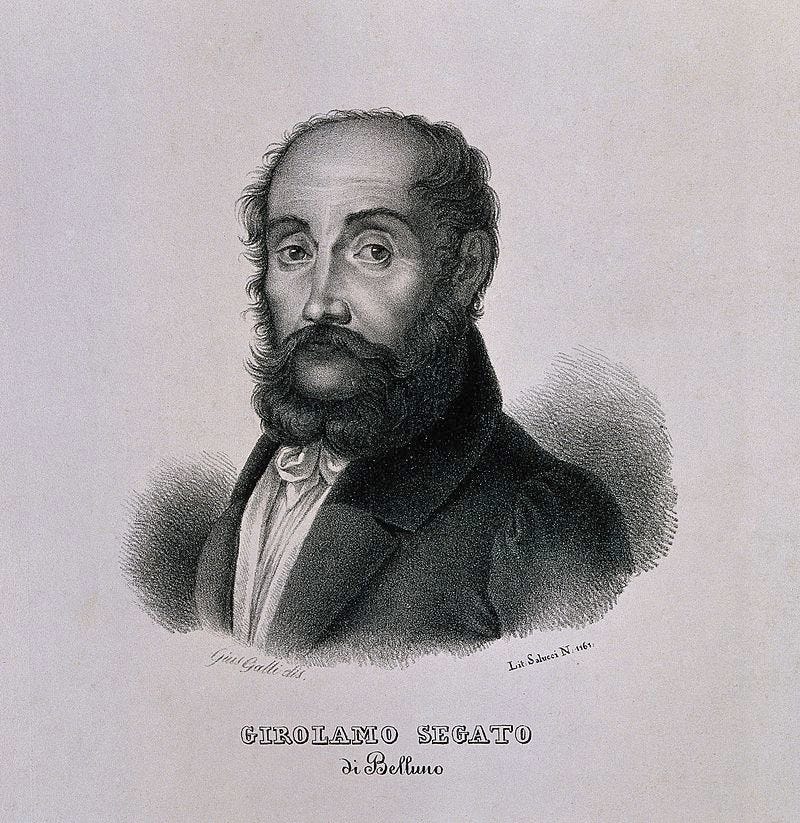
Girolamo Segato (13 June 1792–3 February 1836) was born in an Italian monastery in Northern Italy — the third of thirteen children — and there he started learning the elementary principles of botany, chemistry, and mineralogy. He would eventually become an accomplished naturalist and anatomist.
He tried to continue his studies, but his parents — who were by no means wealthy — accused him of being an ungrateful parasite and urged him to get a job. To extend his knowledge without having to rely on his family’s support, he participated in several archaeological expeditions to North Africa as a cartographist. He ended up in Egypt by chance, but once there he became a full-fledged Egyptomaniac, developing a deep interest in mummification techniques and also, oddly enough, in ancient Egyptian music.
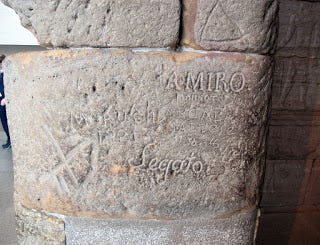
He was a bit of a maverick, Girolamo Segato: he once asked to be lowered in a well in the largest step pyramid of Abusir, north of Saqqara, where he stayed for three days; he was bitten by a snake while he was sleeping in an ancient Egyptian burying site (I mean, who wouldn’t take a nap in an Egyptian tomb?) and he also carved his name on a stone in the Temple of Dendur, as any ill-behaved 5th-grader would do. Apparently, that was the custom back then.
Instant Fossil
What little remains of his Egyptian notes, maps, and drawings are quite impressive (his Atlas of Upper and Lower Egypt was published posthumously, as well as several maps and essays), but almost all of them were destroyed in a fire in Cairo. The eccentric idea that would shape his later life probably occurred to him during his extensive trips and began from his obsession with mummies. I’ll show those damn Pharaohs, he probably thought. Or Italians do it better. Something like that.
Around 1823 — not content of being a naturalist, cartographer, Egyptologist, and anatomist — Segato decided to go one step further and develop a novel technique that would allow the conservation of bodies after death. During his expeditions, he had become an expert in ancient mummification techniques — but ordinary mummies were far too basic for him. He wanted to turn bodies to stone, like a modern version of Medusa. Why though, you may ask. Because it was mid-19th-century, and Segato’s practices were part of a broader context in which scientific research was mixed with an intense curiosity for anything singular and bizarre and tinged with a taste for the macabre. The fact that 18th-century people were pretty obsessed with death might have helped, too. Also, as he probably would have said, why the hell not.
Segato developed multiple preservation methods, producing different groups of preparations: some specimens were obtained replacing organic fluids with some unknown chemical (possibly potassium silicate), not unlike similar preparations used by other embalmers of the time. Some others were dry anatomical pieces obtained by common dehydrating procedures. But the last group is the interesting one: he somehow successfully replaced the organic tissue with mineral matter while preserving the original color, shape, texture, and even the cellular structure of the original material — basically creating instant fossils.
Segato almost always petrified specimens of limited size (fetuses and body parts, with a marked partiality for female breasts and nipples), never whole human bodies or large animals. This might suggest that he used a method that is not applicable to large surfaces: probably a process of immersion in a chemical or mineral solution. About the substances he might have used very little can be said, since Segato destroyed his notes and the preservation of the specimens makes mass spectrometry analyses impossible.
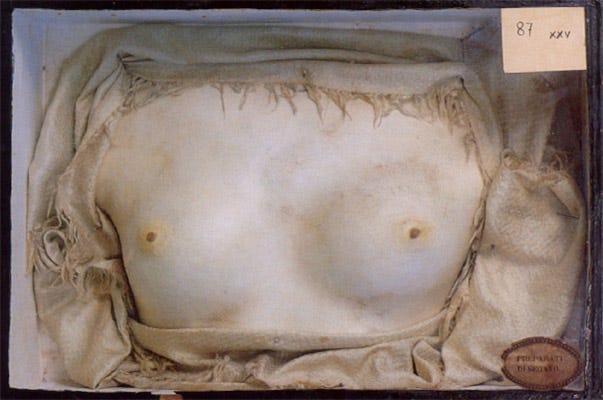
His works were remarkable and could have very well been used as anatomical models by med students, but were almost exclusively regarded as curiosities: Segato experienced a brief period of intense fame and, after someone tried to break in his laboratory to try and reverse-engineer his formula, he became paranoid and secretive. Today, many of Segato’s surviving petrified human remains — feet, hands, hearts, a stomach, two kidneys, a couple of brains, a few human heads, some babies, some small animal and more than a few human nipples) can be found in the Museum of the Department of Anatomy in Florence, the city he settled in when he got back from Egypt.
Between 1832 and 1836 Russian, American and French enthusiasts insistently requested Segato’s services, but he replied “la mia seduttrice mi tien forte”, my mistress holds me tight. By mistress, he meant his beloved Florence… or maybe Isabella, the woman he gifted with two small petrified fishes and three petrified drops of blood (the blood was hers, in case you’re wondering).
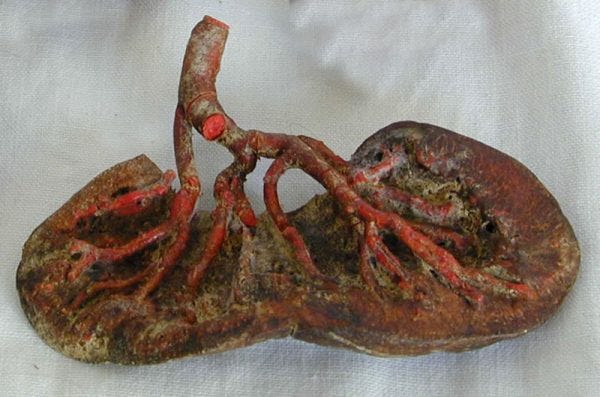
But Florence did not return his affection: the Church accused him of performing “Egyptian magic rituals”, the University of Florence ostracised him and considered his work unscientific (maybe because of the vast amount of fossilized human nipples?) and patrons of the arts, though initially fascinated with his specimens, would not finance his studies.
Desperate for money, Segato built a tabletop using a mosaic of petrified body parts and sent it to the Grand Duke of Tuscany as a gift: the prick kept the table but refused to give him any monetary help. Enraged, Segato burned all of his notes, papers, and drawings. He died shortly after.
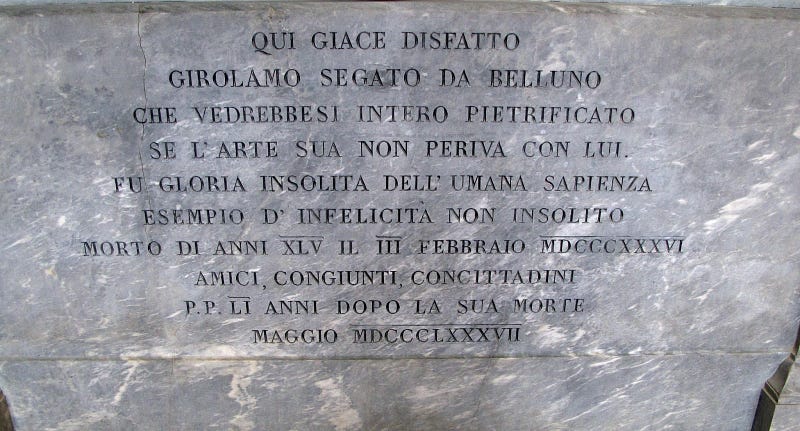
Like many misunderstood geniuses, Girolamo Segato died alone and penniless when he was only 44, right at the time Pope Gregorio XVI had finally decided to take him under his patronage. He was buried, together with his secrets, in the Basilica of Santa Croce, in Florence — the burial site of Michelangelo, Machiavelli e Galileo Galilei. A plaque was placed on his tombstone site several years after his death. It reads:
“Here lies, decaying, Girolamo Segato from Belluno, who could have seen himself turned to stone had his art not perished with him. He was an example of uncommon human knowledge, and unhappiness not uncommon.”
You can take a tour of some of Segato’s (rather graphic) specimens here.