The Way of the Dream: Part Two-Archetypes
The Way of the Dream: Archetypes
Archetypes
This is Part 2 of an original 3 part series written by Celine Lai.
Part 1 (Introduction to Jungian Analysis, Complexes and Concepts) can be read at this link HERE.
The Archetypes of Development
In 1917 Jung termed archetypes the “dominants of the collective unconscious.”
Before that he referred to them as “primordial images”, as mythological manifestations of human behaviour.
In 1946 in his article “The Spirit of Psychology” Jung distinguished between two kinds of archetypes — the “archetype as such (per se)” which is potentially present, and the perceptible archetype with its potential to be “represented” — the so called archetypal image.
Archetypes (per se) are described as structural factors in the collective unconscious, invisible nuclear elements and potential carriers of meaning.
As primordial patterns, archetypes underlie the invisible order of the psyche and are pre-figured in the unconscious. They do not have a material existence until the moment the conscious mind puts flesh to their invisible bones, and an image is born.
The following source has excellent information about the Archetype:
https://appliedjung.com/complex-archetype-symbol
An archetype is often reduced to being defined as the model image of a person or role and includes the mother figure, father, wise old man and clown/joker, amongst others. Archetypes are universal, mythic characters.
Archetypal images are forms or representation taken by the archetype in dreams, fantasies, cultural and religious (mythical) products.
As well as possibly appearing in dreams, they can be projected onto people or places or groups in waking conscious life, i.e. a person may perceive another person as having an archetypal quality.
The mother figure, for example, has caring qualities; she is dependable and compassionate. We all hold similar ideas of the mother figure and we see her across cultures and in our language — such as the term ‘mother nature’.
According to my book by Robin Robertson “Beginner’s Guide to Jungian Psychology”, the 3 archetypes singled out by Jung for special attention are: The Shadow, the Anima in a man, or the Animus in a woman, and the Self. Jung thought they represented sequential stages toward individuation.
The Shadow
Those elements of the self which have not been integrated into the conscious personality. These elements are sometimes in the shadow because the qualities and functions are denied or disowned because the person feels they are unacceptable. Other times these elements may have been repressed or subconsciously disallowed as a protective mechanism.
Although the shadow appears negative, sometimes traits and associations arising from it can suggest a positive resolution to conflict.
Integrating the Shadow requires a high level of courage and honesty. Learning to recognise the Shadow in your dreams helps you to recognise the Shadow in everyday life.
The Shadow stage is that stage of our development where we are forced to consciously admit that some unwanted personality traits are part of us. Once it has been integrated, we move onto the next stage.
Anima/Animus ( 2 separate archetypes )
The anima (in males) or animus (in females) represent the opposite gender to a person’s self. “Anima” is Latin for Soul and “animus” is Latin for Spirit.
The anima and animus are generally idealised impressions of the male or female, which emerge from the collective unconscious in dreams and inform our ideas of the opposite gender.
As we age, they bring us into touch with the aspects of our personality repressed during the formation of a gender identity.
The Anima or Animus appear in dreams in much more complex ways than the Shadow, and it is beyond the scope of this article to go into detail about them. To discover more, please read the excellent book “Beginner’s Guide to Jungian Psychology” by Robin Robertson.
He states that the Anima and Animus are an inner structure through which we filter nearly everything we have a relationship with, through the experience of the relationship between men and women.
Robertson defines the Anima/Animus an an impersonal collective archetype of relationship between us and the world, which appear after the Anima or Animus as Shadow appears as a member of the opposite sex.
Once all Shadow issues are resolved, the Anima or Animus can be fully integrated into the personality.
The Self
This archetype shows the authentic self, the complete personality of someone, which ensures that they can develop themselves. Jung regarded the Self as the Archetype of wholeness.
The Self in dreams can be represented by geometric symbols, such as circles or mandalas. It appears when the person is trying to restore wholeness, and thus along the way to individuation, can appear in dreams as animals, especially if a transformation or change occurs in the dream.
Robertson states that mountains, oceans and trees, and even flowers may appear in dreams as “the Self” and that the Self archetype appears at times of great transformation in the dreamer’s personal life.
Animals and people in various roles can also represent the Persona. It will be the Self in a dream if the appearance of the figure leaves you feeling positively charged and changed.
Jung identified the above four major archetypes, but also believed that there was no limit to the number that may exist.
Some other Archetypes
The Persona
Distinct from our inner self, Jung noted that we each have a persona — an identity which we wish to project to others. Some schools of thought include the Persona as one of the “major” or basic Archetypes, and this is because its expression as a desirable collective identity can push the Shadow even deeper, the Shadow being what is denied or not desirable.
Jung distinguished the persona, or the image of ourselves that we present to the world, from our shadow, which may be comprised of hidden anxieties and repressed thoughts.
I often regard the people in my dreams, even if they appear to be people who I know in real life, as aspects or parts of my persona.
This is because the persona can be constructed from archetypes in the collective unconscious, or be influenced by ideas of social roles in society.
So, for example, if a teacher I know appears in one of my dreams, I may consider it to be a reflection of the qualities of that real person, in what I would like to be projected by me, or what I think is being projected by me, in the context that the dream is showing me.
The Persona is identified with the Ego and it appears in dreams in the form of a figure that embodies those qualities that typify the Ego. Character roles in dreams may indicate the Persona, and clothing is also a presentation of the Persona archetype.
The Persona is neither negative or positive, but will appear in a dream showing you how you unconsciously feel about the image you are presenting to the world. For example, if you are naked in a dream, this will indicate that you are feeling vulnerable and feel that your persona is inadequate.
The Persona archetype allows people to adapt to the world around them and fit in with the society in which they live. However, becoming too closely identified with this archetype can lead people to lose sight of their true selves.
Wise Old Man archetype (sometimes called the Sage)
The Wise Old Man represents the power of peaceful contemplation in the absence of physical prowess. The wise old man, through quiet thought, foresees the future and offers guidance in turbulent times. This archetype is derived from the Animus.
Wise Old Woman archetype (also called the Crone)
The Wise Old Woman represents a primordial energy that can assist one in growth and transformation or, alternatively, in destruction and disintegration. This archetype is derived from the Anima.
The Mother / The Great Mother
The Mother archetype embodies the idealised qualities of the mother figure. She is caring, compassionate, dependable and loving. However this archetype is also the primeval doorway to the unconscious, which can either create or destroy. In this capacity, she is referred to as “The Great Mother.”
In this way, the “Great Mother” can become the “Devouring Mother” if her negative or less nurturing aspects come to the fore.
The Child
This archetype indicates an inner child, characterised by enthusiasm, innocence and imagination, and in need of love, comfort and reassurance. The Child represents our potential, our possibilities for growth.
The Trickster / Magician
In his collected works, Jung describes this archetype as:
“An archetypal psychic structure of extreme antiquity.
In his clearest manifestations, he is a faithful reflection of an absolutely undifferentiated human consciousness, corresponding to a psyche that has hardly left the animal level.”
The trickster is defined as a parallel to the individual shadow. The trickster figure is represented in a normal human by counter-tendencies in the unconscious that appear whenever a human feels himself or herself at the mercy of apparently malicious accidents.
A Trickster may appear in a dream as a Crow, a Coyote, a Fox or a Monkey, animals that are deemed to be clever, wily, or wise.
The Trickster’s advice will never be straight forward, and may take the form of a riddle. “He” may sometimes mislead us, giving us false clues, or leading us somewhere we didn’t intend to go, but if we pay attention and keep an open mind, there can be great lessons to learn from these adventures. The Trickster will often teach us things we didn’t think we wanted to know!
The easiest way to know that you have dreamed of the Trickster is when you wake and feel a little foolish, that something in your dream seemed so clear or obvious, now seems exactly the opposite.
Source: https://thedreamwell.com/2008/10/02/meanning-of-trickster-in-a-dream
The Trickster is a derivative of the Magician archetype.
The Magician
Jung describes the “Magician” as a mana-personality, or possessing supernatural or great powers, along with “the Hero”, “the Chief”, “the Wise Old Man” and “the Medicine Man.”
Once the Anima or the Animus has been integrated into the personality, a transitional figure appears, who prefigures the Self and is in fact, inferior to the Self.
Jung referred alternatively to this as the Mana-personality and the Magician. Unfortunately when a person has an inflated sense of self, he/she stays as the Magician, as he/she has not come to terms fully with the Shadow and the Anima/Animus.
Self-professed gurus and movements that promise enlightenment embrace “the Magician” archetype, but if you ask these people whether they include all Light and Shadow and if they are humble enough to be happy with what is, they will say No. They have not reached wholeness or transcendence.
“The Magician” often appears in lists of 12 Archetypes or other lists that people profess is an essential stage of one’s personal journey. They quote the Magician as a magical conjurer, the innate wise part of a person, who has a difficult job but can be called upon to deal with all the negative aspects of a person.
However, this modern viewpoint does not do justice to Jung’s original intention of conveying “the Magician” as a “Magic Demon” with potentially very positive OR very negative aspects or effects.
The Magician is more likely to appear in dreams via its derivative “The Wise Old Man” or not appear at all. If it does appear it will likely make its presence after the Shadow and the Animus or Anima have been integrated.
How many archetypes are there?
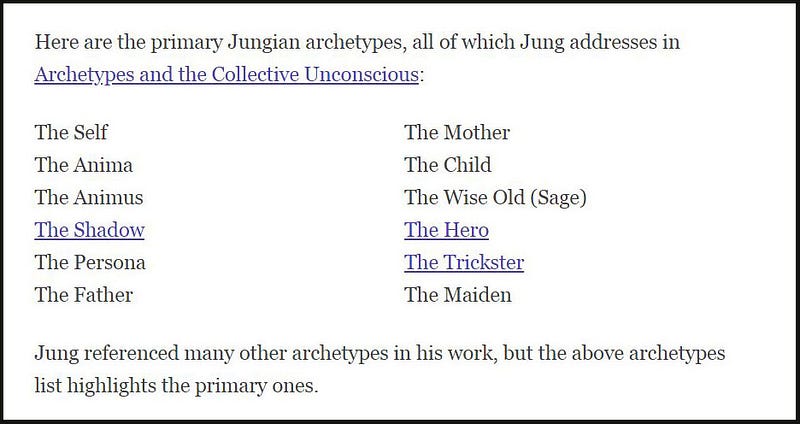
Please note that the literature abounds with different lists and interpretations of 3 to 5 basic archetypes or of 10 to 12 primary archetypes, which may be used in personal journeys or in analytical psychology or dream analysis.
Some people list 12 archetypes, which are “brand archetypes” which are symbols used to define a brand’s personality, whether purposely or not so purposely applied.
It makes sense that given that archetypes are primordial formless patterns for potential, that the number of archetypes is unlimited.
Happenings or events can also be archetypal. There are 12 archetypes mentioned in the web page under the screenshot below.