
Dentistry.
Why Do Teeth Decay? The Very Simple Truth and What to do About it.
Getting the Better of Dental Decay.
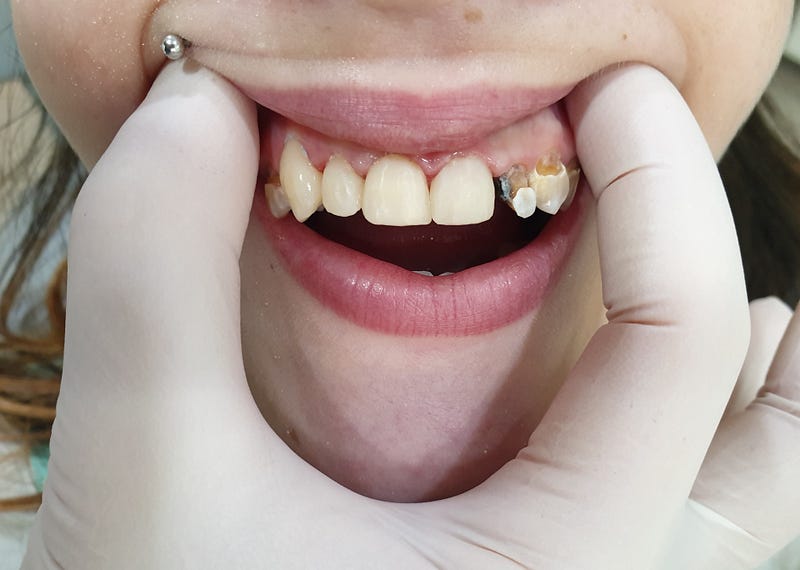
I’ve heard it all: “My teeth are rotting because my second cousin twice removed tripped me 20 years ago on a school trip,” or “My teeth are breaking up because the baby sucked out all the calcium from my teeth during pregnancy,” or “My family has genetically bad teeth, and their eventual demise is inevitable,” and so on and so forth. As a dentist with over 15 years of experience, I have indeed heard it all.
Fabricating falsehoods is a very human defence mechanism. They amazingly absolve us of any wrongdoing and protect us from the horrible truth that sometimes the responsibility lies squarely with us. But self-deception never leads to self-improvement. Don’t get me wrong; even such falsehoods may carry some truth, but you’d have to dig rather deep to find it.
The fact of the matter is that dental decay is simply a result of stagnating bacteria metabolizing fermentable carbohydrates and producing acid, which eats away at your tooth. Remove the bacteria … or the tooth for that matter, and there is no decay. Sure, there are some conditions that can make this more difficult, but the bottom line is that no bacteria means no decay.
If we want to get more “sciency” about it, we will find that the main culprit is Streptococcus mutans (henceforth referred to as Mr. Mutans for humour’s sake, rather than out of any respect for the bugger). When exposed to fermentable carbohydrates, particularly sugars, Mr. Mutans, you guessed it, ferments them through a process called glycolysis. This pathway converts sugars into energy while producing acids as byproducts. The main acid produced by Mr. Mutans is lactic acid. The acid produced by Mr Mutans can lead to a decrease in the pH levels in the oral environment, which promotes demineralization of tooth enamel, ultimately leading to tooth decay.
Individual-specific factors do exist. Someone’s saliva might be less alkaline and, therefore, less able to buffer bacterial acid, or their tooth anatomy may be more irregular, offering more shelter to bacteria from those pesky brush bristles. The pregnant mother may also have more of a sweet tooth (pun intended) and be giving Mr Mutans more fuel to work. However, the crux of the matter is that no bacteria means no decay.
To prove this point, what I can only assume to be a group of very germaphobic scientists reared mice in sterile conditions, feeding them only food that had previously been sterilized, thus completely eliminating bacteria such as Mr Mutans from their diet. They showed that without bacteria, even in the presence of an abundance of sugary foods, no dental decay took place. Eureka! All we need to do is sterilize our environment and our food, and we can live free of dental decay. Easier said than done.
So, if we cannot live in a sterile environment, then what can we do to save our teeth and ourselves from visiting the dentist, after all, I am sure we can all admit that this is what all this is about.
For starters, we need to remove as much bacteria as possible from our filthy mouths:
- Brushing for two minutes twice a day, preferably with a good electric toothbrush, is a minimum requirement, and for goodness sake, keep a timer! Your 2 minutes of brushing may turn out to be more like 20 seconds.
If you want more information about which toothbrush to use, feel free to read this article: https://readmedium.com/electrictoothbrush-vs-manualtoothbrush-making-the-right-choice-bd460d7a7773
- Brush between the teeth with an interdental brush. If you don’t know what that is, look it up! The internet is full of videos on how to use them. The space between the teeth is the number one spot where bacteria stagnate and cause decay, not because the surface is in any way irregular or hard to clean, but simply because people are too lazy to use the correct tools and clean the area.
Check out the prices of a variety of Interdental Brushes on Amazon:
- Use a good toothpaste. Most commercially sold toothpaste passes through stringent testing and regulatory phases, and you can trust them. The disinfectants inside the toothpaste kill off the honourable Mr Mutans (please note the sarcasm), and fluoride makes the outer layer of the tooth surface less soluble to acids by converting the hydroxyapatite crystals in the enamel to fluorapatite. Some people have a synthetic aversion to fluoride, but please be aware that fluorides are common in nature and naturally present in drinking water pulled from lakes, rivers, and groundwater. Like anything in high levels, it can cause harm, but unless you’re going to be binging on toothpaste, you will be fine.
- If you are one of those unlucky people with very irregular tooth surfaces, you may need to visit your dentist and get those fissures sealed. Fissure sealing is a method of closing off deep fissures, which bacteria love, with resin, making the teeth easier to clean and therefore less likely to decay.
- Despite your best efforts, you are never going to get rid of all those delinquent bacteria from your mouth, so you may need to reduce their fuel.
You see, another group of what we can only imagine to be diet-obsessed scientists got a bunch of unsuspecting mice and eliminated any source of fermentable carbohydrates from their diet. Lo and behold, even with the poor dental hygiene you could expect from your typical house mouse, no dental decay developed. But how does this help us? Unless you want to become a social recluse completely eliminating all the good stuff from your diet is not an option. So, what can you do with this bit of information?
- Reduce the frequency of fermentable carbohydrate intake rather than the quantity. Even a small amount of sugar is enough to get those bacteria going, but after an hour or so, they’ll burn through the fuel. However, if you feed them regularly, they will keep going, and if you feed them every hour, they will go on non-stop, working away at your teeth.
- Do not eat any fermentable carbohydrates one hour before sleeping. Preferably, don’t eat anything at all for that hour before bed, even if you brush your teeth. You’re unlikely to brush 100% of the surfaces, and the surfaces that you’re unlikely to brush will be the same surfaces you miss day in and day out. The sugars that you eat before sleeping last longer in the mouth at night and will do more damage.
Follow this advice and adhere to it religiously for the long term. Print it out and hang it on your walls, teach it to your children, praise it, and make it your raison d’être if need be. You won’t regret it; you’ll keep your teeth for longer and, therefore, eat well, speak well, and smile for longer. Additionally, it is a well-known fact that dentists already earn enough money, so don’t give them any more than they already have.
If you want to read more about interdental brushes click on the link below: https://readmedium.com/interdental-brushes-an-open-secret-to-great-oral-health-c0a2278d7d36
*This article contains affiliate marketing links through which the author gains commissions for purchases.


