
History, Art
The Vatican Doesn't Want You To Know About This Gay Romance
Homosexuality oozed through Michelangelo’s art
Michelangelo di Lodovico Buonarroti Simoni was born more than five centuries ago, 6 March 1475 to be exact. As a young man, he was a magnificent block of marble that was throughout his life broken down steadily by people around him. First the pope and the church, next by his thievious assistants, and finally by his own flaming love for young men.
Michelangelo’s art is human. Although naked for the most part, his images and sculptures do not have horns or wings. Most of these are images of young men. He was extremely discreet with his art and his sexuality. To the extent that he burnt most of these papers and sketches before he died. This makes speculation even more dangerous, but with what is left it is plausible that he was in fact gay.
Gay People in The Renaissance Period
The words ‘gay’ and ‘out of the closet’ have modern implications and do not translate too well in relation to the era Michelangelo was living in. The Vatican has had a rocky relationship as far as LGBTQ are concerned. Pope Francis was a step forward on gay rights and this did bring many gay people back to church.
Outside the church, in Florence homosexuality was better tolerated. Although not publicly embraced and still considered a crime, the elites largely turned a blind eye to it. Homosexuality played a role in Renaissance art and it shaped Michelangelo in particular.
To say that the entire era was in some way defined by gay men might be atrocious to some. Or at least by ‘allegedly gay men’, since there was no such thing as ‘out of the closet’ back then. Leonardo da Vinci was even arrested for sodomy, in fact, several times. Benvenuto Cellini and Sandro Botticelli were publicly charged with the same. Michelangelo did face sodomy charges but was acquitted; largely because the young men belonged to an elite family.
Michelangelo’s Gay Romance
Michelangelo frequently hired male models for his drawings and sculptures. It would be an understatement to say that he was obsessed with the male form. So much so that in his work the women are distinguishable from the men only by their long hair and lack of beards.
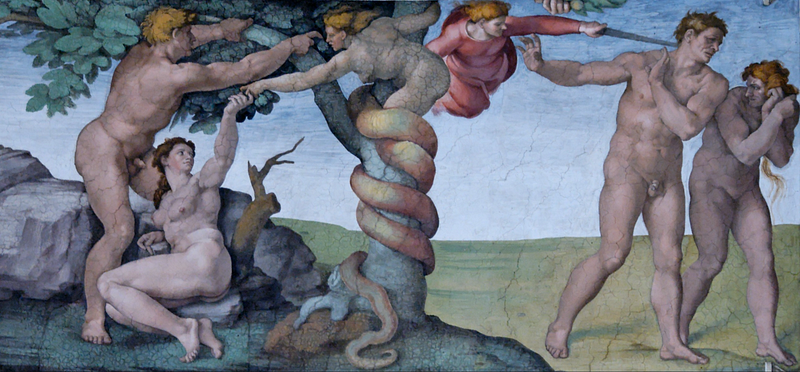
Some argue that his muscular portrayal of women in the Sistine Chapel frescos is because he was homosexual and had a long-term relationship with Tommaso dei Cavalieri. The breasts of these women do not resemble natural anatomy. Although I’d disagree with most historians about the supposed inability of gay men to depict naked women, the above mural certainly speaks volumes about Michelangelo’s source of inspiration.
Modern views of what is feminine tend away from strong physical form. Such sweeping statements and rash judgments of the past can give us the wrong idea about a period of time. That being said, it is safe to say that he used male models for his studies of females.
Michelangelo’s Paintings & Drawings
Cavalieri was an Italian nobleman and was just 23 years old when he met Michelangelo. Michelangelo was 57. He left the evidence of their love in several ways. For one, the image of Christ in The Last Judgement is most likely a portrait of Cavalieri.
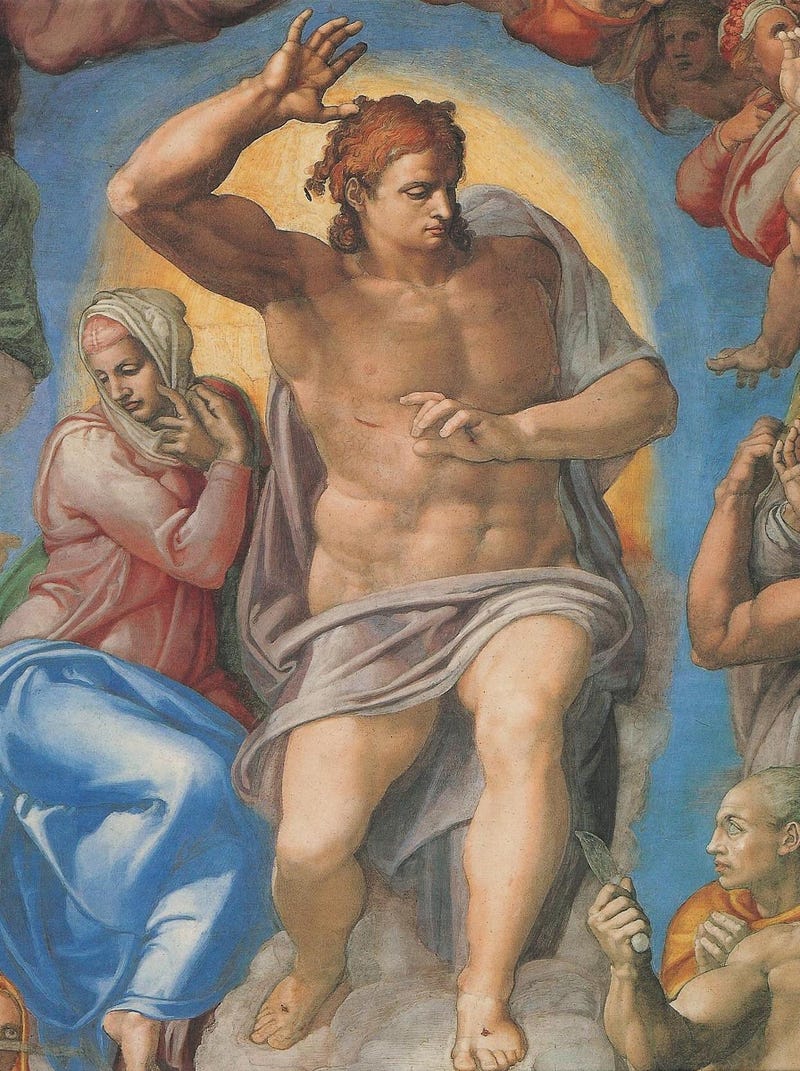
Cavalieri embodied all the ideals of masculine beauty that the aging artist had searched for throughout his career. His Neoplatonic sonnets and erotic poems for Cavalieri are another troves of artistic evidence that seem to record his attraction to Cavalieri.
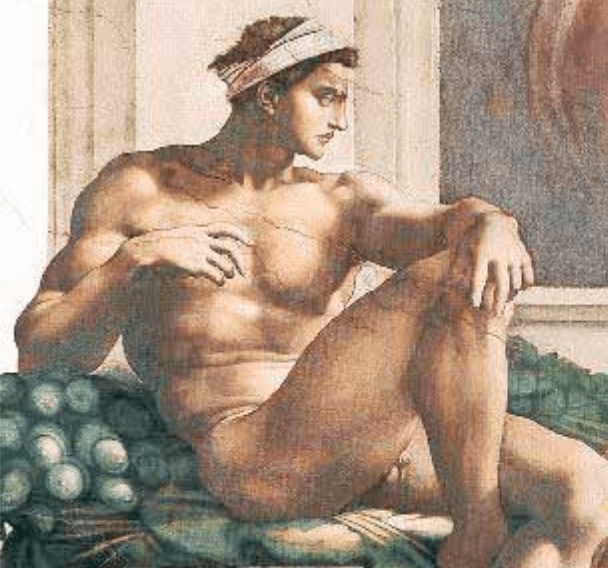
His twenty nude youths — or ignudi — in the Sistine Chapel outraged several pontiffs. Moreover, the greek-looking males had no role in the Church’s narrative. (see title image of this story).
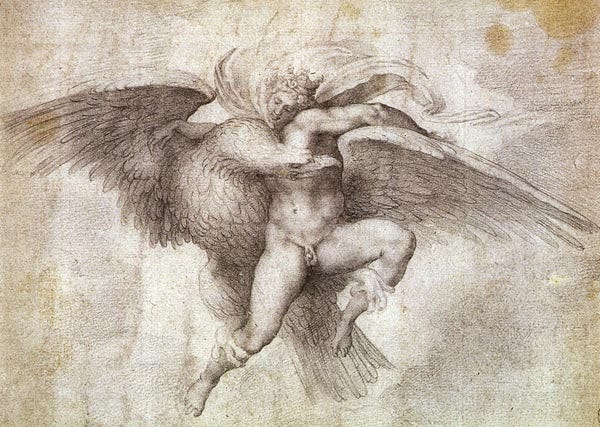
Of particular interest to gay studies and artform is Michelangelo’s imagery of Ganymede. In poetry, Ganymede is a symbol of homosexual desires and love. The drawing of Ganymede, which we are told was expressly made for the beloved Tommaso, portrays the nude Trojan prince Ganymede being swept aloft by a giant bird that is actually Jupiter in disguise. Michelangelo intended the iconography of Jupiter to portray himself. Ganymede being Cavalieri, they both fly to the highest realm of unabashed erotic ecstasy.
The fact this drawing was specially made for Cavalieri along with seductive poetry implies that the artist was trying to convey a subliminal message of ardent desire.
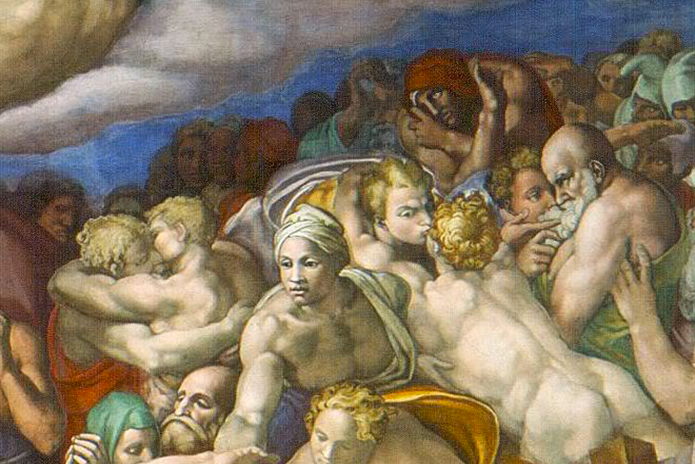
Michelangelo also painted several same-sex male couples kissing each other in his version of The Last Judgement on the ceiling of the Sistine Chapel.
Michelangelo’s Erotic Poems
Michelangelo’s seemingly erotic poems to Cavalieri, which some argue are purely Neoplatonic in nature are very well documented. In the poem ‘Silkworm’, he imagines himself as being Cavalieri’s clothes, tightly hugging his body and at one point desiring to be his lover's shoes so that he could kiss Cavalieri’s feet.
Other examples include poems like these —
The flesh now earth, and here my bones, Bereft of handsome eyes, and jaunty air, Still loyal are to him I joyed in bed, Whom I embraced, in whom my soul now lives.
Some take this as his confession of love towards Cecchino Bracci, another one of his assistants. Others imagine this as emotionless erotic poetry with an expression of refined sensibilities of that era.
In ‘Love’s Lordship’, a poem dedicated to Cavalieri, Michelangelo begs to become a slave of passion to his lover.
If only chains and bands can make me blest, No marvel if alone and nude I go An armed Cavalier’s captive and slave confessed.
Historians of the 19th century have discovered notes in the marginalia of manuscripts of poems by Michelangelo’s grand-nephew Michelangelo il Giovane, saying that these poems should be censored before being published in their original form. Giovane, therefore, replaced all masculine pronouns with feminine, thus ensuring any homosexual sentiments remain hidden.
It has also been discovered that Michelangelo himself sometimes changed the word Signor to Signora before circulating his poems.
In Conclusion
Michelangelo’s poetic legacy deserves the full attention of the academy. He is an appropriate figure to be understood as participating in the evolution of the gay literary tradition. Michelangelo sure was mysterious, his amorous sonnets to Vittoria Colonna, muddy the waters while attempting to explore his sexuality. Up until the 1970s, homophobically blind scholars have attributed that the poems were written for Colonna.
Cavalieri and Michelangelo remained close for the rest of Michelangelo’s life — over thirty years of friendship. Cavalieri was present at Michelangelo‘s deathbed.
If you have enjoyed reading his story, you might also like to read how a gay artist defined the perfect American male through his advertisement campaigns for a shirt company.
ReferencesMichelangelo-Gender and Sexuality
Michelangelo's Women
Michelangelo’s Christ in the Last Judgment (1534–41)
BIOGRAPHY OF MICHELANGELO


#/media/File:Andr37.jpg)