
The Vanishing Interface: The Best UI is No UI
This idea of the invisible UI is not new. Golden Krishna wrote the book The Best Interface is No Interface back in 2015 and it raised a few eyebrows at the time.
Despite this, it’s probably fair to say that the focus on UI only increased in the following years and we became even more screen-addicted. Then 2023 happened, and my hunch is that the end is nigh for the UI because the goal becomes reducing all friction, personalising every experience, and augmenting the real world.
I commented on Paul DelSignore’s blog post from back in June on a similar topic and have been thinking about the trend for a while now. I’m breaking this post down into 4 categories to illustrate the broader point:
- Copilots
- Voice
- Wearables
- AI Assistants
Copilots
The thought dawned on me again recently when I started getting into the habit of using the AI DJ in Spotify:
Being a Gen Xer, I’m old enough to have developed quite a broad, eclectic, taste in music. Whilst I have created one or two playlists in the past I don’t have the time to do this as much as I would like and that means I end up listening to the same thing repetitively or need outside inspiration to spend the time open the app and search.
This made me wonder, for users like me, if Spotify could become a single button or prompt. One thing I immediately did was add BarRaider’s Spotify Plugin to my Stream Deck so I could like tracks more easily and train on my preferences:

Other notable apps in this category:
Voice
OpenAI launched interacting with ChatGPT for plus users recently:
It’s really an incredible experience, with many making reference to the movie “Her”, particularly as vision was added soon after. Incidentally, it was released in 2013 and really is starting to seem prophetic a decade later.
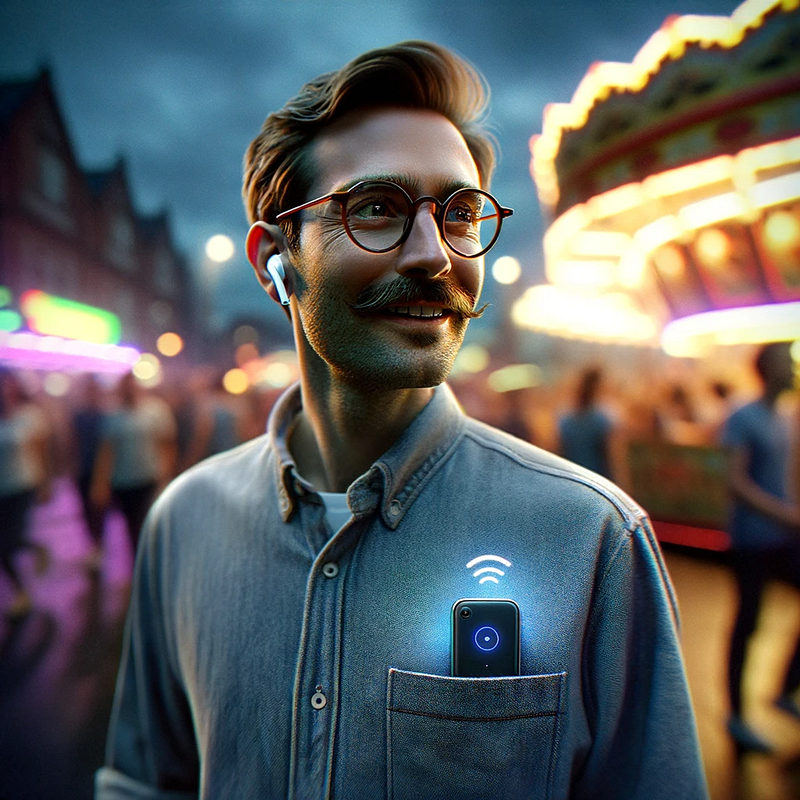
It’s not quite the seamless experience depicted in the movie, yet, but you can certainly tell life is trying to imitate art.
Other notable apps in this category:
That leads us neatly into this next category….
Wearables
Meta announced their second iteration of the Ray-Ban smart glasses last month, and this time they’ll see what you see and have a conversation with you. Or at least a Meta AI will.
The potential here for an AI to interact with the world around you, complementing your senses and perhaps even understanding the context. It also links nicely back to my first point on music… an AI DJ that doesn’t require me to search for music, just knows my tastes (and maybe even what I am doing as weird as that sounds right now)
Other notable apps in this category:
Not to mention all the watches and headphones already out there, connected to mobile phones… which brings us to the final category:
AI Assistants
Bringing us up to the current day, OpenAI just had their first “DevDay” and brought us a step closer to autonomous agents as they launched GPTs, with Sam pretty much saying as much.
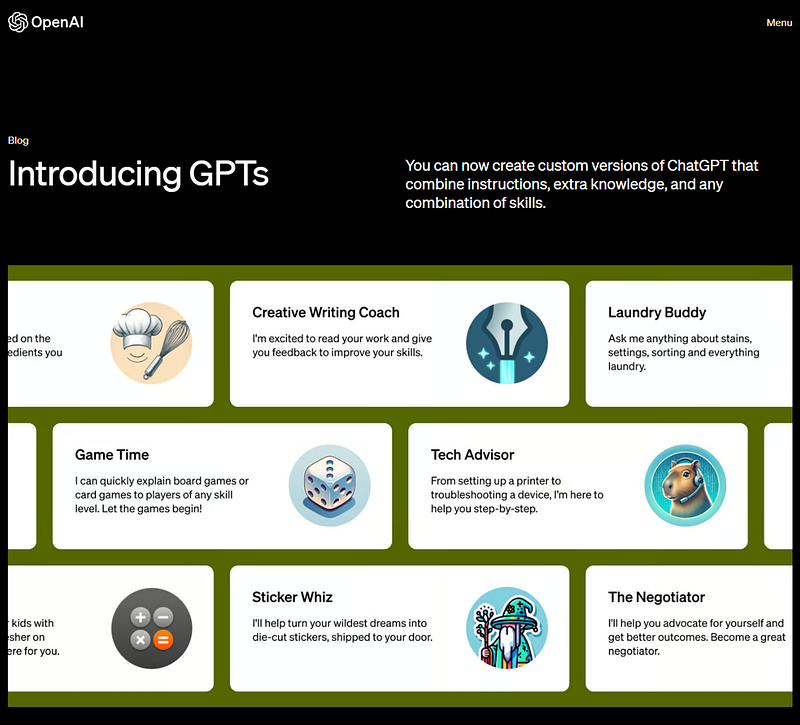
The example they used was with a Zapier GPT interacting with a calendar, I highly recommend watching the whole session if you’ve not already seen it. The point here is that of the evolution of what was plugins and is now GPTs. GPTs lower the barrier to entry for anyone to create an agent, and Sam mentioned that the GPT marketplace will be launched later this month enabling monetisation. I really can see this as a new UI to an existing WebApp or platform, travel assistants, customer service agents for online groceries who remember you, or your own personal assistant running errands for you.
At the beginning of the year, there was a lot of talk about ChatGPT being the end of Google’s dominance online, due to search. At the time, this was a function of ChatGPT’s core offering which didn’t really add up at that point, but more importantly, Bing added AI features natively to search. None of that came to fruition. But we’ve come a long this year and GPTs might just be the paradigm shift that reignites this narrative… maybe incremental innovation in search is not what consumers want, maybe it’s something much more transformative and frictionless that’s needed.
Other notable apps in this category:
This was largely a space that enthusiasts were playing in:
- AutoGPT (GitHub project by Significant Gravitas)
- MetaGPT (GitHub project by geekan)
The Big Ideas
These examples all point to 2 trends:
- Personalisation
- The digital imperative to reduce friction.
With personalisation, it’s about understanding context, having conversational interaction, and overlaying experiences on top of the world around you.
As for reducing friction, a non-music related example might be — in the same way as “one-click checkout” transformed the e-commerce experience in the internet era, in the AI era “one-search checkout” might be the future. Completely removing all friction of searching and browsing for the right product, at the right price, with the right review. Of course, it’s very unlikely to completely replace the experience in the short term, but I think we’ll begin to see significant changes in the not-too-distant future. I could see a huge UI/UX shift if this is successful.
I’ll wrap this up with a quote from Golden Krishna’s book, Best Interface Is No Interface:
After all, as Edward Tufte once said, “Overload, clutter, and confusion are not attributes of information, they are failures of design.
What do you think, is a friction-free future something you see too?
References and Inferences
- The Best Interface is No Interface (Golden Krisha)
- The best interface is no interface: why we don’t always need An App for That (The Verge)
- No UI Is The New UI (Tech Crunch)
- Spotify Plugin for the Elgato Stream Deck (BarRaider)
- Her (2013)
- AI Photo Prompt Builder (ChatGPT)
- Ray-Ban Meta smart glasses review: Instagram-worthy shades (Engadget)
- You can now prompt ChatGPT with pictures and voice commands (The Verge)
- Neuralink’s First-in-Human Clinical Trial is Open for Recruitment (Neuralink)
- Everything announced at OpenAI’s first developer event (Tech Crunch)
- Hype grows over “autonomous” AI agents that loop GPT-4 outputs (Ars Technica)
- Introducing GPTs (OpenAI)
- OpenAI DevDay (YouTube)
- How Google’s long period of online dominance could end (CNN)
- The new Bing has failed to take any market share from Google after six months (Search Engine Land)


