
Spatial Computing: The Invisible Interface of the Future
Why Apple’s Vision Pro Is Only A Baby Step
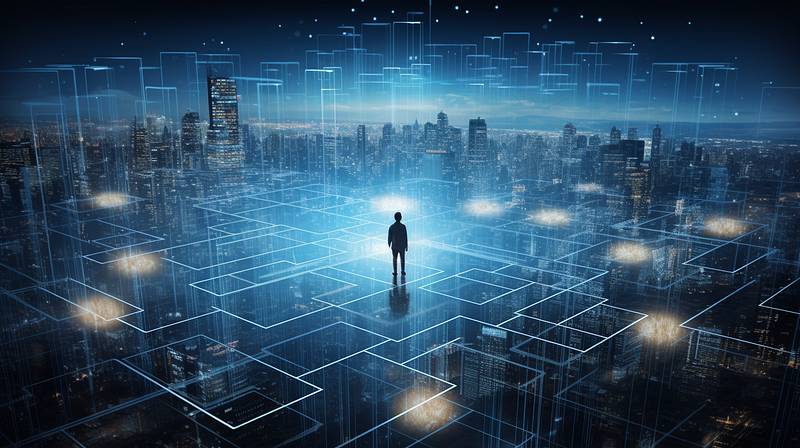
Apple’s Vision Pro announcement has energized some of the metaverse disillusionment in the XR community.
While Zuck’s ‘Meta’ is struggling to find ways to make virtual reality more accessible to the general public, Apple is pitching toward a more nuanced digital augmentation of reality.
Both visions are missing the mark.
One vision is overpromising fully immersed virtual worlds, in which our digital personas will engage and communicate in a realm that is entirely distinct from our physical existence.
Another vision is targeting a spatial experience where we engage with desktop apps in your physical space and watch immersive movies.
According to Apple, This latter vision is the beginning of a new era of spatial computing.
To be clear, I think Apple is on the right track toward this concept of a spatial dimension, but technically… they are underselling what true spatial computing is.
What Is Spatial Computing?
The term “spatial computing” is often attributed to a research paper by Simon Greenwold in 2003, where he defines it as such:
“Spatial computing is human interaction with a machine in which the machine retains and manipulates referents to real objects and spaces. It is an essential component for making our machines fuller partners in our work and play.” - Simon Greenwold
The paper is fascinating in that the way spatial computing was traditionally understood was more akin to ubiquitous computing rather than concepts of virtual reality.
This is closely related to the concept of an invisible computer, as espoused by Donald Norman in the 90s.
Norman’s concept of the “invisible computer” is not about making the physical device disappear, but rather about making the interaction with the computer so seamless and integrated into our daily activities that we’re not consciously aware we’re using a computer.
Technology becomes “invisible” in the sense that it fades into the background of our awareness.
Therefore, the true objective of spatial computing is as follows:
To eliminate the boundaries between the physical and digital realms, allowing for more natural and immersive interactions with digital technology.
Examples Of Spacial Computing
Although it is not always recognized as such, the Global Positioning System (GPS) provides an excellent illustration of Spatial Computing technology.
When you use a GPS, the system is not only computing your location but also providing you with spatially relevant information, such as directions based on your current location and the location of your destination.
This interaction between digital information (the GPS data) and the physical world (your location and movement in the world) is a key aspect of Spatial Computing.
Another example is in the construction industry, where Spatial Computing technology can be demonstrated through the use of sensors, photogrammetry, and artificial intelligence.
By utilizing these tools, computer systems can obtain real-time information about a product or environment, which can then be analyzed and utilized to develop user-friendly applications and automated workflows.
A Modern Approach
To be fair to Apple, in the modern sense, the term ‘Spatial Computing’ has been used as an umbrella term for anything XR, including augmented reality (AR), virtual reality (VR), and mixed reality (MR) experiences.
Even 3D gaming that integrates spatial properties (on a 2D digital screen) has sometimes been referred to as Spatial Computing.
Since Tim Cook appears to be intentionally avoiding the term “metaverse” like the plague, Apple’s concept of running an operating system in augmented reality could be seen as aligning with the idea of “Spatial Computing,” even if it isn’t entirely precise.
Similar to how personal computers use a desktop GUI of files and folders to make the interaction relatable, Apple aims to extend the conventions of apps and desktop interfaces to headsets.
The Spatial Interface Of The Future
While I understand what Apple is doing, in terms of making the headset interactions familiar, a likely first step toward spatial experiences.
It’s only a baby step.
In the future, interfaces will be integrated into our physical surroundings, making traditional application interfaces obsolete.
Cumbersome headsets will be replaced by wearables tapping into our senses.
Spatial computing will be a digital mesh layering over our physical world, triggered by voice gestures, haptics, and neural connections.
Everything will be one spatial reality.
If you liked this article, throw out some Medium love… claps, comment, and be sure to follow.
You can also support my work on Medium by becoming a member using this referral link.


