
The Unsolved Mystery of the Vagina Caper
In 1990, a Sheela-na-gig worth 7 million dollars was stolen from the Augustinian abbey at Kiltinan. Now, Irish residents want her back.
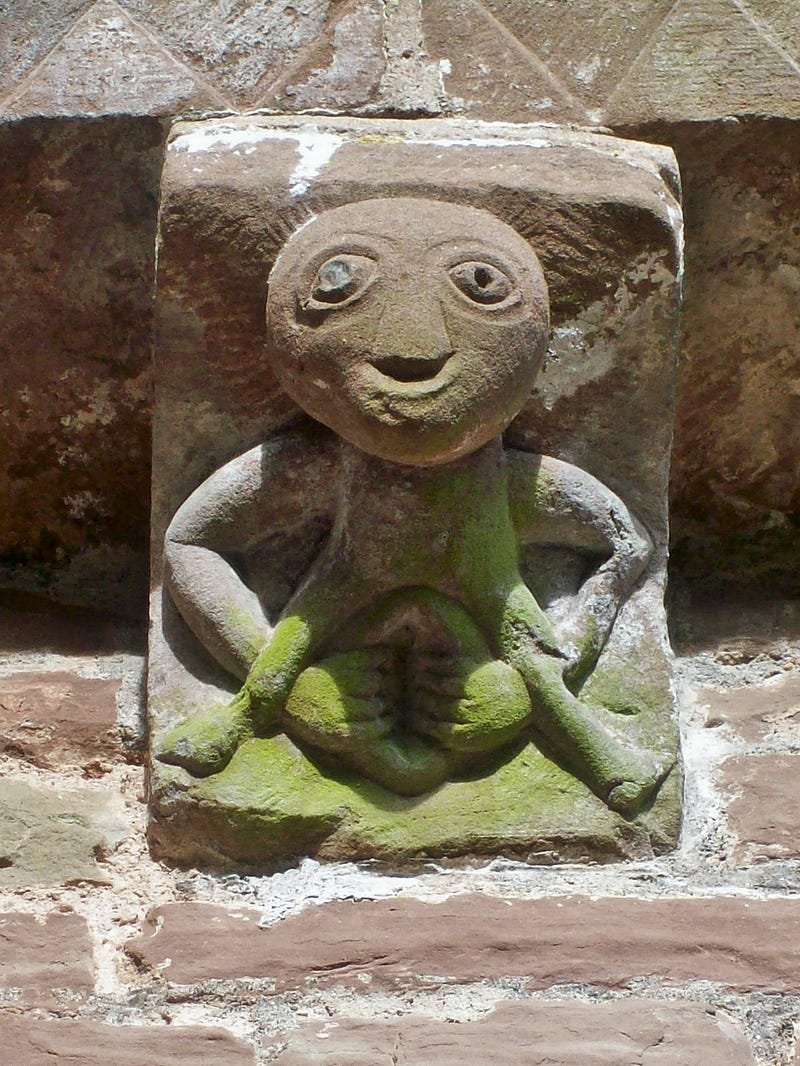
In 1840, Thomas O’Conor called them the “grossest idea of immorality and licentiousness.” He wasn’t referring to pornographic art. He was describing those wanton, vulva-flashing stone sculptures known as Sheela-na-gigs. (Pronounced Sheila Nah Gig)
Sheela-na-gigs (above) adorn many twelfth and thirteenth-century Romanesque churches, mainly in Ireland. They typically portray older women with lined, almond-shaped eyes and an incorrigible grin. But her most distinguishable trait is always her pose — squatting, her hands pulling apart her labia to expose her gaping vagina.
What a stone-cold hussy.
The meaning of the Sheela-na-gigs is still hotly debated. One theory is she is a pagan touchstone to protect mothers giving birth. Supposedly, women would touch the screaming vulva to make the baby come out.
But this theory doesn’t explain why such a talisman would be placed above church doors and windows and scattered along walls and wells. No one is giving birth in a well.
Others contend she is a demonic pagan ghoul warning people to control their unbridled lust. In a world of mass illiteracy, society got morality lessons through art. The Sheela-na-gigs may have reminded medieval kids that if they did not keep it in their pants, they would be ripping apart their giant vulvas.
But here is a more puzzling question — Why were pagan Celtic goddesses placed on Christian churches?
My whacky theory is that their macabre nature helped priests convert pagans to Christianity. In the twelfth and thirteenth centuries, Christianity wasn’t exactly branded as the fun club. Like many mischievous gothic grotesques, perhaps Sheela’s lewdness allowed pagans to see a little mischief in stuffy Christian ideals.
For example, I present to you exhibit A:
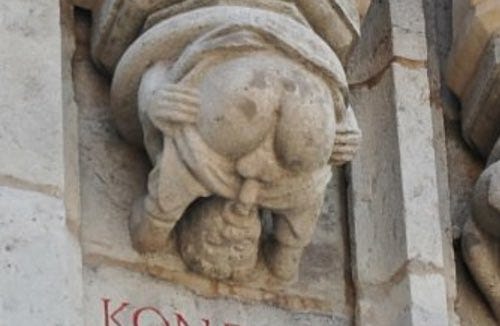
Just like mooning today, flashing your butt cheeks was the proverbial f*ck you to authorities. Perhaps Sheela is flashing her lady bits for the same reason. Most of them clearly look amused. I guess the joke would be — Look what pregnancy does to your body! Your vagina will turn into a howling monster.
And let’s face it. Monster stories have always intrigued people. The Sheelas were like TikTok videos — they allowed the viewer to consume stupidity, depravity, and eroticism without picking up a book. Personally, if I lived in a world where disease, war, and childbirth would kill me before the age of 30, I would just escape to a church protected by a magical pussy monster too.
In other words, Sheela-na-gigs might have been like screwball Gothic scarecrows, frightening the evil childbirth pain away.
And given the hi-jinx that unfolds in the marginalia of most medieval manuscripts, I don’t think my theory is a stretch. Anyone who studies medieval history comes to one inevitable conclusion — priests had a serious fratboy sense of humor.
Unfortunately, not everyone wanted an old lady flashing her bits over their church door. Consequently, most Sheela-na-gigs were defaced or destroyed.
Well, duh. If you put a vagina sculpture over your door, someone is going to get pissed. (Not a personal reference.)
Since later priests censored these howler vaginas, only about a hundred now remain in Ireland, with a few more in the UK, France, and Spain. And because so few are left, the Irish have grown rather attached to their pagan past.
Or at least attached enough to mourn the theft of one of their most famous Sheelas.
On January 9th, 1990, an employee from a local farm noticed the southwest corner of the Augustinian abbey at Kiltinan had been hacked away. Residents immediately knew. Their beloved Sheela-na-gig had been stolen.
At the time, Celtic monuments and gravestones were being looted and pilfered by gangs all over Ireland. They were sold on the black market for millions, usually to wealthy American collectors hungry for Celtic artifacts. I bet Elon Musk has a Sheela-na-gig over his bed.
The Kiltinan Sheela was especially grotesque. She has emaciated limbs, two nipples on one breast, and a bony, triangular face. One hand is lifted in a cheerleader wave. The other hand opens her vulva.
She is said to be dancing a jig. I dunno. She looks to me like she is engaged in a different form of pleasure.
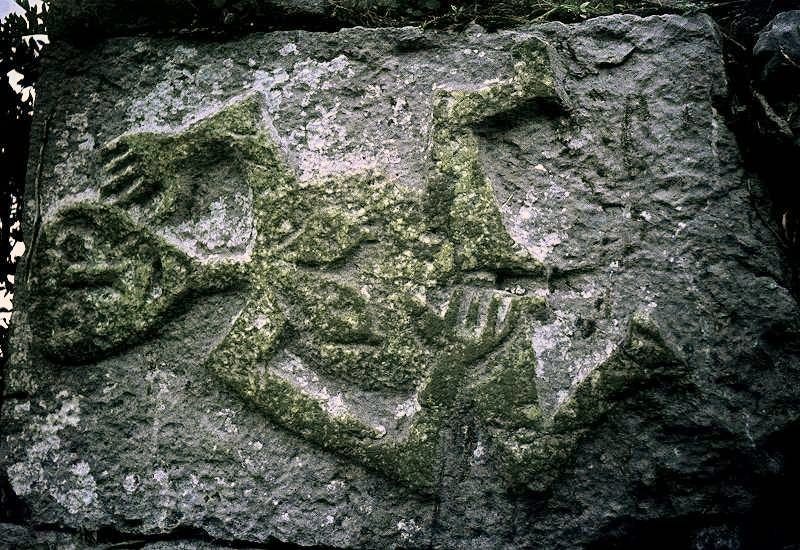
Who stole the Sheela-na-gig?
The first suspect was Jim O’Conner — a local historian obsessed with protecting Ireland’s Sheela-na-gigs. Apparently, he got a little too excited about field monuments, putting him in the authorities’ crosshairs. Jim was questioned but was never charged.
Then, in 1991, Ned Kelly, the keeper of antiquities at the National Museum of Ireland, found another suspect. 67-year-old Irishman Peter Kenny was rumored to be removing ancient gravestones and other artifacts from several sites.
Suspicions were raised further when Kenny sailed west. As he crossed the Atlantic, a conversation with one of his gang members was intercepted. Unfortunately, the conversation didn’t give investigators enough to arrest him.
But then Kenny tried to sell his treasures.
On March 6th, 1991, Kenny contacted Robert O’Neill, Director of the Burns Library of Rare Books and Special Collections at Boston College. Kenny claimed he was a retired ship captain trying to unload his family heirlooms. But librarians are not easy to fool. O’Neill grew suspicious and contacted the National Museum of Ireland, who then contacted the FBI.
The FBI wiretapped agents posing as Boston College students and planned to arrest Kenny after he accepted an offer. By this point, Kenny had no idea he was walking into an FBI sting operation.
On April 22nd, Kenny was arrested on smuggling charges. He served four months in a US prison before returning to Australia. He died shortly after. Although Irish authorities recovered several stolen gravestones and artifacts (some were fake), the Sheela-na-gig was not in Kenny’s procession.
Today, the Sheela at Kiltinan is estimated to be worth 7 million dollars. She has never been found.
If you happen to see her over some billionaire’s door, here is the 1990s wanted poster with information on whom to contact.
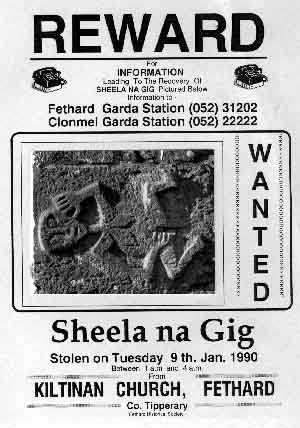
So spread the word. Tell your friends and neighbors. It’s time Sheela returned to her home.
*Sources available in the comment section upon request.
‘The obscenity of the feminine sex is that of everything which “gapes open”. It is an appeal to being as all holes are.’
— Jean Paul Sartre

Carlyn Beccia is an award-winning author and illustrator of 13 books. For past articles grouped by subject, see my Table of Contents.
Update! I am launching Conversations with Carlyn soon to have more open and honest conversations with readers about sex, love, feminism, culture, and the latest science behind our most intimate human interactions.
If you enjoyed this article, please support my research and writing by becoming a paid pledge. You won’t be charged until the conversation gets rolling.


