
The Twisted Relationship of Love and Capitalism
As observed by Erich Fromm

In 1956, the social philosopher Erich Fromm wrote an insightful critique of the effects of capitalism on love. In his book, the Art of Loving, he exposed the economic system’s influence and offered solutions for its deficiencies. In this first article of a two-part series, I want to explore the former by updating it to a 2020 reality.
A Free Market of Love
“Automatons cannot love; they can exchange their ‘personality packages’ and hope for a fair bargain. […] Two persons thus fall in love when they feel they have found the best object available on the market, considering the limitations of their own exchange values” — E. Fromm.
It doesn’t sound harmful, does it? We’re done with choice limitations, segregation and arranged marriages! Everyone is free to love as strongly and as widely as one wishes.
You can pursue whomever you want. You can end the relationship at any time. You can have one lover, many lovers, or none at all! You can date adults of various age groups, people of different races and of the same sex.
So why are most of us still not satisfied under this umbrella of freedom?
“Just as modern mass production requires the standardization of commodities, so the social progress requires the standardization of man and this standardization is called ‘equality’” — E. Fromm
The freedom isn’t there to begin with.
Capitalism is just a well camouflaged form of conformity. It’s a worldwide maze of revolving gears wrapped in emojis and glitter. It offers people the “freedom” to take the position of a cog. Sure, it’s better than being forced in that position by an authoritarian regime. Yet, it would be hypocritical to call it ‘freedom’.
The free market is caged by perpendicular bars of written and unwritten rules. Show up at this exact time. Think for yourself by agreeing with us. Eat when you’re told to eat. Wear this to express your unique style so we can all match.
Yet, under the piles of snuggies and ab king pros, beneath the politically correct rules of HR departments, lurks the one true commandment: everything is a commodity.
“Life has no goal except the one to move, no principle except the one of fair exchange, no satisfaction except the one to consume.” — E. Fromm
People’s lives are used as commodities. You have a life? Great. Write about it; vlog about it; sing about it; post about it; put it out for all to see! If you're mildly original and/or attractive, chances are, you will make a buck!
Love is not an exception to the market. The oil lubricating the gears trickles down into our hearts. Rolled dollar bills are clogging aortas.
We’re told we must be having fun, so we chase the highs of infatuation and orgasm. We’re told we deserve the best, so we keep swiping left until the perfect package pops up. We’re told more variety is better, so we jump on to the next person because we have to try that flavor. We’re told being alone is a problem, so we’re desperate to find someone.
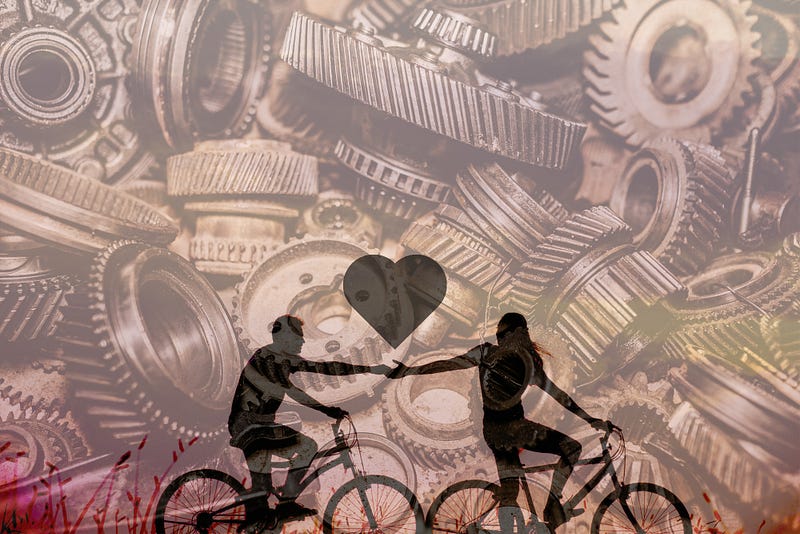
Unbeknownst to us, in relationships, we become each other’s employees. Every word, every action becomes a trade, a transaction, a deal. We want to be satisfied with our product but we also want a good review.
We’re so distracted every second of the day that we neglect our deep-rooted issues. We pour series, movies, news and purchases on them. We keep drowning them in likes, hearts, shares and retweets. We don’t solve our personality problems. We look for someone else, with their bag of problems, so we can fuse into a single self-concerned organism projecting twice the level of egotism into the world! We avoid hurting each other’s egos instead of mutually transcending them.
We want the ideal rowing partner to sit alongside us in our boat of separateness making circles in a sea of hostility. But the ideal partner is often more than we deserve.
Idolatrous Love
“If a person has not reached the level where he has a sense of identity, of I-ness, rooted in the productive unfolding of his own powers, he tends to ‘idolize’ the loved person.” — E. Fromm
Despite the reign of fair exchanges, we often overestimate the qualities of the partner we merit.We spend way more time searching for the best match than we spend working to become our best selves. Which might usher us into an idolatrous relationship.
Historically, people had relationships within their respective social classes. The advent of social media intensified the imbalance between idols and idolators. Nowadays, average women have a potential access to the top 10% of hyper-successful men. If a good-looking young woman is so inclined, she can — without stepping out of her house — find the best “package” on a social network and “slide into his DMs”. Success is not guaranteed but opportunity is rampant!
The situation is heartbreaking for almost everyone involved. Women get used by successful men who have more sexual advances than they know what to do with. Average men get looked down on by women who are not better than them in any way. Even the “winners” are admired for their projected persona instead of being loved for the entirety of their being.
Sentimental Love
Here’s an unromantic truth: love sells. Just like it did with everything else, capitalism transformed the natural experience of love into fictional super-stimuli to profit from. Every day, movie studios, recording companies, book publishers and (especially!) porn sites bombard us with exaggerated, unrealistic and skewed ideas about love.
“All the unfulfilled desires for love, union and closeness find their satisfaction in the consumption of these products.” — E. Fromm
This creates a feedback loop in which people with boundless cravings don’t find the stimulus they seek in their relationships and keep consuming more sappy content to console themselves.
Don’t deal with your feelings of loneliness, just watch The Notebook one more time. Don’t work on your lack of confidence, just imagine you’re conquering tens of women by watching porn.
The entertainment industry doesn’t want you to build a meaningful relationship. It doesn’t want you to be satisfied with the intangible. It wants you to keep spending.
Projective Mechanisms
There is no better way to procrastinate than trying to reform someone else. People are often hyper-sensible to the shortcomings of their partner while being oblivious to their own. Yet, the best way to reform someone for the better is to improve oneself. Actions speak louder than words.
Instead of spending hundreds of hours looking for “the right person” perhaps we should convert that time into developing our bodies, our minds and our contributions to society. “The right person” will appear in only one place: the mirror. If we don’t see that person just before brushing our teeth, it means we’re not ready to meet them elsewhere.
Nails do not attract each other. Magnets attract nails. Nails look like coarse hunks of metal next to the sophistication of a magnet. Magnets also attract other magnets. Yet, the making of a magnet takes way more time, precision and knowledge than the making of a nail.
In order to thrive emotionally, it is vital to understand how “love” adapts to the passing centuries and economic systems. If accepted blindly, its adaptation seldom contributes to an individual’s well-being. In the 21st century, we would do well to consider how the credo of consumption trickles into our private lives.
This first part was an illustration of the problem. In the second part, I will proceed with solutions to the problem, with the wisdom of Erich Fromm.


