
How to Love Better
With the Wisdom of Erich Fromm
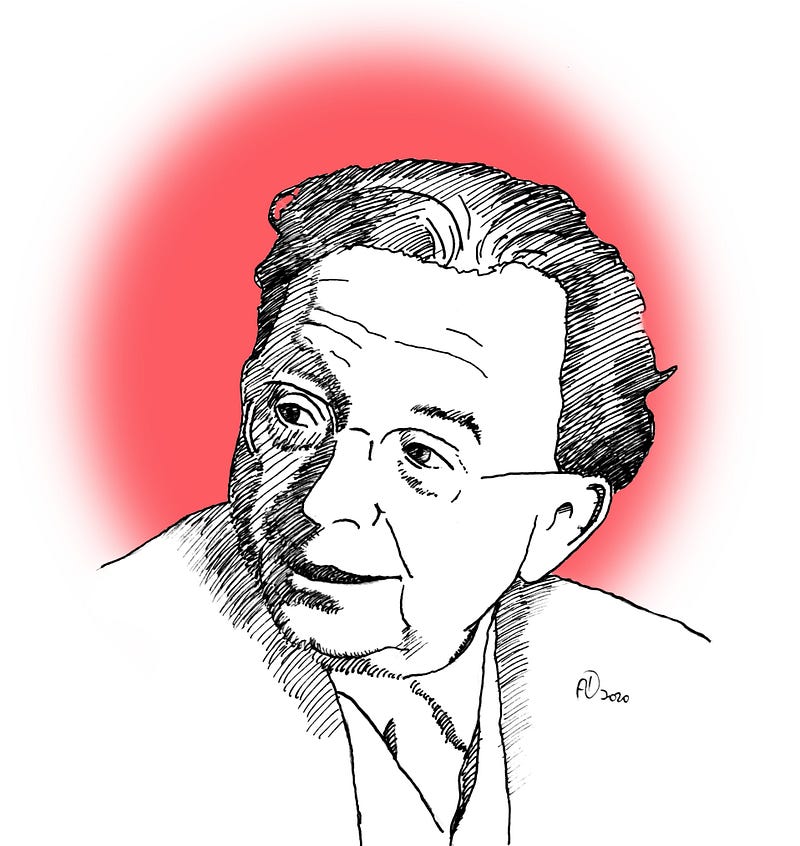
In the middle of the 20th century, Erich Fromm made one of the greatest contributions to our understanding of love with The Art of Loving. In his bestselling work, he describes the hurdles and misconceptions surrounding the idea. He then proceeds with flexible guidelines to improve one’s practice of love. This is the second article of a two-part series. The first one illustrated the troubles caused by the fusion of love and capitalism. This one is about how to love better.
“The first step to take is to become aware that love is an art, just as living is an art; if we want to learn how to love we must proceed in the same way we have to proceed if we want to learn any other art […]”
From the beginning, Fromm imparts that love is incorrectly perceived as an object instead of a faculty.
People spend hours, days, weeks and years searching everywhere for somebody to love. Imagine if an artist spent the same amount of time searching for something to paint instead of just painting. Great artists know that any object can be interpreted in a compelling way. It’s how they look not what they look at that matters.
Likewise, love is not the pursuit of the right object, it is the improvement of a faculty. Most people are under the illusion that they fall in love when they mutually find the best product available. They fix themselves up to look like the best possible recipient. They work on parallel baits. Traditionally, men show off their success and influence; women radiate their physical beauty.
Once two people connect, they assume that the intensity of the initial chemical fireworks in their brains will correlate with the longevity of the relationship. The pleasure they receive from each other becomes the measuring stick for the quality of their interactions. So, they take. They consume instead of creating.
But how is the faculty of love cultivated? How does one transition from being a consumer of love to an artist of love?
Brotherly love
“Brotherly love is love for all human beings; it is characterized by its very lack of exclusiveness.”
The ability to love requires a foundation. Fromm calls it “brotherly love”. It is a baseline of goodwill towards all human beings; relative or stranger, friend or foe. It doesn’t require anyone to do anything useful to be loved. It is a feeling projected from within towards all of humanity.
We tend to judge others because we fear the surfacing of their flaws within ourselves. We might look down on people who have inferior wealth, strength, looks, intellect, talent or social recognition. Yet, this outlook itself is weakness in disguise. It’s a feeling of insecurity caused by constant comparison. True strength of character projects love towards all beings instead of segregating them into “worthy” or “unworthy”.
Loving-kindness meditation is one of the best ways to develop such a state of mind. To practice it, take 15 to 20 minutes to sit down with your eyes closed and wish the best for people in your life. Start with those closest to you and gradually expand to all of mankind. Yes, including that bully from high school.
To love better, love everyone.
Self-Love
“If an individual is able to love productively, he loves himself too; if he can love only others, he cannot love at all.”
Fromm himself was reticent to use the word “self-love”. It sounds akin to selfishness or narcissism. Yet, self-love is the polar opposite of selfishness.
A selfish man will have no foundation of brotherly love. He will divide people into “useful” and “useless” based on what he can get out from them. He will then exploit the first category to patch his frustrations instead of fixing his internal conflicts directly. These conflicts often manifest as camouflaged self-hate.
Unresolved self-hate prevents one from loving. It comes from weakness, not from strength. It’s a manifestation of a scarcity mindset, the feeling that one is “not enough”.
Self-love, however, is not a passive acceptance of one’s flaws. It is daily work to improve one’s internal balance. Love yourself by taking care of yourself as if you were your own child. Nourish yourself, learn, exercise and rest.
By creating harmony in your mind, you will create harmony in the minds of others.
To love better, love yourself.
Erotic love
“Sexual attraction creates, for the moment, the illusion of union, yet without love this ‘union’ leaves strangers as far apart as they were before […]”
Fromm highlights that erotic love is often misconstrued as an exclusion of all mankind for union with only one person.
When caught in the overwhelming fireworks of infatuation, people mix up their desire for each other’s bodies with love. Intercourse connects them with the present moment for the briefest instant followed by the inevitable decrescendo back to their unresolved problems.
Deep erotic connection occurs when a love for humanity, for all of life, is projected into one’s partner. Intercourse overcomes separateness only if it comes from a desire to give, not to use the other person.
These truths might sound self-evident, yet in today’s hook-up culture facilitated by technology, the problem of casual sex is still rampant. People use each other for hits of pleasure and validation. The satisfaction lasts for a couple of hours in the best case. Usually, it’s back to baseline within a dozen minutes. It’s procrastination at its finest.
When you work on yourself enough to overflow with love instead of needing it, you will experience true physical connection.
To love better, make love to give.
The Practice of Love
In the last third of his book, Fromm spells out general requirements for the practice of love as an art.
First of all, it requires discipline to project a loving outlook on life whether one is in the mood or not. Moods are for hobbyists. Love is work, not leisure. It’s not easy, but it’s the most rewarding work there is.
Next, it demands concentration, especially when by oneself. Fromm recommends a 20-minute morning meditation to nurture a sense of well-being and focus while being alone. The ability to stay in the present turns you into a great listener. Moreover, if you’re able to concentrate and relish in enjoyment by yourself, others will be delighted to share that energy.
“Paradoxically, the ability to be alone is the condition for the ability to love.”
Unsurprisingly, patience is paramount for the practice of love as it is for the mastery of any art. If you stop chasing quick results and find zest in the process, you become unstoppable.
Finally, the practice of love necessitates a concern for mastery. You must not be satisfied and always seek to listen better, to help better, to analyze better and to transcend yourself better.
To love better, practice love as an art through discipline, concentration, patience and a concern for mastery.
The Art of Love
“If I want to learn the art of loving, I must strive for objectivity in every situation, and become sensitive to the situations where I am not objective.”
Fromm concludes with the qualities necessary to become an artist of love.
The first step is to overcome one’s narcissism. People have varying degrees of narcissism, yet almost no one is exempt from it. Unchecked egotistic biases distort reality and create conflicts.
Contrary to popular belief, love thrives when it is seen objectively more than subjectively. We cultivate harmonious relationships only when we make an effort to understand the other person regardless of our own desires.
Love is about transcending the ego, not yielding to it. Therefore, it requires a healthy dose of humility, objectivity and reason.
The second step is to maintain a rational faith in the endeavor. This is diametrically opposed to irrational beliefs imposed by external authority. Rational faith is the internal drive to keep going. It’s what drives the scientist to make a hundred experiments to find a cure for a disease. It’s what pushes the poet to try hundreds of word combinations to come up with the perfect sonnet. The same core of positive belief should motivate the lover.
The third step is to pair that motivation with courage. The pursuit of an authentic life will deliver its share of pain and disappointment. Courage is needed to interpret the obstacles in our way as opportunities to improve instead of insurmountable hurdles.
Finally, Fromm makes a case for an active approach to the art of loving. Love is not something that happens to us passively, it’s a fire we have to feed with all the other aspects of our lives. Loving well comes from living well. There are no separate compartments in life, everything is connected. The healthier the connections in your mind, the better you will connect with someone else.
“The capacity to love demands a state of intensity, awakeness, enhanced vitality, which can only be the result of a productive and active orientation in many other spheres of life.”
In short, to love better you must expand your love to all beings; love yourself; make love to give; practice the art of love through discipline, concentration, patience and a concern for mastery; and, nurture selflessness, rational faith, courage and a general zest for life.
Once these elements are growing within, as an artist of love, you will be on your way to overcome separateness and unite the world.