avatarDark Energy Articles

Free AI web copilot to create summaries, insights and extended knowledge, download it at here

3820

Abstract

uce the blocks was sourced from various locations. Limestone served as the foundation of the construction and was the closest material available. However, some elements of the buildings required a different material. In some pyramids, <b>the inner burial chambers were lined with red granite brought from Aswan</b>. There was also a need to use white limestone, which was obtained from the Tura quarry.</p><h1 id="113b">What was the pyramid construction process like?</h1><p id="fa91">The construction of pyramids began with a ceremony in which the ruler, assisted by the priestess of the goddess Seshat, stretched a cord towards the stars. This had not only a symbolic meaning but also determined the axis of the building.</p><p id="f1e0">Initially, the pyramids were oriented on a north-south axis. This was of great significance to the Egyptians. In their beliefs, the sky was where rulers existed after death, and stars were perceived as deities. During the construction, only circumpolar stars did not disappear below the horizon, so according to the people of Egypt, <b>they were immortal</b>. As the solar cult’s importance grew, the teams surrounding the pyramids began to be oriented on an east-west axis.</p><p id="4b92">At first, stone blocks were prepared using copper tools, but over time, more durable bronze was used. Iron appeared in Egypt during the late phase of the pharaohs’ empire. The chisels used for removing stone fragments had a cylindrical shape with a sharpened end. They were struck with a wooden mallet.</p><p id="8132">To create even surfaces and level them, a triangular tool with a vertical string attached to its apex was used. Similar tools without the string allowed for marking and smoothing the remaining walls.</p><figure id="ef9e"><img src="https://cdn-images-1.readmedium.com/v2/resize:fit:800/1*8NTZLD_fE9L33ADW8QZK-g.jpeg"><figcaption>[Photo by kendincefotograf from <a href="https://www.pexels.com/photo/ancient-egyptian-pyramids-9675156/">Pexels</a>]</figcaption></figure><h1 id="ad16">How were the blocks lifted to the top of the pyramid?</h1><p id="3ee8">Transporting stone blocks and raising them to the upper levels of the structure was the most challenging stage of the work. The stones were pulled by human strength, but sometimes animals like cattle were also harnessed for this purpose. To facilitate the work and increase transportation efficiency, a path was prepared first with crushed limestone, clay mortar, and wooden beams reinforcing the construction. Evidence of this was found near the Senusret Pyramid in Lisht. Blocks were placed on wooden sleds, and water was poured under the runners to reduce friction.</p><p id="016f">Thus, the blocks reached their designated locations. But how did they get to the higher levels of the pyramid? Many hypotheses have been proposed, but the most likely one suggests that the workers built special ramps for this purpose. This is supported by the discovery made at the Hatnub site.</p><figure id="25bd"><img src="https://cdn-images-1.readmedium.com/v2/resize:fit:800/1*mqgEhQe6-CgHdNJrMpC1SA.jpeg"><figcaption>Moving 70 t stones at the scale of the pyramid of Khufu — [Photo: Khoufou, <a href="https://creativecommons.org/licenses/by-sa/3.0">CC BY-SA 3.0</a>, via <a href="https://commons.wikimedia.org/wiki/File:Building_pyramid.jpg">Wikimedia Commons</a>]</figcaption></figure><p id="ed8f">In the quarry near the city of al-Minya, remnants of a ramp were found, most likely used for hauling stones. On both sides of the construction were stairs and wide openings where wooden stakes were probably placed. <b>Ropes were wound around the stakes, and by pushing against the steps, the workers simply hoisted the blocks to the top.</b></p><h1 id="5938">But why were the pyramids built?</h1><p id="a413">Why did the Egyptia

Options

ns undertake such difficult and time-consuming endeavors? The Roman historian Pliny called the pyramids<i> “a useless and foolish manifestation of wealth.” </i>While these majestic tombs could indeed emphasize the grandeur of the buried ruler, the ultimate purpose was different.</p><figure id="fea6"><img src="https://cdn-images-1.readmedium.com/v2/resize:fit:800/1*QuhFx9_9QL4s2CgW_bGEyQ.jpeg"><figcaption>[Photo by Jiří Zeman from <a href="https://www.pexels.com/photo/pyramids-in-a-desert-6388861/">Pexels</a>]</figcaption></figure><p id="2eaa">The Egyptians believed that pharaohs led an eternal existence in the heavens after their physical death, becoming one of the divine stars. The sloping shape could thus be seen as a symbolic ladder or stairs leading to the skies.</p><h2 id="fa82">Fascinating Pyramid Facts:</h2><ul><li>The Pyramid of Khufu (Cheops), originally measuring nearly 147 meters, <b>was the tallest human-made structure for almost four thousand years</b>. It was eventually surpassed by Lincoln Cathedral.</li><li>The Pyramid of Djoser and its surrounding chapels and courtyards were the first stone buildings in Egypt.</li><li>The Djoser complex covered almost 15 hectares, an area comparable to a large ancient Egyptian city.</li><li>Throughout the history of Egypt, <b>its rulers constructed around 100 pyramids.</b></li><li>The outer casing of the Pyramid of Khafre (Chephren) was made of white limestone, but only the upper part of the structure retains this stone. In the 12th century, Saladin ordered the removal of the stone, which was used to build Cairo’s walls. Otherwise, <b>the pyramid would likely be smooth to this day.</b></li><li>To expedite the construction process, Egyptians used roughly worked blocks for the interiors of the pyramids.</li><li>The construction of the Pyramid of Khufu (Cheops) required <b>2.3 million stone blocks</b>, and researchers estimate the total weight of the structure to be around 6 million tons.</li><li>Building the pyramids was such a massive undertaking that Egyptian rulers had to establish agricultural estates solely for providing food supplies to the construction sites.</li><li>According to Herodotus, at one point during the construction of the pyramid, Pharaoh Khufu ran out of funds to continue the work and allegedly <b>sent his daughter to work in a brothel</b>. However, this account by the Greek historian is likely to be a legend and should be taken with caution.</li></ul><div id="30ff" class="link-block"> <a href="https://readmedium.com/aborigines-of-australia-who-are-the-indigenous-people-of-australia-ce20be39b1f9"> <div> <div> <h2>Aborigines of Australia. Who are the indigenous people of Australia?</h2> <div><h3>Aborigines are the indigenous people of Australia. Their ancestors arrived on the continent up to 65,000 years ago…</h3></div> <div><p>medium.com</p></div> </div> <div> <div style="background-image: url(https://miro.readmedium.com/v2/resize:fit:320/1*KPhDD4vlztND4bqqB7AkPA.jpeg)"></div> </div> </div> </a> </div><p id="683b"><b>Thank you for reading! If you enjoyed this content, please consider giving it a clap, leaving a donation, or offering a tip to support my work. Your generosity helps me continue creating valuable content.</b></p><figure id="e494"><img src="https://cdn-images-1.readmedium.com/v2/resize:fit:800/1*QCQqlZr6doDP-cszzpaSpw.png"><figcaption><a href="https://www.buymeacoffee.com/oconnel">https://www.buymeacoffee.com/oconnel</a></figcaption></figure><figure id="92a2"><img src="https://cdn-images-1.readmedium.com/v2/resize:fit:800/1*fxkd_sjXknSGRO4TY0S9Mg.png"><figcaption></figcaption></figure></article></body>

The Truth Behind Pyramid Construction Uncovered

How were the pyramids built? Finding the answer to this question hasn’t been easy. The oldest written sources on this topic were created over 2000 years after the pharaohs. The archaeology must, therefore, unveil a piece of the mystery. Over the years, many theories about the method of building the pyramids have emerged, but the current state of archaeological knowledge is supported by solid evidence.

[Photo by Murat Şahin from Pexels]

When listing the achievements of the ancient Egyptians, the pyramids must be mentioned first. These works of ancient architecture still impress today, as even with the use of modern technology, constructing such objects would be a significant undertaking. In antiquity, it was a challenge almost impossible to achieve, yet the inhabitants of the Nile region managed to do it.

The pyramids reflected the advancement of Egyptian civilization while also driving its development. It is worth noting that during this time, mathematical knowledge significantly advanced, medical treatises were created, and sculpture reached new heights.

Who actually built the Egyptian pyramids?

First of all, it’s worth explaining who the pyramid builders were. For a long time, the prevailing view was that slaves — prisoners of war, low-born Egyptians, and criminals — were engaged in the construction of these massive structures as a form of punishment for their offenses. In popular culture, the image of unfortunate people forced into grueling labor with overseers who spared no whip has become solidified. However, the truth is entirely different.

The pyramid builders were free people — workers who received fair wages for their work. Rulers made sure that hardworking men had the strength to carry out their tasks, providing them with high-quality food at the construction site. This is not an exaggeration. A worker laboring on the pyramids ate better than the average Egyptian engaged in a different profession.
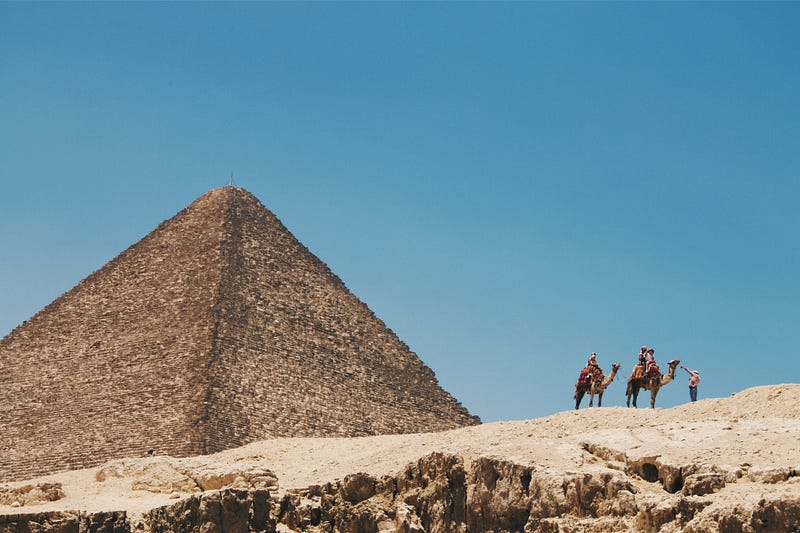
[Photo by Arralyn from Pexels]

The builders worked in teams/brigades, each responsible for constructing a different part of the burial complex. Those not involved in construction were responsible for tool making, supply organization, kitchen operations, and other tasks.

All workers lived in a prepared settlement, consisting of long mud brick buildings. There was also a class division there. Supervisors and higher-ranking individuals resided in a separate part of the complex. Workers with higher qualifications had better accommodations than those performing simpler tasks.
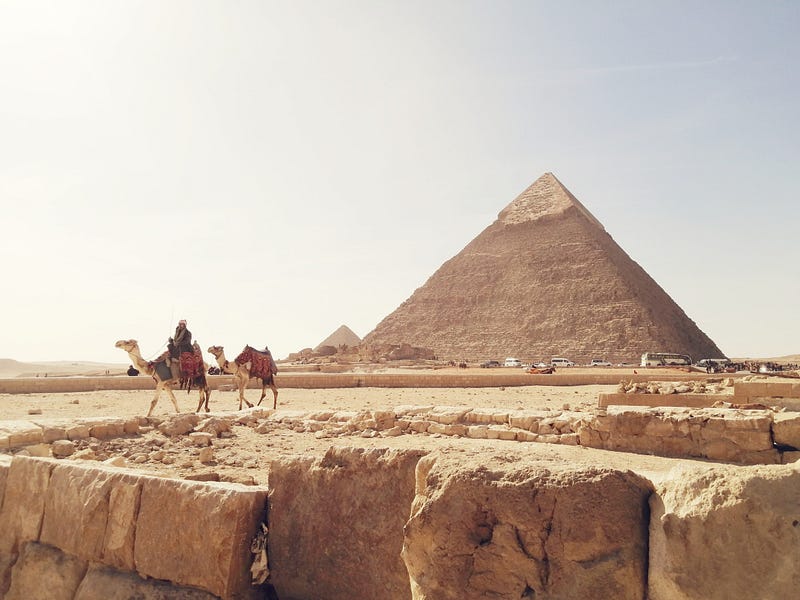
[Photo by amr osama from Pexels]

What were the pyramids built of?

Most Egyptian structures were built using reeds, wood, and unfired bricks. Stone was a challenging and time-consuming material to obtain and process, so it was reserved for building the most important objects, including the pyramids.

The stone used to produce the blocks was sourced from various locations. Limestone served as the foundation of the construction and was the closest material available. However, some elements of the buildings required a different material. In some pyramids, the inner burial chambers were lined with red granite brought from Aswan. There was also a need to use white limestone, which was obtained from the Tura quarry.

What was the pyramid construction process like?

The construction of pyramids began with a ceremony in which the ruler, assisted by the priestess of the goddess Seshat, stretched a cord towards the stars. This had not only a symbolic meaning but also determined the axis of the building.

Initially, the pyramids were oriented on a north-south axis. This was of great significance to the Egyptians. In their beliefs, the sky was where rulers existed after death, and stars were perceived as deities. During the construction, only circumpolar stars did not disappear below the horizon, so according to the people of Egypt, they were immortal. As the solar cult’s importance grew, the teams surrounding the pyramids began to be oriented on an east-west axis.

At first, stone blocks were prepared using copper tools, but over time, more durable bronze was used. Iron appeared in Egypt during the late phase of the pharaohs’ empire. The chisels used for removing stone fragments had a cylindrical shape with a sharpened end. They were struck with a wooden mallet.

To create even surfaces and level them, a triangular tool with a vertical string attached to its apex was used. Similar tools without the string allowed for marking and smoothing the remaining walls.
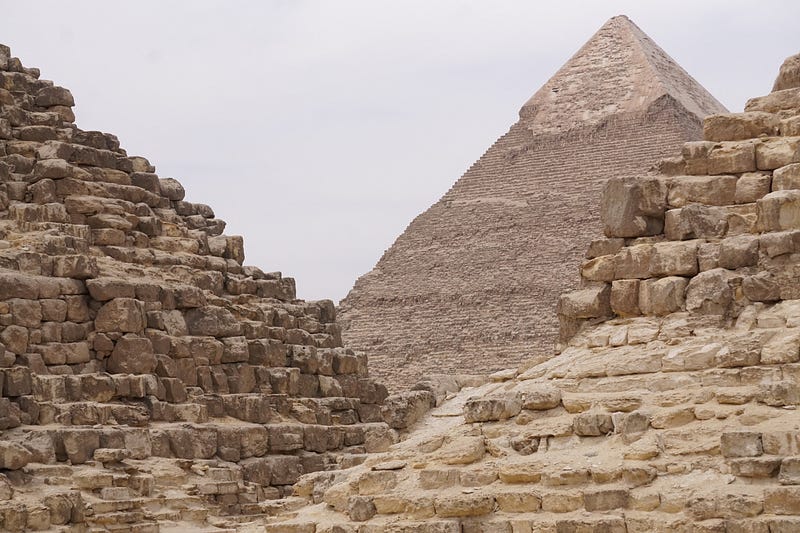
[Photo by kendincefotograf from Pexels]

How were the blocks lifted to the top of the pyramid?

Transporting stone blocks and raising them to the upper levels of the structure was the most challenging stage of the work. The stones were pulled by human strength, but sometimes animals like cattle were also harnessed for this purpose. To facilitate the work and increase transportation efficiency, a path was prepared first with crushed limestone, clay mortar, and wooden beams reinforcing the construction. Evidence of this was found near the Senusret Pyramid in Lisht. Blocks were placed on wooden sleds, and water was poured under the runners to reduce friction.

Thus, the blocks reached their designated locations. But how did they get to the higher levels of the pyramid? Many hypotheses have been proposed, but the most likely one suggests that the workers built special ramps for this purpose. This is supported by the discovery made at the Hatnub site.
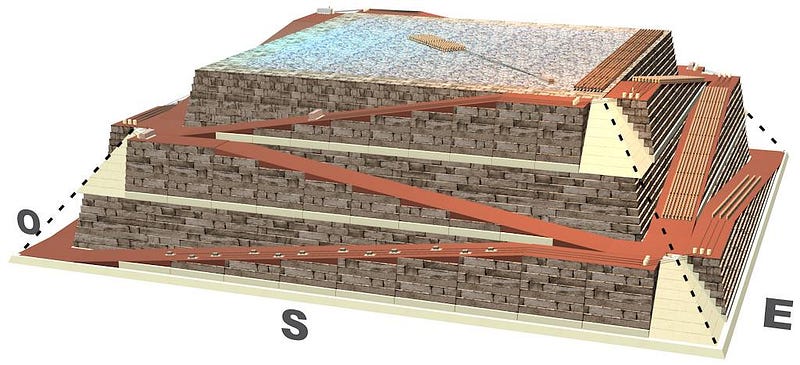
Moving 70 t stones at the scale of the pyramid of Khufu — [Photo: Khoufou, CC BY-SA 3.0, via Wikimedia Commons]

In the quarry near the city of al-Minya, remnants of a ramp were found, most likely used for hauling stones. On both sides of the construction were stairs and wide openings where wooden stakes were probably placed. Ropes were wound around the stakes, and by pushing against the steps, the workers simply hoisted the blocks to the top.

But why were the pyramids built?

Why did the Egyptians undertake such difficult and time-consuming endeavors? The Roman historian Pliny called the pyramids “a useless and foolish manifestation of wealth.” While these majestic tombs could indeed emphasize the grandeur of the buried ruler, the ultimate purpose was different.
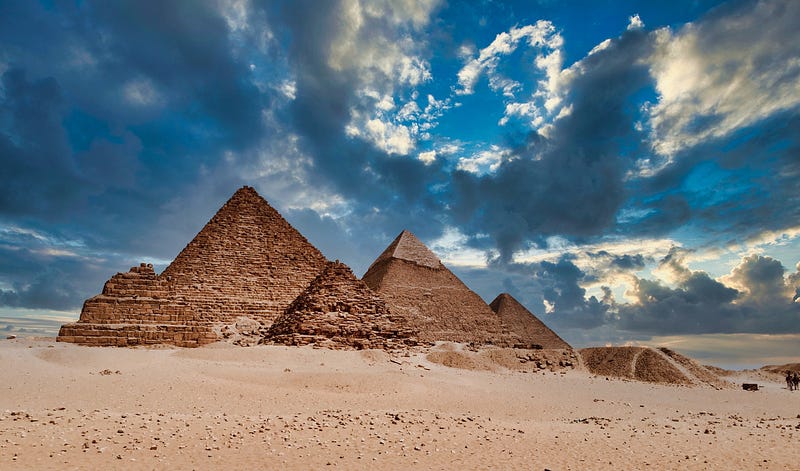
[Photo by Jiří Zeman from Pexels]

The Egyptians believed that pharaohs led an eternal existence in the heavens after their physical death, becoming one of the divine stars. The sloping shape could thus be seen as a symbolic ladder or stairs leading to the skies.

Fascinating Pyramid Facts:

  • The Pyramid of Khufu (Cheops), originally measuring nearly 147 meters, was the tallest human-made structure for almost four thousand years. It was eventually surpassed by Lincoln Cathedral.
  • The Pyramid of Djoser and its surrounding chapels and courtyards were the first stone buildings in Egypt.
  • The Djoser complex covered almost 15 hectares, an area comparable to a large ancient Egyptian city.
  • Throughout the history of Egypt, its rulers constructed around 100 pyramids.
  • The outer casing of the Pyramid of Khafre (Chephren) was made of white limestone, but only the upper part of the structure retains this stone. In the 12th century, Saladin ordered the removal of the stone, which was used to build Cairo’s walls. Otherwise, the pyramid would likely be smooth to this day.
  • To expedite the construction process, Egyptians used roughly worked blocks for the interiors of the pyramids.
  • The construction of the Pyramid of Khufu (Cheops) required 2.3 million stone blocks, and researchers estimate the total weight of the structure to be around 6 million tons.
  • Building the pyramids was such a massive undertaking that Egyptian rulers had to establish agricultural estates solely for providing food supplies to the construction sites.
  • According to Herodotus, at one point during the construction of the pyramid, Pharaoh Khufu ran out of funds to continue the work and allegedly sent his daughter to work in a brothel. However, this account by the Greek historian is likely to be a legend and should be taken with caution.

Thank you for reading! If you enjoyed this content, please consider giving it a clap, leaving a donation, or offering a tip to support my work. Your generosity helps me continue creating valuable content.


https://www.buymeacoffee.com/oconnel
Egypt
History
Architecture
Culture
Life Lessons
Recommended from ReadMedium