
The Truth About the Summer Blues
If you feel worse in the summer you aren’t alone.

I was out with a couple of friends recently and one said how happy she was that summer had finally arrived here is Chicago. She asked us if we wanted to go to the beach for the Fourth of July, and my heart sank.
I live right on the water, steps from a private beach and with a half mile of another dozen or so. I rented this apartment because I love the water and have always wanted to live by the ocean. While it’s nothing like the ocean, it still is nice or should be at least. I have to admit, since I moved to this apartment over three years ago, I’ve actually gone out and sat near the water maybe a half dozen times. And that was only because I felt like I was wasting an opportunity and forced myself. Along with that I almost never open my blinds, much preferring the dim light to the sunshine that comes in.
While I’m happy when spring comes, because I’m no longer in danger of getting frostbite, I can’t say, I enjoy the heat of the bright sunlight. Growing up in Georgia, I liked the summer because we were out of school. But again the heat and bright light was not necessarily my forte, even when told I was “supposed to” like summer because, “everyone liked summer.”
So, when the one friend asked about the beach, I was hesitant to answer, I mean who doesn’t like the summer right? No one. Or so I’d been taught. Before I had to say anything, my other friend spoke up.
“Not me. I’m really not into the summer. Maybe at night, but gritty sand, heat, too bright light, lots of noise? Not my thing. Truthfully, it bums me out. I’d rather just stay inside with the blinds pulled.”
I was so relieved. Maybe I wasn’t so weird after all. It always made sense that people would get depressed in the winter. It was grey and cold, you couldn’t go out for a long period of time and the day seemed more night than day. But to get depressed in the summer?
I enthusiastically agreed with my friend, lamenting over the heat and brightness that hurt my eyes, the exhaustion and, later privately, the depressed mood.
It turns out that while poor mood in the summer may not be as common as it is in the winter, it definitely affects a number of people.
Seasonal Affective Disorder
Many people are familiar with Seasonal Affective Disorder (SAD), but most of them only know about the type that occurs in the winter. Seasonal Affective Disorder describes any mood disorder that occurs at the same time every year.
Experiencing symptoms of SAD in the summertime (aka, summer depression, Reversed SAD), isn’t as rare as once believed however. With increased awareness that other suffer from the same malady, more people have sought treatment, increasing what we know about the problem and the rates at which it occurs.
Summer Depression
Almost 10 percent of those who suffer from SAD experience their symptoms in the summer. It’s believed that like winter depression, summer depression has a biological cause or at least a predisposition. It’s possible it may also be related to the month someone is born, and how much seasonal light there is at the time which affects neurotransmitters in the brain.
There are also other factors in the summer time that increase symptoms of summer depression. Light and temperature in particular, seem to cause people with summer depression to feel miserable and agitated. Disrupted summer schedule can also play a role in summer depression as routines are often interrupted or changed.
Sometimes body image can also contribute as people are running around in less clothing and outdoor activities often require this. Financial concerns can play a part, as people take off work and spend a lot of money on vacations. For families, there may be increased expenses for childcare when kids are out of school and camps and other activities.
How Do Summer Depression and Winter Depression Differ?
There are a number of ways that SAD differs based on the season it occurs during. These are listed below:
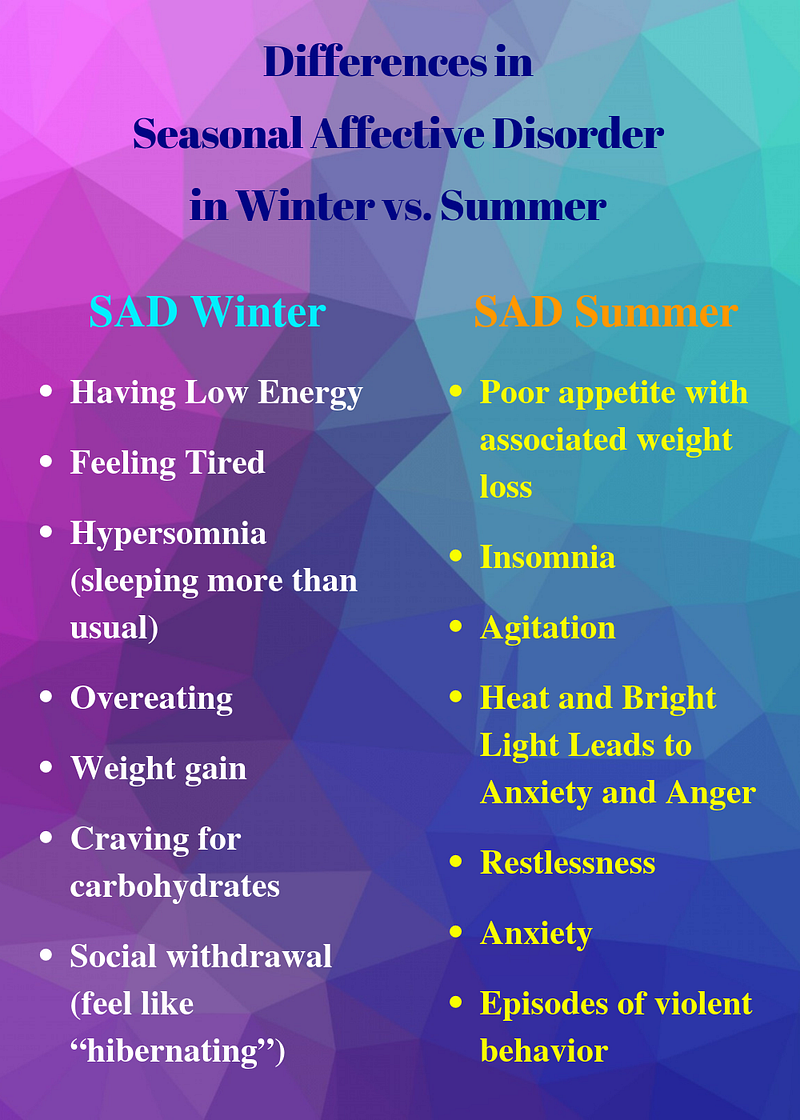
Why Aren’t I Having Fun?
One of the primary problems in summer depression is the concern that something is wrong with you. There is the sense that you should be having fun. Everyone else is, why are you just sitting inside with the blinds pulled wasting all that good weather? There is a fear of missing out on all of the opportunities that summer brings, meeting new people, and taking part in fun activities.
For me, since living in Chicago, I have almost never pulled my blinds in the summer, and when I have, I close them again fairly quickly. I also leave the room where the blinds are open and sit in a room where they are shut. I don’t leave the apartment and almost never take art in any kind of activity. I feel so guilty about wasting the days, then months, year after year. I constantly tell myself that I’ll do better tomorrow and perhaps once in a while I do, it’s more the exception to the rule.
What You Can Do About Summer Depression
In addition to getting help, and possibly starting medication, there are some basic things that you can do that will help. I think the most important one is to do what works for you and don’t get caught up in following advice that seems to make things worse.
Early morning exercise can help if it’s cool enough as it will get your energy up and make it so that you can accomplish something during the day. If you are extremely sensitive to the heat, like I am, this may not be the best strategy as getting hot and sweaty may wear you out to the point that not even a cool shower and air conditioning can help.
If you are like me and live in a building without air conditioning exercise may not be the best idea or at least exercise that causes you to heat up and sweat. It seems that people with summer depression have a difficult time regulating their body temperature so that once they are overheated, it is extremely difficult for them to cool down. In this case try stretching routines throughout the day and consider joining a gym if you can afford.
Keeping cool and out the bright sunshine are the best ways to limit your symptoms. Forcing yourself to be outside when it’s the last place you want to be will further impact your mood, making you more irritable and short tempered. It will also prevent you from enjoying whatever it is you are doing.
Getting enough sleep can help moderate the effects of summer on your mood. If you are already tired the exhaustion you may experience from the depression will increase and everything will look and feel a bit worse. Your irritability and anxiety will also likely spike and you may become convinced that you can do nothing right.
The main thing I have learned to do that helps is to cut myself some slack. We can get so caught up in thinking that if we just tried a little harder, just sucked it up, forced ourselves to get out there that we’d be having a bast also. Looking at all the happy faces and reports of summer fun on social media pages further encourages this way of thinking.
A lot of our suffering can come from the discrepancy between where we are and where we think we should be based on what others are telling us and what we observe them doing. Comparing how we feel about summer to how other people do is just making matters worse. I’ve given myself permission to do what I need to do including not engaging in outdoor activities, not going places if its hot given I have no car and walking to and waiting for the subways can be tough in high temperatures.
This may mean I don’t leave my apartment for a week at a time, possibly more, but it protects me from the effects of the heat and light. I have stopped assuming that I should be happy just because the calendar says it’s summer. Instead, I pay attention to my mood and do what I need to do to take care of myself based on what I know I need and not what others say I do.

If you enjoyed reading this article, you might also like these:
You can find links to my other work on Medium and follow me here. Thank you for reading and for your support!


