
The Trial of the Chicago 7
Aaron Sorkins curiously blunted drama is an autopsy of frustration.
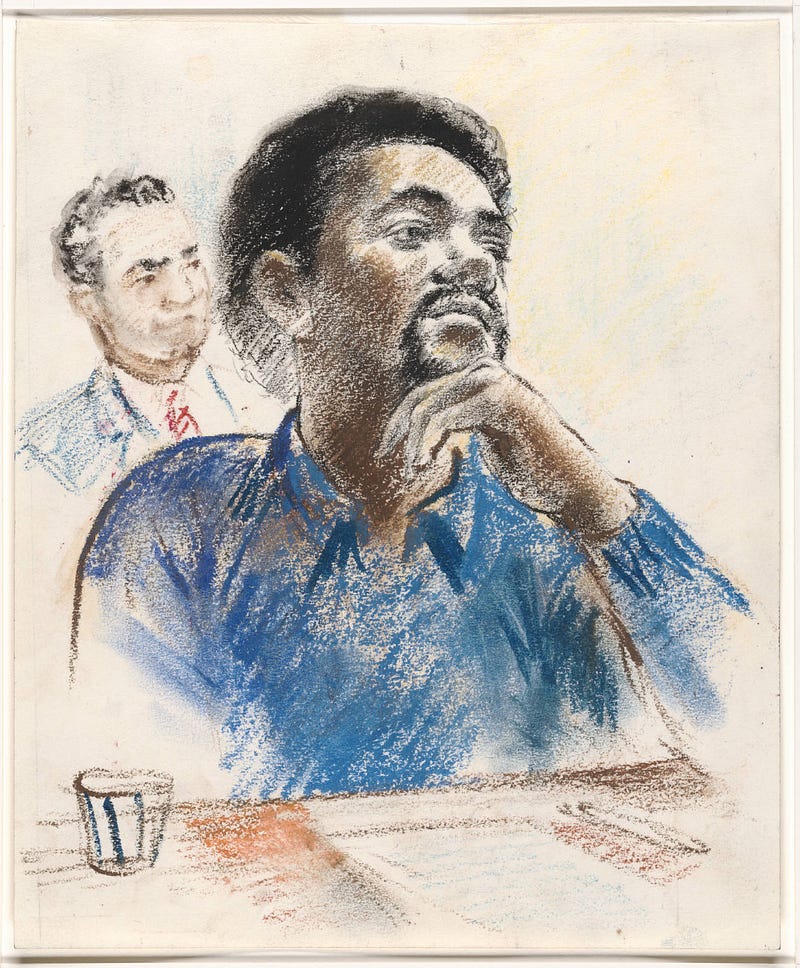
Near the beginning of The Trial of the Chicago 7, Jerry Rubin and Abbie Hoffman walk the gauntlet of court steps, surrounded by an extravagance of anger and mutual hostility: Culture and counter-culture in two seething blobs of mutual loathing amidst the ricochet of crossfire invective.
Once inside the courthouse Hoffman turns to the apparently stunned Rubin. “Ah you aaright?” He asks.
“I was until I saw that,” Rubin replies. (Rubin, in fact, stalks the entire movie with that stunned look.)
The pair continue walking through the grand lobby of the Chicago courthouse until they approach another, smaller gauntlet. It is press and citizens and assorted others. Suddenly, from the back of the crowd a projectile arcs right at the two. Deftly, Jerry Rubin catches it. It is an egg.
“How did you do thahat?” Says a surprised Hoffman.
“Experience,” Rubin says with a sort of pleased surprise at his own reflexes.
The two continue walking through the flash of bulbs and the clamor of the gauntlet. Rubin holds the egg gingerly. Hoffman laughs.
“You don’t know what to do with the egg, now, do you?” Hoffman asks.
“No.”
Such is, apparently, the question of the movie. A quick arc of tension, arrested by deliberate action, leaving a frustration and a question of, exactly, what next to do.
The Liberal condition is, essentially, a grim, repeated, bootstrapping of hope. The Liberal imagination must constantly navigate a series of occasional and small — barely digestible — victories paced unevenly between drastic, mean-spirited, losses. What drama there is, lives in the losses: In the act of being beaten down; The boot on the throat; vicious character assassinations; actual assassinations; and, of course, their own failures to control a moment with the appropriate possessive pronoun. What vindication there is lies in the small moments, as when you catch the egg. Or the times you succeed in getting people to simply act decently towards each other. What do you do with it, if there is anything to do with it, is the question of the movie.
It is hard to say if Aaron Sorkin is deliberate in depicting this frustration or if it is so ingrained he simply can’t escape it. In The Trial of the Chicago 7 Sorkin surfs the dramatic moments without, actually, letting them pay off. To mutilate Chekhov’s famous dictum, if you show an egg in the first act, it has to be scrambled by the third. Such is drama. But here the egg just disappears and we don’t really know what happened to it. Perhaps this is the point. The enemy of progress isn’t conservatism, but frustration and Sorkin diligently autopsies that frustration with a precision that is chilling.
The Trial of the Chicago 7 is heavy on the exposition in a way only Aaron Sorkin can make enjoyable. The introduction of the context and the characters, sketching out the pressure points, fractures, fissures, characters and events preceding the 1968 Democratic Convention in Chicago takes just seven minutes and twenty seven seconds to unfold.
In that time we see a palimpsest of motives, players, circumstance and events; LBJ fumbles; MLK and RFK each speak and then each die; draft boards; a classroom lesson on how to make a Molotov cocktail; young men getting their draft notices; Richard Daly and the Chicago Police in full feckless white flex; young men in uniform boarding military aircraft to go to Viet Nam; body bags and caskets coming back.
In this palimpsest we meet Tom Hayden as portrayed by Eddie Redmayne in a 60’s fright wig and a permanent tension behind his eyes locked in combat with the entirely separate tension in his shoulders.
We are introduced to Abbie Hoffman channeled by Sacha Baron Cohen with an outrageous — but not inaccurate — Worcester Massachusetts accent. Hoffman is equal parts ferocious intelligence, droll charm, and child of sadness.
Jeremy Strong is quietly powerful as Jerry Rubin, man-child permanently awed by… well… anything and everything. The earnest Rennie Davis played straight by Alex Sharp. David Dellenger is portrayed by veteran character actor John Caroll Lynch, as a serious organizer, dedicated to non-violence and peaceful protest, aghast as things spin out of control.
Rounding out the defendant lineup, making defendant number 8, is Yahya Abdul-Mateen II, playing Bobby Seale as a strong man caught in a maelstrom of pure ambivalence, wracked by opposing stressors, inside and out, in forcible tension.
When, so many years ago now, the movie version of Sorkin’s play, A Few Good Men, was released, I thought, at the time, that it could be described as two movies, mashed together. One movie was a fantastic and well acted courtroom mystery with a syncopation of motives and circumstances that was compelling and dramatic. The other movie — that is to say, everything that happened outside the courtroom — was a cringeworthy and already wilting grab-bag of entitled White male self-pity; of daddy issues; of performance anxiety; of weak redemption strongly embraced. One movie starred Jack Nicholson and, of course, the other starred Tom Cruise. As the narrative unfolds in The Trial of the Chicago 7, I feared a similar dynamic as the events of the convention of 1968 are depicted in flashback according to the momentum of the trial.
Sorkin does interject some personality and backstory, and we learn who is and is not really courageous and how the leadership is laid out, but overall he resists adding much of a spine, lest it take away from the spine of the courtroom scenes. The flashbacks are, therefore, tiny self-contained narratives, often used in counterpoint to the flagrant perjury committed in the courtroom. The White male self-pity is there, but in perhaps the most poignant scene in the film, Bobby Seale confronts Tom Hayden about it, directly.
After Hoffman and Rubin are stumped by the egg, we are introduced to the ungainly and lumbering William Kuntsler played by the magnificent Mark Rylance. The physicality of the character — more shoulder than seems physically possible and hair more preposterous than Tom Haydens— is tempered with a wry humor and a permanent look of resigned surprise on his face. As well, Rylance’s voice is a soft burr with the keenest of edges, like a velvet glove wielding a well-honed straight razor.
But the performance of the movie is from Frank Langella. In a part that easily could have slipped into caricature, Langella is fearless and exacting in a portrait of a man far past a prime that probably didn’t have all that much prime to begin with. His Judge Julius Hoffman is barely able to articulate his rage, but little else coheres around him. He has long ago relinquished his dignity but has yet to cotton on to that fact and everybody around him knows it but fears to acknowledge it. He’s the pocket mashup of Nixon, Reagan, Bush and Trump: great power and responsibility in the hands of petty and vindictive man surrounded by yes men.
Langella’s voice is wonderful, alternating between a smooth, unctuous, purr and the deep, savage, percussive roar of a jungle cat. But it is his off-kilter cadences, often interrupting others, that betray a befuddled old man far out of his depth but unwilling to admit it, clinging tightly to the status quo as though it were salvation itself.
All this tension, drama and frustration has to be swallowed and Langella is precise in spoon feeding it, drop by drop, adding a side salad of ‘and you’ll like it too.’
Take for instance, Joseph Gordon-Levitt’s genuinely straight arrow prosecutor, Richard Schultz. He’s given a build up that never really pays off. Or Michael Keaton’s insider intensity as former Attorney General Ramsey Clark. The audience sees his testimony but the jury does not, so it would be vindication if was not, in fact, defeat.
Abdul-Mateen is the chairman of the Black Panther Party confused, by the court, for Dred Scott. Sorkin takes Seale and the trial and much of the sixties full on, strumming the harmonics to an excited pitch. In a few short lines, and with a taut physicality, Abdul-Mateen eviscerates everyone around him with a barely contained righteous fury.
…And then he disappears. Poof. Gone. Just like that. That’s when they become the Chicago 7. The obligatory ‘where are they now’ lines at the end are the next time he is referenced.
Much the same is done with Ramsey Clark: a buildup is made to a tension that is allowed to leak away. The drama is blunted, left hanging like so many Florida chads, and the movie takes on an undertone of confused and seething bitterness before which we all begin to feel a little more than helpless.
Perhaps the characters were sacrificed to the exigencies of an entirely ensemble piece. Or maybe that’s what really happened: The sight and sound of victory and vindication so near, but held back, again and again, by the invidious, but essentially clueless, force of status quo.
Such is the history of liberal progressivism. Go back and see the moment of victory in the Civil War snatched away by the assassination of Lincoln. Then further blunted by the failure of Northern politicians to continue U.S. Grant’s aggressive prosecution of Reconstruction. Thereafter freedmen returned to all but slavery with a thick cover of terrorism thrown over. Jim Crow and actual monuments to actual traitors. You think you’re frustrated at yesterdays mad tweet? Try imagining what it was like to be Frederick Douglass.
Fast forward 100 years and the call of JFK’s first inaugural address, a foundational statement of American purpose in the 20th century, silenced by yet another bullet, giving way to LBJ’s long slow suicide as his earnest and genuine liberalism fell, helpless, before his cynical and feckless political cunning. You’re mad that we can’t have Bernie Sanders? We had more than that in LBJ and he ate himself.
The promise of non-violent protest stilled, again, by another assassins bullet. Which one? You take your pick. Medgar Evers. RFK. Martin Luther King Jr. The promise of growth and and a nascent intersectionality snuffed out by internecine squabbling and, boom, Malcom X is taken away. Onward to the perfidy of Reagan and Iran/Contra. The nullity of Clarence Thomas replacing Thurgood Marshall with naked smugness and a group smirk by the good old boys who, fifty years earlier, would have happily lynched either one. The 2000 election, the Brooks Brothers riot, and a ham-fisted Supreme Court junta. The war of terror. The sheer insanity of the invasion of Iraq. Trump. Neil Gorsuch. Brett Kavanagh. Amy Coney Barrett. The history of progressives bootstrapping hope, again and again, in the face of frustration is almost as old as the country.
Suddenly, the impatience of todays young white millenials lamenting Joe Biden and bemoaning the fact that they can’t have Bernie Sanders and everything last thing they want right now — and blaming Democrats for it — seems naive. (I’m looking at you, Lauren Martinchek) Tell it to Bobby Seale; And to John Lewis; And to Ruth Bader Ginsburg. Tell it to the hand.
Sorkin’s movie is a call to remember that frustration lies at the heart of the long hard slog that is Liberal/Progressive/Left efforts. If you are going to take up the fight, Sorkin seems to say, you are going to have to get used to frustration. You are going to have to eat it, again and again, and be willing to come back for more. You are going to have to face feckless and resist the temptation to be, yourself, feckless. It’s a hard path to walk.
On the plus side, Liberals sure do have a sense of humor.
Sorkin infuses the entire movie with comedy that is bone dry and feather light but has the impact of immediate thunder and lightning. Kunstler verbally slaps around anybody and everybody and is even funnier, it appears, when he is drunk and stoned. Hoffman doing actual stand-up and blurring the lines where standup ends and protest begins. Jerry Rubin being Jerry Rubin. Rather than comic relief it is integral to the characters and to the story. The only alternative is madness.
And then there is Lee Weiner (Noah Robbins) and his running series of acerbic one-liners. In one trial scene, after a long montage of police admitting to undercover operations amongst the protestors, Sorkins camera eavesdrops as Weiner leans into John Froynes (Daniel Flaherty) and asks in a whisper, ‘Do you think it possible that in Chicago, 1968, seven people were leading ten thousand undercover cops in protest?’ If I could find a martini as dry as that delivery, I’d drink nothing else the remainder of my life.
Some of the humor does fall flat, as Sorkin recycles some old West Wing jokes (‘one egg is an oeuf’) and indulges his personal compulsion to revive the word ‘ensorcelled’ but, overall, the knowing comedy, sets a hopeful antidote to the rage the frustrations would otherwise evoke. At one point Hoffman is confronted with his antics, to which he replies, “We don’t have any money. But I can get cameras to show up with my little outbursts.”
It’s like a lifeboat floating away from the wreckage of the HMS Titannic-Rage.
After an hour and a half of steadily ratcheting exasperation, The Trial of the Chicago 7 has one last, self inflicted, frustration to drop on us. I won’t spoil it, but it illustrates that speech may just be a life and death matter. What follows from it sets the stage for the denoument that isn’t really a denoument, but a defiant re-calibration.
Progressive effort is a long hard walk, arm in arm with with frustration, and a clear conscience — as the man said — the only sure reward…
“Now the trumpet summons us again — not as a call to bear arms, though arms we need — not as a call to battle, though embattled we are — but a call to bear the burden of a long twilight struggle, year in and year out, “rejoicing in hope, patient in tribulation” — a struggle against the common enemies of man: tyranny, poverty, disease and war itself.” — John F. Kennedy, Inaugural Address, 1961
© Petr Swedock 2020


