
Enola Holmes and The Case of the Steampunk Feminist.
Millie Bobby Brown is impressively straightforward in a beautifully filmed, but depressingly muddled story.
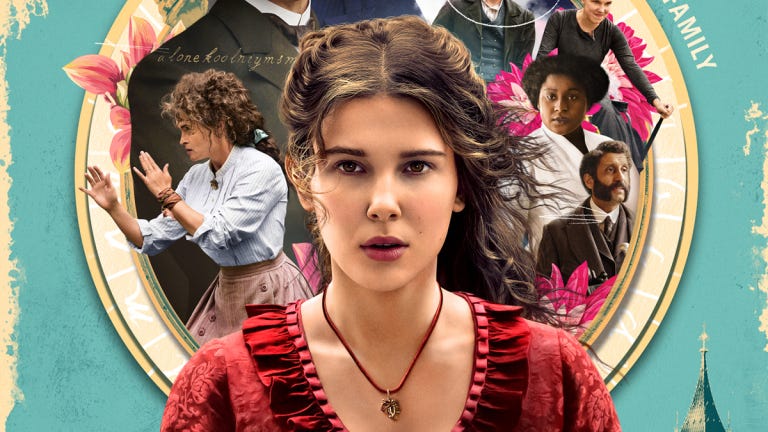
How do you overturn centuries of patriarchy and oppression? Why, with a plucky young heroine who knows how to do jiu jitsu in a dress. Girl power, circa 1884, is just as free and unfettered as girl power is today, you see.
At least, that’s the conceit of Enola Holmes, wherein Millie Bobby Brown plays the eponymous heroine as a steampunk terminator, created… err… trained by her revolutionary suffragette mother over the course of sixteen years and then abandoned to learn how to fly on her own. Or something.
I blame Guy Ritchie.
Of all literary characters Sherlock Holmes is both one of the most well known and yet least decipherable. A consulting detective in Victorian England, Holmes was brilliant and neurotic in equal measure. Subject to days-long bouts of melancholy that he would relieve with cocaine and other behaviors that, today, would charitably be described as ‘anti-social,’ alongside brilliant powers of deduction that relied upon keen observation of details.
Detail. Detail. Detail.
A Sherlock Holmes story, if it is anything at all, is all about the details. It is the details — sometimes tiny and sometimes large — that form the architecture of a Sherlock Holmes story. I don’t think any effort to simultaneously celebrate and subvert the Holmes canon is destined to end well. I was not, however, prepared for just how muddled such an effort could become. Enola Holmes is, unfortunately, that muddle.
Steampunk is an aesthetic in which anachronisms flow in both directions: past put into the future, future put into the past. Copper, wood, and leather in bulk and cobbled together in service to our problems today. Steampunk, as much as Sherlock Holmes, also relies on details.
Not that Enola Holmes doesn’t pay a certain attention to detail. It is beautifully filmed with a great, if superficial, eye for period characteristics. The country land evoking the early pastoral idyll of young Enolas upbringing in wide lens is set against the frenetic city busyness captured in cramped, overpopulated, tight shots. The trains are a stunning call to the technology and culture of the time. The costuming is perfectly gorgeous and as far as I can tell, very period specific. This, however, affects a mitigating confusion. We’ll get to that in a minute.
Unfortunately, the details the film takes seriously are all but window dressing. The director, Harry Bradbeer, has a good eye, a clever sense of camera movement and a steady hand at editing. But the story, as written, lacks pace, opting instead for zigs and zags and turnabouts in place of beats and momentum. Its being knocked about so much might be why it misses some of the important details.
In recent years, mainly thanks to the aforementioned Ritchie — and the generally public distaste for anything intellectual — Sherlock Holmes has been turned from detail-oriented brain to mostly brawn with some brain and few details. Robert Downey Jr. — fairly neurotic himself — struggled to portray the character on the page through the lens of Ritchie’s fast-paced and determined effort to make him a Marvel character, blunting the finer points of Downey’s performance.
In Enola Holmes comes the final insult, Sherlock Holmes is portrayed by Henry Cavill, an actor (sic) whose range extends from his pectoral muscles to his biceps. His grabbag of techniques include a single raised eyebrow, and clenching his jaw, perhaps bending space and time itself, in order to make it look more square, in order to convey thought. That is still a better fate in this movie than that of Sherlock’s brother — — who, on the page, was equal parts smarter and lazier than Sherlock. Mycroft Holmes as portrayed in Enola Holmes as a small minded, somewhat hysterical, rather peevish… well… shrew. I suppose that’s equality of a Harrison Bergeron sort to conform Mycroft to a stereotype of women but it likely would have turned a rigid sort of dyspeptic in Arthur Conan Doyle’s craw.
Yet, alas, even that is more than is given to Dr. Watson in Enola Holmes. Dr. Watson is not so much as mentioned or alluded to throughout the film. This is a tragedy because both Sherlock and Mycroft Holmes on the page, taken on their own terms, are thoroughly unlikeable characters. It is the eye and perspective of Watson that keeps our interest in the Holmes’ brothers.
Subtract one character, that of Dr. Watson, to be replaced by two… Remember, details matter… First Helena Bonham Carter is introduced as Eudoria Holmes, The 54 year old mother to what appears to be a 47 year old Mycroft, somewhat younger brother Sherlock and what surely must have been a desperate attempt to save the marriage, the 16 year old Enola. (A name we’re repeatedly told when spelled backwards is ‘alone.’ Why and to what end, is uncertain,) At the start of the film, Enola and Eudoria are living in the ancestral home, Mycroft and Sherlock long having fled, and Eudoria keeps Enola busy with a regimental education disguised as fun. From history, to chemistry to the everyday training of ‘fight combat,’ in a dress… Making it, possibly, both a tautology and a dichotomy.
Neat trick that. We’ll get back to it in a moment.
When the neccessity arrives for an actor to play casual cruelty, Helena Bonham Carter answers that call. Here the plot layers her characters cruelty most casually: First in the insistent trials she subjects her daughter to, all while withhholding certain information — and a degree of affection — before disappearing without a word. Don’t worry. They are briefly re-united in the end and she has a sort-of explanation but it neither rings true nor would be any kind of justification if it did. I’m not even tempted to term this a spoiler alert as it is both predictable and disappointing. It comes pre-spoiled, if you will.
Millie Bobby Brown, who was actually fifteen at the time of filming and who shares a producer credit on Enola Holmes, attacks the role — and the breaking of the fourth wall — with the polish and skill of an actor many years her senior. She’s game enough and plenty for the part. And she brings real anguish to a 16 year old girl whose mother has just disappeared.
Brown has great chemistry with newcomer Louis Partridge, who portrays the Viscount Tewkesbury, Marquess of Basilwether. It is the appearance of Tewkesbury which knocks the plot sideways. Partridge holds his own with Brown and their characters seems to do the same, so the two road trip it for a while, before parting and then coming back together. This coming back together is an opportunity by the movie to introduce a whole new trope, the girl saviour, since Tewkesbury just wants to play with flowers. Any agency Partridge managed to imbue in the films first reel is gone by the third. When they part ways again, the plot is again knocked sideways. All this knocking about is tiring. I dearly hope no sequel is birthed dizzy…
But for all the verve, anguish and talent of both Partridge and Brown, it is wasted in an energetic plot that careens aimlessly until it falls in on itself with contradictions and cross purposes… like jiu jitsu in a dress.
Let me step back for a moment. Enola Holmes takes place in 1880’s England, first in the countryside and then in London. At about that time, in the real world, the full Victorian regalia for women was subject to great swings of fashion and was known to be constricting and limiting. The American economist and iconoclast Thorstein Veblen theorized that fashion and clothing were specifically used to signal three things; great cost; novelty; and ineptitude. He would later publish his findings in the early 1890’s, in a book called “The Theory of The Leisure Class.” Later, he would expand on his thesis in an article entitled “The Economic Theory of Women’s Dress,” claiming that women’s fashion was a form of binding of, and imposition of physical limitations on, the female form. Whether or no Veblen’s theory is entirely accurate, whatever the underlying sociology, women’s dress at the time was notoriously constrictive.
Here’s the problem: if it’s easy to fight in a dress, what exactly are you fighting against? If it is easy to fight in a dress, have the patriarchy bound women all that much, or all that well? If an undercurrent of the film is women’s suffrage in Victorian England, don’t you think it would be fit and right to actually address the issue? It wouldn’t be a truly oppressive patriarchy if it could be shrugged off so easily. You are, after all, only so strong as your strongest opponent.
The truly maddening thing is that the film itself makes the point and then ignores it. About to be packed off to finishing school Enola stands firm and cries, “I won’t be imprisoned in these clothes.” Deciding that she needs to run away she wisely chooses clothes suitable to the purpose, Sherlock Holmes’ hand-me-downs. You can’t run away in a dress. Although Enola does run in a dress sometime later.
The filmmakers seem to say, ‘skip it. That’s too much cerebellum for a Sherlock Holmes story.’
Take a moment. Read that sentence again. I’ll wait.
This isn’t so much a plot hole as a missed opportunity to celebrate the ingenuity of Arthur Conan Doyles creation and, not incidental to the motives of the filmakers, that of Victorian feminists.
It is, apparently, not impossible to fight in a dress. The makers of this film somehow portrayed it. But to do so they must have changed the dress somehow.
Sherlock Holmes, Victorian consulting detective, would have instantly ruled it improbable that a female committed a crime involving great physical exertion. Faced with the impossibility of anything else, Holmes would have got busy figuring out how it could be done and what clues that left. That’s the point of Holmes story. I know. I read them all.
As I imagine a young Enola Holmes, or even an older Eudoria Holmes, learning how to make a dress in which one could fight would be as integral to the story as, say, Sherlock Holmes learned to be a master of disguise (which he was) or how Sherlock studied the composition of cigar ashes to determine the properties of the cigar and the habits of the smoker. Or how he studied the chemical composition of wallpaper to discern if a poison can be derived from it. Such details and characteristics are part and parcel of the Holmes mythos.
And, not for nothing, the villain of the piece, (spoiler alert) when revealed is rigidly encased in embrocaded Victorian tight-collar splendor.
The film was not a slapdash production. It is beautifully shot, generally well acted, and with careful attention to incidental details. The film is sumptuous in its aesthetic and sweeping in its generosity, much like the heart of Victorian earnestness, even as it practices a pinched Victorian cluelessness that almost makes it the opposite of a Sherlock Holmes story.