avatarJustyna Cyrankiewicz

Free AI web copilot to create summaries, insights and extended knowledge, download it at here

3862

Abstract

cardiologist Dr. Herbert Benson called the relaxation response. You have a natural <a href="https://www.webmd.com/balance/stress-management/stress-symptoms-effects_of-stress-on-the-body">stress response</a> designed to help you deal with dangerous situations.” (<a href="https://www.webmd.com/balance/what-to-know-4-7-8-breathing">source</a>)</p><p id="d03f"><b>Here’s how you do it:</b></p><ol><li>Sit or lay down; you can do it standing too, but perhaps you’d prefer to be more stable at first.</li><li>Place your tongue against the back of your top teeth and keep it there.</li><li>Exhale completely through your mouth around your tongue, making a whoosh sound. Purse your lips if it helps.</li><li>Close your lips and inhale slowly through your nose for a count of four.</li><li>Hold your breath for a count of seven (same tempo).</li><li>Exhale slowly through your mouth until you empty your lungs for a count of eight.</li><li>This completes one cycle. Repeat for three more cycles or as many as you need to calm down.</li></ol><p id="ee8f">The idea is to make the out-breath twice as long as the in-breath.</p><p id="b29b">I recorded a short video explaining and guiding this method (<a href="https://www.instagram.com/p/CaZ0noTLhrv/?utm_source=ig_web_copy_link">link</a>) and posted it on my Instagram when the Russian war in Ukraine started. During this time, many of my Ukrainian friends found it nearly impossible to deal with their anxiety, and I wanted to share something that I know from experience is helpful.</p><figure id="c9d7"><img src="https://cdn-images-1.readmedium.com/v2/resize:fit:800/1*xsNOnaVIRtsamx1rRNUlkA.png"><figcaption>My short video explaining and guiding the 4–7–8 breathing method (<a href="https://www.instagram.com/p/CaZ0noTLhrv/?utm_source=ig_web_copy_link">link</a>).</figcaption></figure><p id="969d">There’s also <a href="https://getbreathe.com/">an app</a> made solely for this breathing technique, which you can use if you feel like you’d need some extra guidance.</p><figure id="1613"><img src="https://cdn-images-1.readmedium.com/v2/resize:fit:800/1*Hde1KyQCPaxkcorDli-1AA.png"><figcaption><a href="https://getbreathe.com/">Breathe</a> App.</figcaption></figure><h2 id="d036">2. Journaling / Writing The Sht Out Of Yourself</h2><figure id="e788"><img src="https://cdn-images-1.readmedium.com/v2/resize:fit:800/1*LxcMS7URryPAiH71zCuLjw.jpeg"><figcaption>Photo by <a href="https://unsplash.com/@findezukunft?utm_source=unsplash&amp;utm_medium=referral&amp;utm_content=creditCopyText">Finde Zukunft</a> on <a href="https://unsplash.com/s/photos/journaling?utm_source=unsplash&amp;utm_medium=referral&amp;utm_content=creditCopyText">Unsplash</a></figcaption></figure><p id="d21f">Whenever I’d sense that my emotions were about to overflow or that I was falling into the spinning loop of thoughts, I’d grab my notebook or phone and start writing whatever came to my mind.</p><p id="b299">Writing works because it forces our mind to start collecting thoughts and carried by them pieces of information to put them in a logical order. Linear thought organisation is unnatural for our brains. Hence, it requires extra effort to facilitate, thus helping us gradually calm down by redirecting the anxious brain’s energy from jumping between thoughts to managing them.</p><p id="0263">After I “wrote the sht out of myself,” I’d often feel much calmer and gained better clarity regarding my situation.</p><p id="9342">This one might not necessarily work for the intense panic attacks, though.</p><h2 id="d77b">3. Forcing Your Mind to Here and Now</h2><figure id="f80f"><img src="https://cdn-images-1.readmedium.com/v2/resize:fit:800/1*aEwIsEPQ4pkzCmCMi4J_hg.jpeg"><figcaption>Photo by <a href="https://unsplash.com/@beazy?utm_source=unsplash&amp;utm_medium=referral&amp;utm_content=creditCopyText">Beazy</a> on <a href="https:/

Options

/unsplash.com/s/photos/room?utm_source=unsplash&utm_medium=referral&utm_content=creditCopyText">Unsplash</a></figcaption></figure><p id="24d6">When we experience anxiety or a panic attack, our thoughts are usually racing in all directions, and that chaos spins up our already intense emotions.</p><p id="5ae3">Experiencing racing thoughts is never the case when we submerge in the Here and Now. While this mindfulness approach usually involves an effortless process in ordinary circumstances, it might require some force during an emergency.</p><p id="b8b6">What worked best for me was forcing my mind to focus on whatever object caught my attention. It might be a mug, a lamp, a table, a plant, or a book cover.</p><p id="e57c">Just look at what’s in front of you and pick the first object you see. Force your mind to focus all of its attention on this thing. Slowly and carefully study the shape, colours, texture, shadows, and position. Treat it like the most important task you’ve ever had to perform. Don’t let your mind take in anything besides what you can observe about this object.</p><p id="775f">Once you’re done, immediately pick another thing, and do the same. Then with one more.</p><p id="abaa">After this, the intrusive thoughts should be gone.</p><h2 id="f3db">4. Emergency Help Line</h2><figure id="e2de"><img src="https://cdn-images-1.readmedium.com/v2/resize:fit:800/0*CNxWtfrZOq4b-p_b.jpeg"><figcaption>Photo by <a href="https://unsplash.com/@a_d_s_w?utm_source=unsplash&amp;utm_medium=referral&amp;utm_content=creditCopyText">Adrian Swancar</a> on <a href="https://unsplash.com/s/photos/calling?utm_source=unsplash&amp;utm_medium=referral&amp;utm_content=creditCopyText">Unsplash</a></figcaption></figure><p id="9bce">Just like in the previous article, I must mention this one. There are situations in which we can’t seem to be able to cope, and the emotions are so overwhelming as if they were to tear us apart at any second.</p><p id="99ba">A few times, I was so scared of my own thoughts and the pain I felt that I needed to talk to someone immediately.</p><p id="8fd9">I called emergency helplines a few times. I ran out of a lecture at the university in a rising panic attack. I ran straight to an emergency mental help center in my home city, drowning in tears and barely able to breathe in panic hyperventilation.</p><p id="0b03">In your good moment, take time to research and write down numbers and addresses of emergency mental health centers in your country/city. Make sure you know without fail where you save them. Remember that you can also reach some helplines online via chat. Sometimes I’d cry so much that I could not speak, so it’s handy to have those on your list as well.</p><p id="e109">Trust me; you don’t want to be researching it when you actually need it.</p><p id="b1cb">I hope these few methods can help you when you’re feeling out of control. They are simple enough that your body can remind you of them almost automatically, but at the same time, they’re effective (as my and my friends’ experience has proved).</p><h1 id="93a5">Before you go</h1><p id="bd33"><i>I’m Justyna Cyrankiewicz, and I write about simple things that make overcomplicated minds.</i></p><p id="366c"><i>If you enjoyed this piece, consider subscribing to my <a href="https://stackingstones.substack.com/"><b>free weekly letters</b></a><b>. </b>It’s a community of people who, like you, care about what’s up in their heads.</i></p><p id="6b1e"><i>P.S. Please note that this story is based on my personal experience, the books I’ve read, and the teachings I have received. Don’t follow online advice if your mental health is severely at risk; reach out to friends, professionals, and other groups to gain relevant support for your particular situation.</i></p><p id="b520"><b><i>Thank you for being here.</i></b></p></article></body>

The Things that Helped Me Deal with Anxiety and Panic Attacks

Photo by Joice Kelly on Unsplash

In my previous articles, I’ve described my Healing Journey Through a 6-year-long Depression and the 10 Things That Helped Me in the Process.

However, the story wouldn’t be complete without talking about anxiety and panic attacks, which are often the prominent and most terrifying aspects of clinical depression.

Panic attacks and anxiety, although sometimes used interchangeably, are two different things.

Panic attacks are an abrupt surge of intense fear or discomfort accompanied by other physical and mental symptoms.

On the other hand, anxiety is part of the emotional and protective responses hardwired into the human body. When anxiety is excessive or gets in the way of your everyday life, there is cause for concern (source).
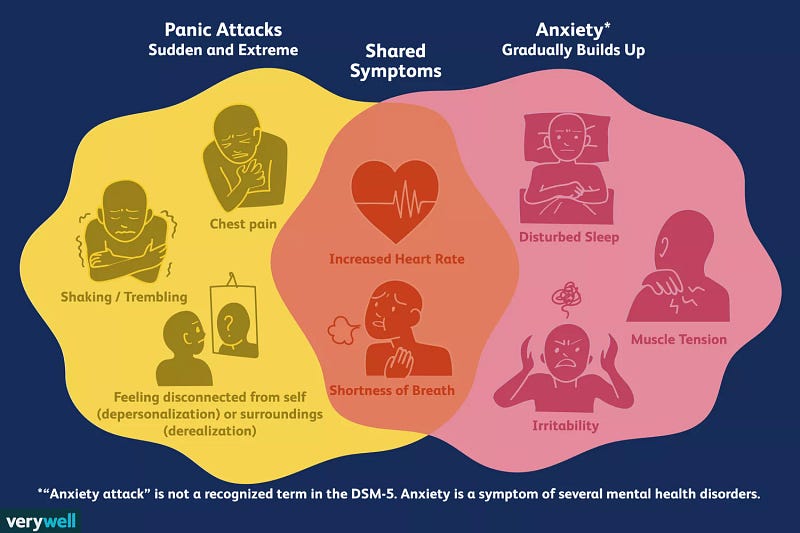
The difference between panic and anxiety attacks. Infographic source here.

Of course, anxiety can occur without panic attacks, and the latter can occur without diagnosed anxiety. One can also experience both simultaneously, or they can be interchangeable.

Below, I’d like to share a list of things that helped me manage my anxiety and panic attacks (even the most intense ones).

Photo by Aliaksei Lepik on Unsplash

Things That Helped Me Manage My Anxiety and Panic Attacks

1. Breathwork

Photo by Darius Bashar on Unsplash

There’s one specific breathing technique that, without fail, would help me calm down and lower the intensity of anxious feelings during the attack.

It’s the 4–7–8 breath technique.

“These types of mindful breathing exercises have been shown to have many benefits for stress reduction and relaxation. The 4–7–8 breathing technique was developed by Dr. Andrew Weil. He refers to it as a “natural tranquilizer for the nervous system (…). Mindful breathing practices such as 4–7–8 breathing can produce what Harvard cardiologist Dr. Herbert Benson called the relaxation response. You have a natural stress response designed to help you deal with dangerous situations.” (source)

Here’s how you do it:

  1. Sit or lay down; you can do it standing too, but perhaps you’d prefer to be more stable at first.
  2. Place your tongue against the back of your top teeth and keep it there.
  3. Exhale completely through your mouth around your tongue, making a whoosh sound. Purse your lips if it helps.
  4. Close your lips and inhale slowly through your nose for a count of four.
  5. Hold your breath for a count of seven (same tempo).
  6. Exhale slowly through your mouth until you empty your lungs for a count of eight.
  7. This completes one cycle. Repeat for three more cycles or as many as you need to calm down.

The idea is to make the out-breath twice as long as the in-breath.

I recorded a short video explaining and guiding this method (link) and posted it on my Instagram when the Russian war in Ukraine started. During this time, many of my Ukrainian friends found it nearly impossible to deal with their anxiety, and I wanted to share something that I know from experience is helpful.
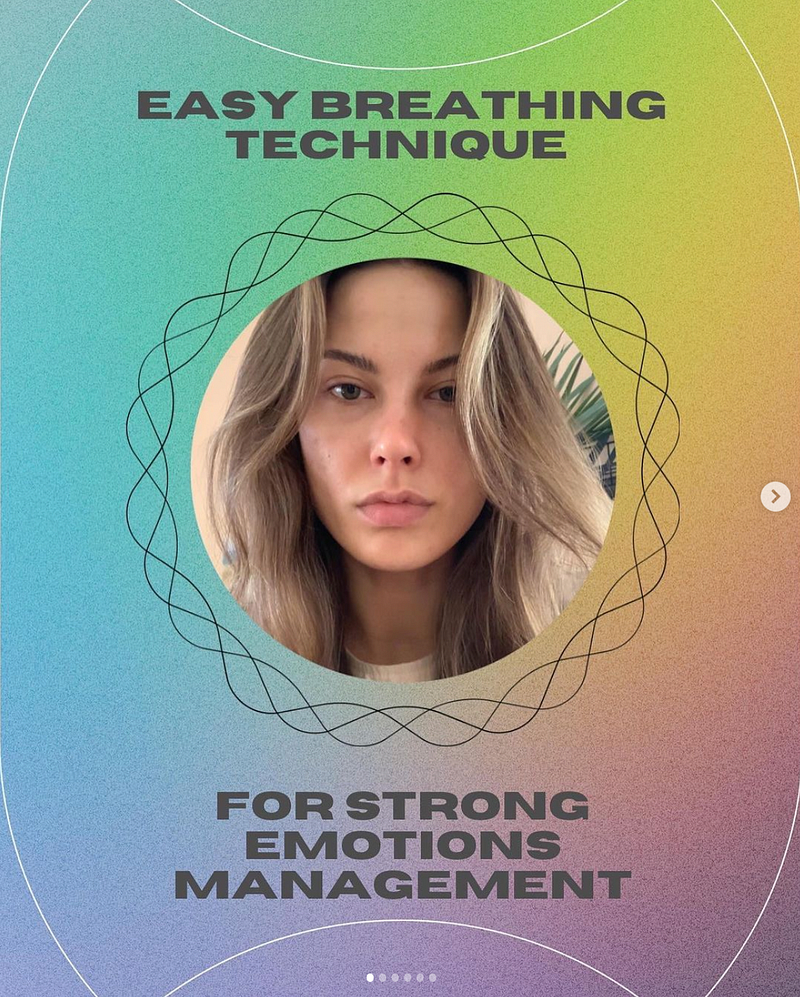
My short video explaining and guiding the 4–7–8 breathing method (link).

There’s also an app made solely for this breathing technique, which you can use if you feel like you’d need some extra guidance.
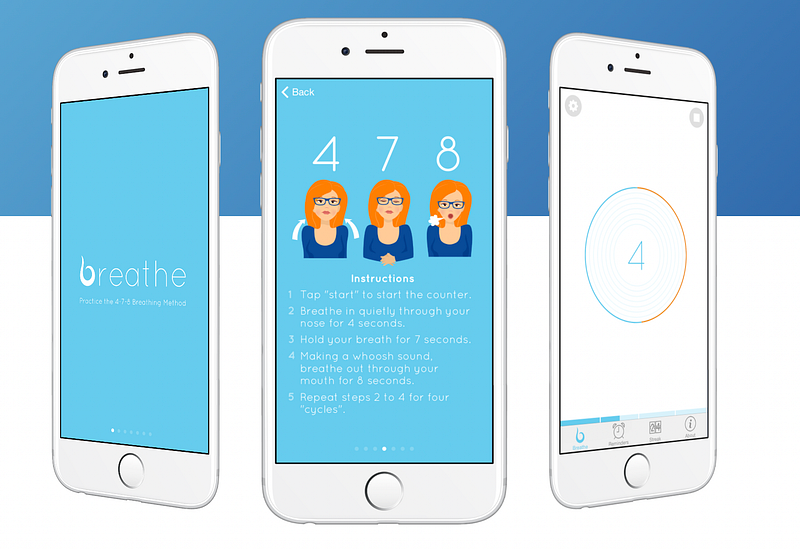
Breathe App.

2. Journaling / Writing The Sh*t Out Of Yourself

Photo by Finde Zukunft on Unsplash

Whenever I’d sense that my emotions were about to overflow or that I was falling into the spinning loop of thoughts, I’d grab my notebook or phone and start writing whatever came to my mind.

Writing works because it forces our mind to start collecting thoughts and carried by them pieces of information to put them in a logical order. Linear thought organisation is unnatural for our brains. Hence, it requires extra effort to facilitate, thus helping us gradually calm down by redirecting the anxious brain’s energy from jumping between thoughts to managing them.

After I “wrote the sh*t out of myself,” I’d often feel much calmer and gained better clarity regarding my situation.

This one might not necessarily work for the intense panic attacks, though.

3. Forcing Your Mind to Here and Now

Photo by Beazy on Unsplash

When we experience anxiety or a panic attack, our thoughts are usually racing in all directions, and that chaos spins up our already intense emotions.

Experiencing racing thoughts is never the case when we submerge in the Here and Now. While this mindfulness approach usually involves an effortless process in ordinary circumstances, it might require some force during an emergency.

What worked best for me was forcing my mind to focus on whatever object caught my attention. It might be a mug, a lamp, a table, a plant, or a book cover.

Just look at what’s in front of you and pick the first object you see. Force your mind to focus all of its attention on this thing. Slowly and carefully study the shape, colours, texture, shadows, and position. Treat it like the most important task you’ve ever had to perform. Don’t let your mind take in anything besides what you can observe about this object.

Once you’re done, immediately pick another thing, and do the same. Then with one more.

After this, the intrusive thoughts should be gone.

4. Emergency Help Line

Photo by Adrian Swancar on Unsplash

Just like in the previous article, I must mention this one. There are situations in which we can’t seem to be able to cope, and the emotions are so overwhelming as if they were to tear us apart at any second.

A few times, I was so scared of my own thoughts and the pain I felt that I needed to talk to someone immediately.

I called emergency helplines a few times. I ran out of a lecture at the university in a rising panic attack. I ran straight to an emergency mental help center in my home city, drowning in tears and barely able to breathe in panic hyperventilation.

In your good moment, take time to research and write down numbers and addresses of emergency mental health centers in your country/city. Make sure you know without fail where you save them. Remember that you can also reach some helplines online via chat. Sometimes I’d cry so much that I could not speak, so it’s handy to have those on your list as well.

Trust me; you don’t want to be researching it when you actually need it.

I hope these few methods can help you when you’re feeling out of control. They are simple enough that your body can remind you of them almost automatically, but at the same time, they’re effective (as my and my friends’ experience has proved).

Before you go

I’m Justyna Cyrankiewicz, and I write about simple things that make overcomplicated minds.

If you enjoyed this piece, consider subscribing to my free weekly letters. It’s a community of people who, like you, care about what’s up in their heads.

P.S. Please note that this story is based on my personal experience, the books I’ve read, and the teachings I have received. Don’t follow online advice if your mental health is severely at risk; reach out to friends, professionals, and other groups to gain relevant support for your particular situation.

Thank you for being here.

Anxiety
Anxiety Relief
Panic Attack
Mental Health
Depression
Recommended from ReadMedium