
The theory of relativity, or what Einstein’s genius was all about
More than 100 years have passed since the publication of the general theory of relativity. Although its author is primarily associated with the famous equation E = mc², Albert Einstein also contributed to the development of other fields of science.
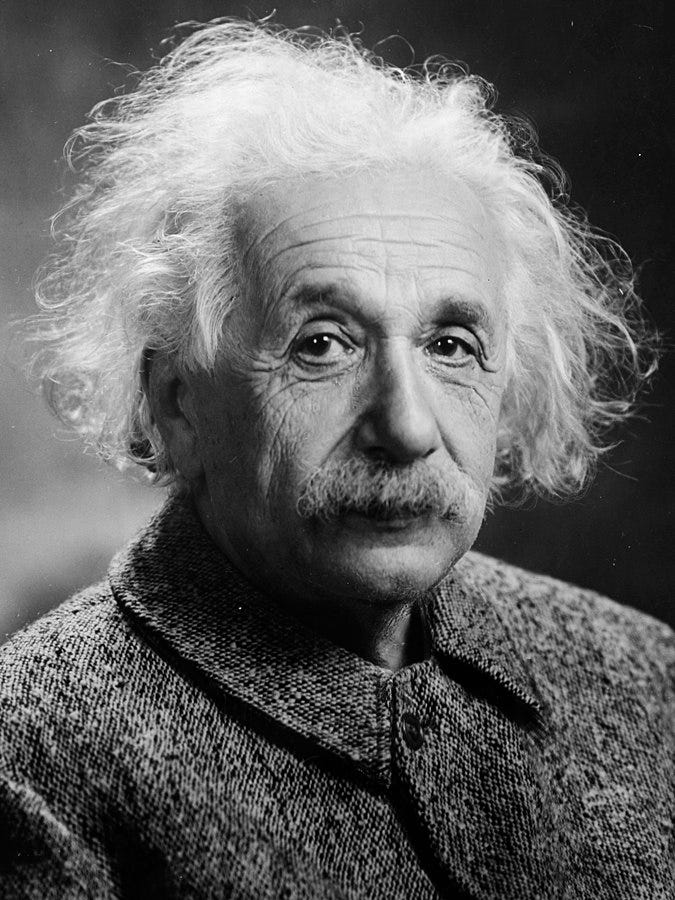
Einstein’s great asset was his imagination, which was characterized by a childlike fantasy unlimited by the schemes imposed on us by realistic maturity. He was not satisfied with the description of the functioning of the world given by the physics of the time. He asked “why?” and searched for an answer for so long that a model explaining the laws of nature was created in his mind. This is how he created the theory of relativity — a scientific hypothesis that cannot be grasped without freeing one’s imagination.
The constant speed of light
It is possible that the scientist’s first inspiration was a train pulling into the station in Zurich, where Albert Einstein was living and working at the time. As we move slowly out of the train station, looking out the window we see the platform departing. An adult would immediately recognize that it is the train and not the platform that is moving. However, Einstein asked himself: how do we actually know this?
The answer is the Earth. It is it that we consider stationary, and so we assign speed to objects relative to it. But if the Earth were not there? How would we determine whether it is our spacecraft that is moving or the space station that is moving away from us? The first thing that comes to mind is the laws of physics. Maybe there are some rules that take velocity into account and that way we can tell from the course of phenomena whether we are standing still or moving?
The best candidates are magnetic and electric fields. We learned in school that they are actually one interaction — electromagnetism. The work of the Dutch physicist Hendrik Lorentz shows that light, which is actually an alternating electromagnetic field, would have to always run at the same speed, regardless of our motion.
How to check it? Since we know that the Earth moves (and moves quite fast) around the Sun and around its own axis, then if the speed of light depends on the motion, a ray of light traveling from the west to the east — that is, in the direction of the Earth’s motion — should travel the same distance in a different time than another one traveling from the north to the south. American scientists Albert A. Michelson and Edward Morley conducted such an experiment. And it turned out that the speed of light really does not depend on the direction of its course.
Einstein — knowing the results of the work of Lorentz, Michelson and Morley, as well as many other physicists of the time — came to the conclusion that in this case it is impossible to distinguish between moving and stationary systems at all.
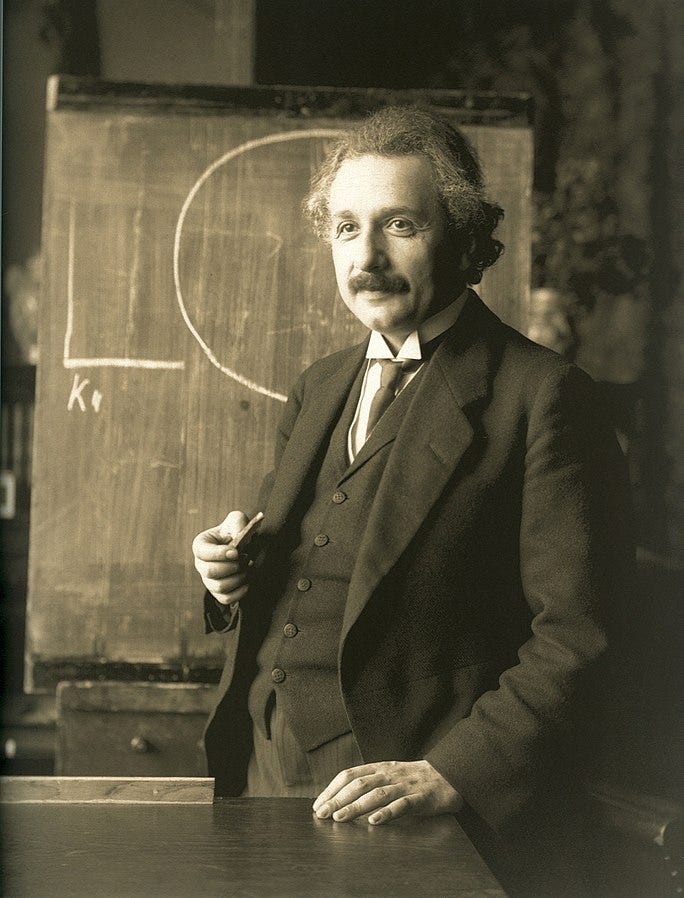
Special theory of relativity
Motion exists only in the context of two observers comparing their systems, it is always reciprocal, and it makes no sense to define systems at rest. All correct physical theories must therefore be independent of velocity and position as well as time. If it were otherwise, it would be possible to distinguish between moving and stationary systems.
How can the constant speed of light be reconciled with this? After all, this means that if a cosmic “lighthouse” sent out a light signal, and we got into a rocket flying at close to the speed of light and chased that signal, it would still be moving away just as fast from both us and the lighthouse. This is counterintuitive to our intuition, but not to a child’s imagination.
Since this is the case, either the distance between us and the ray is being stretched, or time is running slower for us. The degree to which space is stretched or time is slowed down is proportional to relative velocity. In the case of the pursuit of light, space will stretch to infinity and time will stand still.
We come to a point where imagination may not be enough for us. What does it mean that time will stand still? Will we freeze in one position? Well, no, we will live normally in our frame of reference — except that we will feel like gods existing outside the time of the rest of the universe. But since motion is relative and reciprocal, the same can be said of the world outside of us. So what will simultaneity be? How do we reconcile the principle of cause and effect with it?
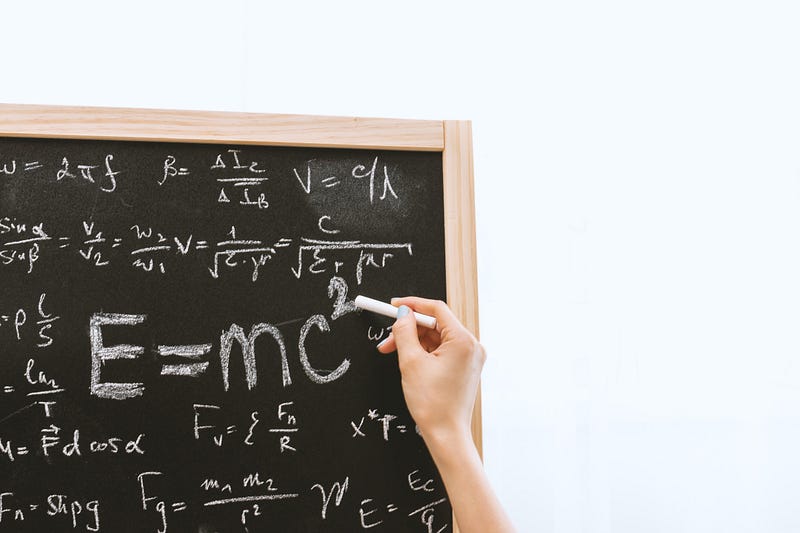
All the conclusions of the theory of relativity are still not understood today. Einstein gave the two most important ones. First, the speed of light cannot be achieved. The energy required to increase the speed increases in inverse proportion to the difference between it and the speed of light. An object moving at the speed of light would have infinite energy. But since motion is relative, what is this energy? As we remember from school, the energy of motion is proportional to velocity and mass. Einstein therefore concluded that it must be mass. From here he derived his most famous equation. E=mc² — mass is the resting form of energy.
The second conclusion from the constancy of the speed of light is the necessity of including time as a fourth dimension in the familiar three-dimensional space described by Euclid in antiquity. Only the space-time thus created, first defined by the German mathematician Herman Minkowski, will correctly describe physics. A point of space-time is a specific location of space at a specific instant of time. A segment of space-time connecting two points is the distance between two events.
Note that it can be spatial (e.g. New York — Washington), temporal (e.g. 2010–2016), but also space-time. Each of these forms means the same thing. Moreover, it turns out that the postulate of the speed of light as a maximum value causes that the space-time for each observer is divided into a part that he can know and a part that is not available to him.
General theory of relativity
Einstein’s conclusion about the equivalence of mass and energy did not give him pause. Mass is not only a measure of the amount of force it takes to accelerate an object, and therefore its degree of inertia. It is also the source of gravitational force. After all, these definitions deal with quite different phenomena. Can they contain the same physical quantity? Such “coincidences” in nature do not happen.
The corresponding experiment was conducted by the Hungarian geophysicist Loránd Eötvös, using a torsion pendulum. It turned out that the inertial and gravitational masses were perfectly equal. For Einstein, this was proof that, like the electric and magnetic fields, gravity and the inertial force must result from the same model. When subjected to a force, we change the value or direction of our velocity, which is called acceleration in physics. Acceleration is a change in velocity, and velocity is, after all, always relative. Since motion itself is relative, acceleration must also be relative.
Since the energy of motion in another frame of reference was transformed into mass, the acceleration from another point of view must be gravity. Let’s refer to an example. Driving a bus around a tight curve to the right, we feel a force throwing us around the outside of the curve. According to Einstein’s concept, this is equivalent to a mass appearing outside the left window of the bus to attract us.
Similarly, a helium-filled balloon that normally floats upward will fly in the opposite direction from us when the bus turns. So Einstein, led by his imagination, generalized his earlier thesis. He concluded that all physical phenomena occur in the same way, regardless of the relative velocity and acceleration of reference systems.
All that was left was to create a model, or the laws of physics, in such a way that these phenomena were described. Inspired by the example of the Earth — the curved surface on which we live and measure — Einstein knew that a flat surface was not the only possibility allowed by geometry. If four-dimensional space-time were not a plane, then the trajectories of objects without any external interference, and thus according to the classical laws of physics moving in straight lines, would have to curve.
In some systems this could be explained by gravity, in others by inertia, and in the model simply by the curvature of space. Two trains traveling on adjacent parallel tracks — and also on the same track but at a fixed interval — could collide.
The concepts of parallel and straight had to be understood anew, as did the concept of time. Since space is curved, light should also bend on such curvatures. Since curvature is supposed to produce effects such as gravity, then any mass should create irregularities in space-time, and thus, for example, affect the passage of time.
Many of these conclusions have been confirmed experimentally, such as the irregularity of the passage of time at the nearest and farthest points of Mercury’s orbit, resulting in its slow changes, or the possibility of seeing stars hidden behind other massive cosmic bodies. Many others are still awaiting confirmation.
But for now, the theories formulated by Einstein a century ago, including the theory of relativity, have survived all the tests and have been confirmed with great accuracy. And to think that it all could have started with a single Swiss train.
Cool that you made it to the end of this article. I will be very pleased if you appreciate the effort of creating it and leave some claps here, or maybe even start following me. Thank you!


