
The Sun: the birth and death of our nearest star — what will happen to the Sun in the future?
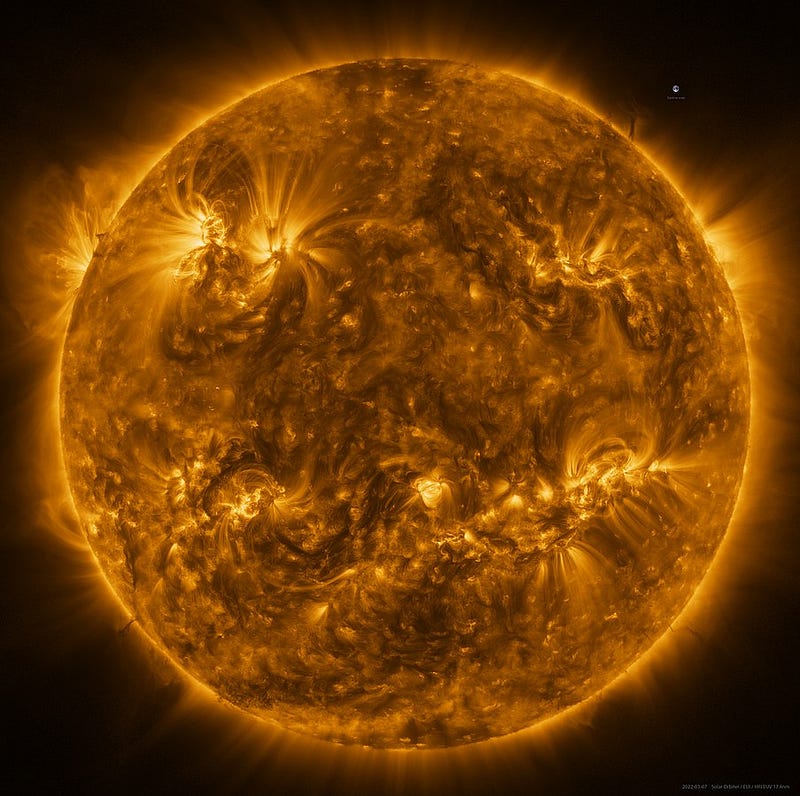
The Sun is a nearly perfect ball of hot plasma, held together by gravity and shaped by its magnetic field. And although three-quarters of its mass is light hydrogen, the rest mostly helium and a small amount of heavy elements, it accounts for as much as 99.9 percent of the mass of the entire solar system. The Sun, a life-giving star that will bring death to Earth in about five billion years.

The Sun formed about 4.6 billion years ago from a molecular cloud. This term is used to describe a cloud of hydrogen gas that shrinks and thickens under the influence of its own gravitational field. But a molecular cloud alone is not enough. It took the explosion of a nearby supernova, which propagated at a speed of thousands of kilometers per second, which threw the cloud out of balance and initiated a rapid process of shrinkage. After exceeding a certain density, the cloud began to shrink, collapsing under the influence of its own gravity, forming the Protosolar.
How was the Sun formed?
As it shrank, the rotation speed of the future star increased. The temperature of its interior also rose. The rotating cloud became a protoplanetary disk. The dust condensed in the disk. Closer to the Sun only heavy elements and compounds could condense. Further away, in colder regions, volatile compounds condensed to form ice. In the course of long processes planets and other objects of the Solar System were formed from them.
During the initial formation of the Solar System, the Protosun shone brighter than today’s Sun. However, this was not the result of nuclear changes. The Protos Sun drew its energy from its own collapse. The entire period of the Sun’s formation lasted about 10 million years and ended when its temperature rose to a level that allowed nuclear reactions to take place. It is this moment that we recognize as the birth of the Sun. During the 10 million years of formation, the density of the material from which the Sun was formed increased 1020 million times and its temperature increased one million times.

Properties of the Sun
The Sun is classified as a yellow dwarf, which is misleading because it is white when seen from Earth. It has a G2 spectral type and a V luminosity class. The G2 spectral type is associated with an effective temperature of 5778 K, or 5505 degrees C. This is the temperature of the surface of our nearest star. Even higher temperature is inside the Sun. It is about 15 million K.
However, the “V” spectral class designation indicates that the Sun belongs to the so-called main sequence of stars and generates energy through nuclear fusion, combining hydrogen nuclei into helium. In one second, the Sun processes about 620 million tons of hydrogen in its core and releases as much energy as the explosion of 100 billion hydrogen bombs.
The Sun — the future
The Sun belongs to the average stars. It is neither small nor big. The largest stars have a radius of more than 2000 times that of the Sun. The smallest are only slightly bigger than the Moon. But for us, the Sun’s “mediocrity” is good news. It is a stable star and its supply of helium will last for more than five billion years of continuous nuclear fusion.
When the helium runs out, the Sun will become a red giant. It will enlarge to the point that it will engulf the inner planets of the solar system, including Earth. The red giant discards its outer layers, which form a vast envelope around the star’s core. This envelope is called a planetary nebula. In contrast, the star’s interior collapses and turns into a white dwarf. The process from white dwarf to black dwarf will take billions of years.
The Sun — internal structure
There are four main components in the internal structure of the Sun:
- A nucleus whose main components are electrons, protons, and nuclei of helium atoms. Its temperature reaches 15 million K. This is where nuclear fusion takes place;
- the photosphere, or its visible surface, where most of the light we can see comes from. The name comes from Latin and literally means “ball of light”;
- the chromosphere, located between the photosphere and the corona. The temperature in the chromosphere increases with increasing altitude above the Sun’s surface. Between 500 km and 2000 km, it increases from 4400 K to 25,000 K. The main factors responsible for the temperature increase in the chromosphere are magnetic phenomena and acoustic waves;
- the corona, the outermost part of the solar atmosphere. It extends millions of kilometers from the Sun. Its temperature can reach up to 2 million K. The reason why the solar corona is so hot is one of the main puzzles that solar scientists are working on.
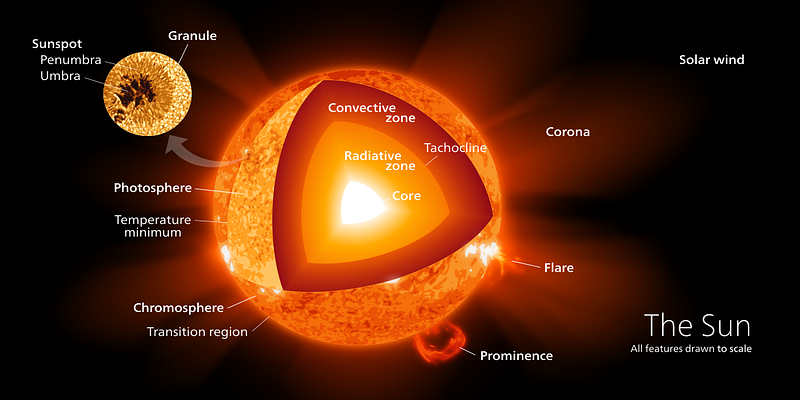
There are sunspots on the surface of the Sun, which are areas that are darker than the rest of the visible part of the Sun. They are dark because, although their temperature is about 4,000 degrees Celsius, they are areas that are much cooler than the rest of the surface. Sunspots usually form groups that move as the Sun rotates. Such groups can have an area as large as several times the surface of the Earth. The number of sunspots changes as part of an eleven-year cycle.
Sun — coronal mass ejections and magnetic storms
Coronal mass ejections (CMEs) are a phenomenon that has recently received a lot of attention. They cause solar storms on Earth or, more precisely, geomagnetic storms. A coronal mass ejection is a very spectacular phenomenon. It is a huge cloud of plasma ejected into space, which is characterized by a very intense magnetic field. The clouds of ejected plasma reach velocities of almost 200 to over 2000 km/s. The frequency of their occurrence varies depending on the phase of the solar activity cycle.
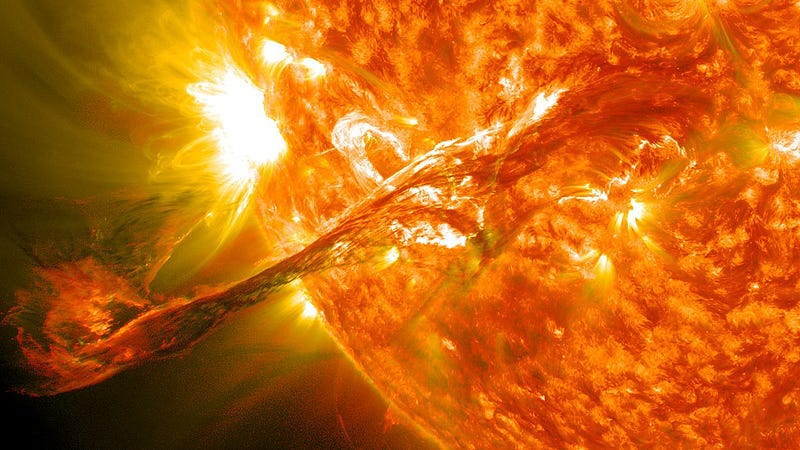
When a coronal mass ejection approaches the Earth, it leads to a disturbance of the Earth’s magnetosphere. It then causes the formation of auroras. Intense solar storms can damage power grids, disrupt communications, and even alter the trajectories of satellites and destroy their electronic components.
But even without coronal mass ejections, the Sun continually sends a steady stream of plasma into space called the solar wind. It spreads radially in all directions. The solar wind deforms Earth’s magnetosphere. Mars’ loss of atmosphere is also likely a result of solar wind activity. The extent of the solar wind also defines the boundary of the so-called heliosphere.
The Sun in numbers
- It takes nearly a million Earth-sized geoids to fill the Sun’s interior;
- Sunlight takes about 8 minutes and 20 seconds to reach the surface of our planet. It takes millions of years for it to reach the surface from the star’s core;
- The rotational speed of the Sun is 1.997 km/s;
- The Sun rotates from west to east, which is the opposite of the Earth;
- The star rotates faster at the equator than near the poles;
- The Sun is moving at 220–250 km/s. It is located about 24–26 thousand light years from the center of the Milky Way. It takes about 225–250 million years to complete one orbit around the center of our Galaxy.
- Earth’s distance from the Sun is not constant. Variations in distance are the result of the elliptical orbit in which our planet moves. The distance varies from 147 to 152 million km. The average distance between the Sun and the Earth is 149,597,870 km. This is also a measure called the astronomical unit (a.u. or AU).
Cool that you made it to the end of this article. I will be very pleased if you appreciate the effort of creating it and leave some claps here, or maybe even start following me. Thank you!


