avatarMelinda Blau

Free AI web copilot to create summaries, insights and extended knowledge, download it at here

6449

Abstract

iday card.</p><h1 id="61e6">My much-younger consequential stranger</h1><p id="69be">Were it not for our dogs, Sara and I might never have met each other.</p><p id="4f4c">Her Cavalier King Charles puppy, Ralphie, is four months old when we meet on a street in the 7th Arrondissement of Paris. Both of us are American ex-pats, she is from California, me from New York. Ralphy is beyond adorable, and Rocky immediately takes to him. (Dogs have “chemistry,” too.)</p><p id="9696">I instantly feel the same way about Sara.</p><p id="be1c">Our relationship continues to unfold in the various parks around Paris. When two people get to know each other, it’s like peeling layers of an onion — sharing bits of our biographies, making small talk. This is we move along the continuum from strangers to consequential strangers.</p><p id="438d">Sara and I have dogs and Paris in common. We never share a meal or even stop for a coffee, but…</p><p id="a7be">When I’ve been at my desk all day and hanker for a little conversation and a dog-walk, Sara’s at the top of the list.</p><p id="b272">When I mention one day that I “miss” Skinny Pop, Sara thoughtfully buys me a box of French microwaveable popcorn.</p><p id="9645">When I want a buddy to attend the French Open with me, I ask Sara if she’s free. We go with her old friend, Keemia.</p><figure id="8c1e"><img src="https://cdn-images-1.readmedium.com/v2/resize:fit:800/1*zvfGjzKm9A7lIeo14TcWLg.jpeg"><figcaption>L to R: Keemia, Melinda, Sara. Author’s photo (taken by a passerby, a complete stranger!)</figcaption></figure><p id="937d">Sara is bright, ambitious, and upbeat. She is interesting to me, both in spite of — and because of — our 50-year+ age difference. Admittedly, when I look now at the photos we took at <a href="https://www.rolandgarros.com/en-us/">Roland Garros</a>, I see a hip still-attractive grandma sandwiched between two beautiful Millennials!</p><p id="ce13">Sara is slightly older than Grandson #1. I enjoy peeking into her world, hearing about her love life, following <a href="https://www.instagram.com/sarahpardo87/">her Instagram</a>, and realizing how different her life is from mine at the same age. She seems to appreciate the advice an older woman who is impartial and non-judgmental — and not related to her! I’m <i>her</i><a href="https://readmedium.com/10-surprising-lessons-in-loneliness-from-the-most-unlikely-teachers-50739d389023">old lady</a>”!</p><p id="ee08">I leave Paris for the summer in June. When I return, I learn that Sara is Lausanne, attending grad school. I feel her absence. I miss what we had.</p><h2 id="4c5f">And then, her holiday card arrives.</h2><figure id="4fc6"><img src="https://cdn-images-1.readmedium.com/v2/resize:fit:800/1*UU_1O6tYMBrTYU0RWCBJEg.jpeg"><figcaption></figcaption></figure><p id="be34">I am thrilled that Sara reaches out. <i>I’m on her holiday list.</i> Like Sally Field accepting her second Oscar, a little voice inside me says, “You like me. You <i>really </i>like me!” (Sally <a href="https://www.vanityfair.com/hollywood/2020/01/sally-field-you-like-me-oscars">actually said</a>: “This time I feel it. And I can’t deny the fact that you like me. Right now, you like me!”)</p><p id="7d5e">Joking aside, I am deeply touched by Sara’s card. I ask her permission to reproduce her message for all the world to read.</p><figure id="9a30"><img src="https://cdn-images-1.readmedium.com/v2/resize:fit:800/1*jBRYEe1IQI-RoQ-fd2ZmRg.jpeg"><figcaption>Property of author</figcaption></figure><p id="ae89">I have always sensed that a much-older soul resides in Sara, who just turned 26. Still, I am impressed by her self-awareness and honesty. I love the image of a little girl looking forward to the day she could send out her very own holiday cards. What a sweet aspiration!</p><p id="c722">And she’s also spot on: Right now, especially, the world could use a little holiday joy.</p><h1 id="af86">The Power of People Who Don’t Seem to Matter</h1><p id="a00c">Sara’s card, which I read and reread and even read aloud to Jennifer Crittenden during the podcast, reminds me of why I embraced the concept of consequential strangers in the first place. It reinforces why I continue to reach out to people I don’t know.</p><p id="b825">I don’t invite them home for dinner, but I invite them into my life — just a little.</p><p id="d01f">Every relationship we forge adds something to our life: a fleeting, one-time encounter; a same-time-next-year acquaintanceship at a holiday party, an occasional bump-in with someone in the neighborhood.</p><p id="58a2">Sadly, we tend to devalue people in our outer social circles and assign a higher value to our closer contacts. This limits us, confines us to “a kind of prison,” as Einstein describes it.</p><p id="c714">Of course, those nearest and dearest <i>are </i>important. But the reality of a good life is that even if you have a “significant other,” it’s also critical to develop relationships with many “other significants.”</p><p id="4418">Such is the power of people who don’t seem to matter but really do (the subtitle of the <a href="https://www.goodreads.com/book/show/6691266-consequential-strangers">hardcover edition</a>). They better your life.</p><p id="3e6d">I am grateful that Sara and I shared moments. That we got to know each other a little. And that it all started because a year ago, we just happened to walk Ralphy and Rocky on the same block in Paris.</p><p id="6295">As a Millennial might put it, totally random.</p><h1 id="7f6d">6 Ways to Make the Most of Those Random Moments</h1><p id="660d">The fact is, those random opportunities are <i>always there</i>. And by there, at least for this piece, I mean IRL — in real life. Here’s how to make sure you don’t miss them.</p><h2 id="6b7a">1. Pay attention.</h2><p id="fcf3">When you’re out and about in the real world, look up from your screen. See who’s around you. Who looks interesting? Who has something you want or want to know about? Who has good stories? Who spouts surprising or even controversial ideas? Who seems safe? Who has what you need right now?</p><h2 id="d7ec">2. Smile.</h2><p id="033d">Smiling makes <i>you </i>feel better even as it brightens the other person’s day. Just as important, it’s a beacon of connection. It says, “I’m open.” Clearly, not everyone deserves a smile. Also, you can’t <i>see</i> a smile beneath a mask. But if you really mean to connect and convey positive feelings — which is <

Options

a href="https://psychlopaedia.org/health/how-being-positive-improves-your-health/">good for you <i>and</i> for the other person</a> — let your <a href="https://www.wikihow.com/Smile-With-the-Eyes">eyes smile</a> instead.</p><h2 id="45fc">3. Say hello.</h2><p id="a141">Don’t be afraid to make the first move. Someone looks interesting? Go for it. The worst that can happen is they’ll ignore you or look right at you and then past you. No response? Move on. That person probably isn’t someone you’d want to know anyway.</p><h2 id="ec69">4. Initiate small talk by noticing something about the other person — but only if it’s something you genuinely admire.</h2><p id="b091">I love shoes and boots, so I always look at people’s feet when I’m out walking. When I spot a pair I like, I compliment the wearer. I don’t necessarily want the person to stop and have a conversation. It’s just a pleasant momentary exchange that makes two people feel better. However, sometimes it leads to a chat. I might ask where the shoes were purchased. <i>This is Paris, after all.</i></p><h2 id="5f31">5. Find common ground.</h2><p id="054f">Context is your first clue. A guy you’ve seen repeatedly at the gym is probably into sports, another parent at the playground probably likes to talk about children. But look for other signs, too —clothing, a camera, the title of a book, something else the person might be carrying. Be curious. Ask questions. You can always find <i>something </i>you’ll both enjoy discussing.</p><h2 id="3848">5. Introduce yourself…slowly.</h2><p id="6787"><i>Someone </i>has to start peeling the layers of the onion. Let it be you, but take it slow. Don’t get too personal; don’t discuss politics or religion. You might at some point, but for now, feel your way to know what’s safe. Don’t be an over-sharer —it’s never a good idea to reveal deep, dark secrets on a first date.</p><h2 id="3fc8">6. Be discerning.</h2><p id="9a26">Not every stranger is worth getting to know. Don’t rush into giving your address or cell phone number. Wait until you feel comfortable. Trust the inner voice. It helps to frequent safe places and to have a sense of the kind of people you’ll meet there — nature lovers, chess players, science buffs. Still, it comes down to the individual. I like many dog owners, for example, but I don’t necessarily want to befriend all of them. I take my time, watching them with their dog, listening to their conversations with others. And if I don’t like what I see or hear, I walk away.</p><p id="25b0">Luckily, at least in my experience, the good ones outnumber the bad.</p><h2 id="2a4d">More about Consequential Strangers</h2><p id="680e">An earlier podcast with Dick Goldberg:</p><div id="ccc6" class="link-block"> <a href="https://www.dickgoldbergradio.com/consequential-strangers/"> <div> <div> <h2>Consequential Strangers</h2> <div><h3>The quality of our relationships with family and close friends may be the biggest contributor to contentment but how…</h3></div> <div><p>www.dickgoldbergradio.com</p></div> </div> <div> <div style="background-image: url(https://miro.readmedium.com/v2/resize:fit:320/0*YCag70K2xexqnrL9)"></div> </div> </div> </a> </div><p id="abb8">And in case you missed these Medium pieces:</p><div id="d79e" class="link-block"> <a href="https://melindablau.medium.com/consequential-strangers-offer-something-a-soulmate-cant-d3c4f0359301"> <div> <div> <h2>Consequential Strangers Offer Something a Soulmate Can’t</h2> <div><h3>How to Get a Surprising and Healthful “Shot” of Connection from Someone You Barely Know</h3></div> <div><p>melindablau.medium.com</p></div> </div> <div> <div style="background-image: url(https://miro.readmedium.com/v2/resize:fit:320/1*ejubsAJk4K6hkKDqsZ0SQA.gif)"></div> </div> </div> </a> </div><div id="5a98" class="link-block"> <a href="https://readmedium.com/how-can-you-miss-someone-you-hardly-know-6e3210b7e31d"> <div> <div> <h2>How Can You Miss Someone You Hardly Know?</h2> <div><h3>A Surprising Social Stickiness — and Why We Must Pay Attention</h3></div> <div><p>medium.com</p></div> </div> <div> <div style="background-image: url(https://miro.readmedium.com/v2/resize:fit:320/1*nrILLIUXWv_h1Yjfhf9_Hw.jpeg)"></div> </div> </div> </a> </div><div id="8d47" class="link-block"> <a href="https://readmedium.com/consequential-strangers-when-we-need-them-most-a4899f0736ef"> <div> <div> <h2>Consequential Strangers When We Need Them Most</h2> <div><h3>Yesterday — much to my delight — Jane Brody‘s featured “The Benefit of Talking To Strangers” in her “Personal Health”…</h3></div> <div><p>medium.com</p></div> </div> <div> <div style="background-image: url(https://miro.readmedium.com/v2/resize:fit:320/1*QllGOBYSDb2Y2CJNZYvfpA.jpeg)"></div> </div> </div> </a> </div><h1 id="07e1">If you like what you’ve read, by all means:</h1><ul><li><a href="https://melindablau.medium.com/subscribe">Subscribe</a> to my Medium articles — you’ll get an email when I publish.</li><li>Become a member of Medium:</li></ul><div id="82e8" class="link-block"> <a href="https://melindablau.medium.com/membership"> <div> <div> <h2>Join Medium with my referral link - Melinda Blau</h2> <div><h3>As a Medium member, a portion of your membership fee goes to writers you read, and you get full access to every story…</h3></div> <div><p>melindablau.medium.com</p></div> </div> <div> <div style="background-image: url(https://miro.readmedium.com/v2/resize:fit:320/0*TVem9YoJWi75qVHR)"></div> </div> </div> </a> </div><ul><li>Follow me on social media via <a href="https://linktr.ee/melindablau">LinkTree</a>.</li></ul></article></body>

The Surprising Benefits of Collecting Consequential Strangers

Want to better your everyday? Here’s how to reach out to someone you’ve never met…and get to know them a little.

Photo by bruce mars on Unsplash

I was recently a guest on Jennifer Crittenden’s podcast, talking about “consequential strangers” — the book and the concept. Talking about this subject always inspires me to write about it…again.

You might not have 55 minutes to spare. You might never read the book. But know this:

Understanding this concept will make your life richer and better. It will forever change how you move through the world.

At the end of this piece, you’ll find 6 actionable steps to get you there.

How can a stranger be consequential?

As I admitted on the podcast, I “collect” consequential strangers.

I sensed long ago that even casual social connections — sociologists call them weak ties — were valuable. Then I met Karen Fingerman, who coined the oxymoronic term consequential strangers to describe everyone outside of our family and close friends.

When something has a name, it’s easier to recognize and appreciate it.

We need consequential strangers as much as we need the people closest to us. They serve a different and unique purpose. Intimates anchor us at home; consequential strangers give us a sense of belonging in the world.

Our loved ones know what we know, read the same books, listen to the same podcasts. Our consequential strangers possess different knowledge and have had different experiences. We meet them at work and at school and wherever we play and pray. They punctuate our daily comings and goings. They’re our wash-and-wear relationships.

You usually connect with a consequential stranger over shared circumstances or interests or needs. You both have kids or collect butterflies. You both care about the environment or are battling cancer. Beyond that common ground, though, you are different….and that’s the good news.

Consequential strangers lead us to new information and experiences. They open our eyes to new opportunities and to a different way of thinking. Even if we don’t agree, we learn something more about the world and our place in it.

As Einstein famously stressed, humans need each other.

A human being is part of a whole, called by us the ‘Universe’ — a part limited in time and space. He experiences himself, his thoughts, and feelings, as something separated from the rest — a kind of optical delusion of his consciousness. This delusion is a kind of prison for us, restricting us to our personal desires and to affection for a few persons nearest us. Our task must be to free ourselves from this prison by widening our circles of compassion to embrace all living creatures and the whole of nature in its beauty.

That’s not just a nice spiritual thought. It’s practical, too. Research has shown that the richer and more diverse your network, the healthier and happier you are. You have a better chance of being successful, a better shot at longevity. In short, it’s good to have consequential strangers in your corner.

How to count your consequential strangers

If you imagine a continuum of relationship types with “strangers” at one end and “soul mate” at the other, the territory in between is occupied by friends and, in even greater numbers, by consequential strangers.

How do you know the difference? Most of us rely on the same threshold test used in 1964 by Supreme Court Justice Potter Stewart for pornography: “I know it when I see it.”

We know who’s a friend and who’s an acquaintance.

In case you don’t, check out your holiday card list. You’ll see names there of people who aren’t as “important” as your loved ones. Still, you want to reach out to them, if only once a year.

Times have changed since Karen Fingerman first analyzed holiday-card habits, but our need to connect has not. Of the more than 1,400 actual cards she and her team examined, two-thirds were from colleagues and teachers, service providers, acquaintances from the past, people they hoped to get to know better.

Consequential strangers can morph into friends over time. You might even ride off into the sunset with one of them. But usually not.

Each consequential stranger is important in a special and specific way. And although the person is not necessarily a bestie or someone you’d call if needed help in the middle of the night, she might be more important than you realize.

I realized this myself when I received Sara’s holiday card.

My much-younger consequential stranger

Were it not for our dogs, Sara and I might never have met each other.

Her Cavalier King Charles puppy, Ralphie, is four months old when we meet on a street in the 7th Arrondissement of Paris. Both of us are American ex-pats, she is from California, me from New York. Ralphy is beyond adorable, and Rocky immediately takes to him. (Dogs have “chemistry,” too.)

I instantly feel the same way about Sara.

Our relationship continues to unfold in the various parks around Paris. When two people get to know each other, it’s like peeling layers of an onion — sharing bits of our biographies, making small talk. This is we move along the continuum from strangers to consequential strangers.

Sara and I have dogs and Paris in common. We never share a meal or even stop for a coffee, but…

When I’ve been at my desk all day and hanker for a little conversation and a dog-walk, Sara’s at the top of the list.

When I mention one day that I “miss” Skinny Pop, Sara thoughtfully buys me a box of French microwaveable popcorn.

When I want a buddy to attend the French Open with me, I ask Sara if she’s free. We go with her old friend, Keemia.
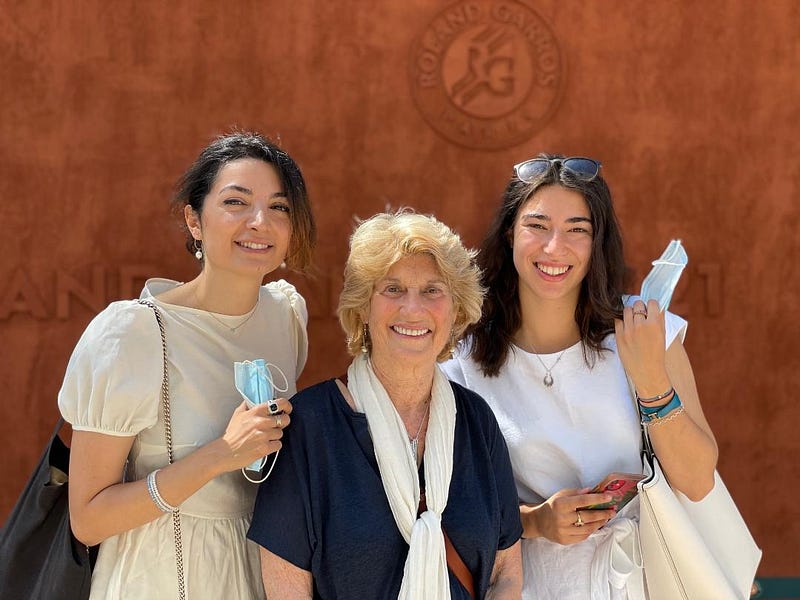
L to R: Keemia, Melinda, Sara. Author’s photo (taken by a passerby, a complete stranger!)

Sara is bright, ambitious, and upbeat. She is interesting to me, both in spite of — and because of — our 50-year+ age difference. Admittedly, when I look now at the photos we took at Roland Garros, I see a hip still-attractive grandma sandwiched between two beautiful Millennials!

Sara is slightly older than Grandson #1. I enjoy peeking into her world, hearing about her love life, following her Instagram, and realizing how different her life is from mine at the same age. She seems to appreciate the advice an older woman who is impartial and non-judgmental — and not related to her! I’m herold lady”!

I leave Paris for the summer in June. When I return, I learn that Sara is Lausanne, attending grad school. I feel her absence. I miss what we had.

And then, her holiday card arrives.
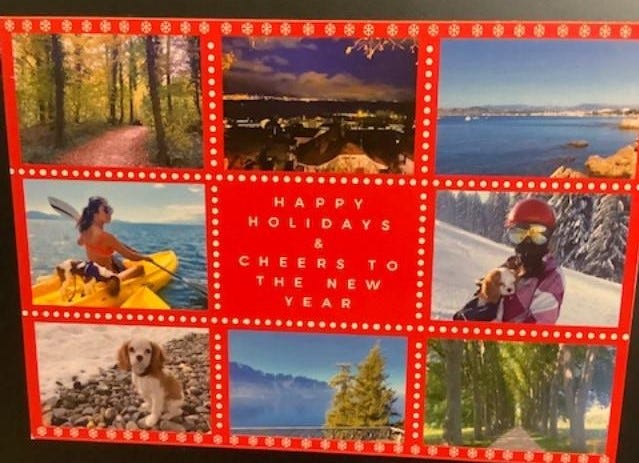
I am thrilled that Sara reaches out. I’m on her holiday list. Like Sally Field accepting her second Oscar, a little voice inside me says, “You like me. You really like me!” (Sally actually said: “This time I feel it. And I can’t deny the fact that you like me. Right now, you like me!”)

Joking aside, I am deeply touched by Sara’s card. I ask her permission to reproduce her message for all the world to read.
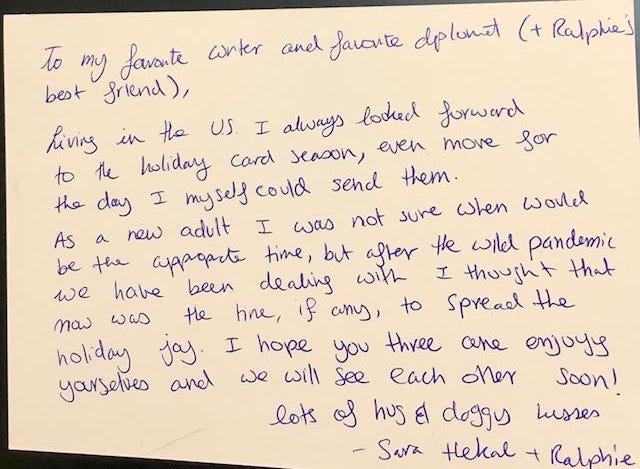
Property of author

I have always sensed that a much-older soul resides in Sara, who just turned 26. Still, I am impressed by her self-awareness and honesty. I love the image of a little girl looking forward to the day she could send out her very own holiday cards. What a sweet aspiration!

And she’s also spot on: Right now, especially, the world could use a little holiday joy.

The Power of People Who Don’t Seem to Matter

Sara’s card, which I read and reread and even read aloud to Jennifer Crittenden during the podcast, reminds me of why I embraced the concept of consequential strangers in the first place. It reinforces why I continue to reach out to people I don’t know.

I don’t invite them home for dinner, but I invite them into my life — just a little.

Every relationship we forge adds something to our life: a fleeting, one-time encounter; a same-time-next-year acquaintanceship at a holiday party, an occasional bump-in with someone in the neighborhood.

Sadly, we tend to devalue people in our outer social circles and assign a higher value to our closer contacts. This limits us, confines us to “a kind of prison,” as Einstein describes it.

Of course, those nearest and dearest are important. But the reality of a good life is that even if you have a “significant other,” it’s also critical to develop relationships with many “other significants.”

Such is the power of people who don’t seem to matter but really do (the subtitle of the hardcover edition). They better your life.

I am grateful that Sara and I shared moments. That we got to know each other a little. And that it all started because a year ago, we just happened to walk Ralphy and Rocky on the same block in Paris.

As a Millennial might put it, totally random.

6 Ways to Make the Most of Those Random Moments

The fact is, those random opportunities are always there. And by there, at least for this piece, I mean IRL — in real life. Here’s how to make sure you don’t miss them.

1. Pay attention.

When you’re out and about in the real world, look up from your screen. See who’s around you. Who looks interesting? Who has something you want or want to know about? Who has good stories? Who spouts surprising or even controversial ideas? Who seems safe? Who has what you need right now?

2. Smile.

Smiling makes you feel better even as it brightens the other person’s day. Just as important, it’s a beacon of connection. It says, “I’m open.” Clearly, not everyone deserves a smile. Also, you can’t see a smile beneath a mask. But if you really mean to connect and convey positive feelings — which is good for you and for the other person — let your eyes smile instead.

3. Say hello.

Don’t be afraid to make the first move. Someone looks interesting? Go for it. The worst that can happen is they’ll ignore you or look right at you and then past you. No response? Move on. That person probably isn’t someone you’d want to know anyway.

4. Initiate small talk by noticing something about the other person — but only if it’s something you genuinely admire.

I love shoes and boots, so I always look at people’s feet when I’m out walking. When I spot a pair I like, I compliment the wearer. I don’t necessarily want the person to stop and have a conversation. It’s just a pleasant momentary exchange that makes two people feel better. However, sometimes it leads to a chat. I might ask where the shoes were purchased. This is Paris, after all.

5. Find common ground.

Context is your first clue. A guy you’ve seen repeatedly at the gym is probably into sports, another parent at the playground probably likes to talk about children. But look for other signs, too —clothing, a camera, the title of a book, something else the person might be carrying. Be curious. Ask questions. You can always find something you’ll both enjoy discussing.

5. Introduce yourself…slowly.

Someone has to start peeling the layers of the onion. Let it be you, but take it slow. Don’t get too personal; don’t discuss politics or religion. You might at some point, but for now, feel your way to know what’s safe. Don’t be an over-sharer —it’s never a good idea to reveal deep, dark secrets on a first date.

6. Be discerning.

Not every stranger is worth getting to know. Don’t rush into giving your address or cell phone number. Wait until you feel comfortable. Trust the inner voice. It helps to frequent safe places and to have a sense of the kind of people you’ll meet there — nature lovers, chess players, science buffs. Still, it comes down to the individual. I like many dog owners, for example, but I don’t necessarily want to befriend all of them. I take my time, watching them with their dog, listening to their conversations with others. And if I don’t like what I see or hear, I walk away.

Luckily, at least in my experience, the good ones outnumber the bad.

More about Consequential Strangers

An earlier podcast with Dick Goldberg:

And in case you missed these Medium pieces:

If you like what you’ve read, by all means:

  • Subscribe to my Medium articles — you’ll get an email when I publish.
  • Become a member of Medium:
Social
Psychology
Self Improvement
Relationships
Consequential Strangers
Recommended from ReadMedium